
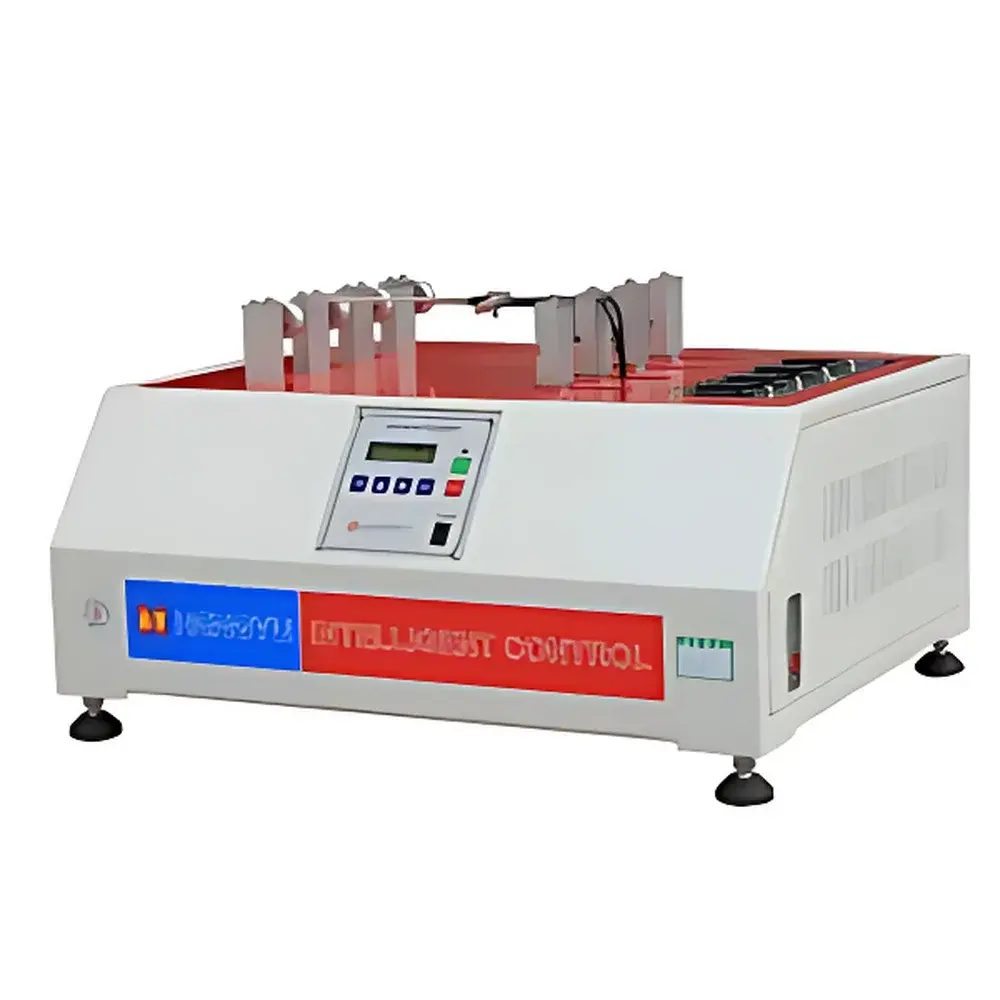
HY780A Shoe Lace Abrasion Tester
| Origin | Guangdong, China |
|---|---|
| Manufacturer Type | Authorized Distributor |
| Origin Category | Domestic (China) |
| Model | HY780A |
| Price | Upon Request |
| Clamp Sets | 4 |
| Weight Load | 250 ± 3 g per clamp |
| Max Clamp Spacing (movable to fixed) | 310 mm |
| Movable Clamp Stroke | 35 mm |
| Oscillation Frequency | 60 cycles/min |
| Test Geometry | 52.2° angle, 120 mm travel distance |
| Counter | LCD display, 0–999,999, four independent channels |
| Standards Compliance | DIN 4843, QB/T 2226, SATRA PM154, BS 5131 |
| Calibration | CNAS-accredited calibration certificate included |
Overview
The HY780A Shoe Lace Abrasion Tester is a precision-engineered tribological testing instrument designed specifically for evaluating the abrasion resistance of textile laces used in footwear applications. It operates on the principle of controlled reciprocating motion under standardized mechanical loading, simulating real-world wear conditions encountered during normal use—such as repeated flexing, rubbing against eyelets or tongue materials, and cyclic tension release. The device subjects each lace specimen to repetitive angular oscillation at a fixed frequency and load, with failure defined either by complete fracture or by evaluation of structural integrity after a predetermined number of cycles. This method provides quantifiable, reproducible data essential for quality assurance, material selection, and compliance verification across footwear R&D and production environments.
Key Features
- Four independent clamp stations enable parallel testing of up to four lace specimens under identical mechanical conditions—improving statistical reliability and throughput efficiency.
- Calibrated dead-weight loading system applies a consistent 250 ± 3 g force per specimen, ensuring traceable and repeatable stress application without drift or hysteresis.
- Precise mechanical drive mechanism delivers stable 60-cycle-per-minute oscillation with a 35 mm stroke and fixed 52.2° angular trajectory over a 120 mm linear path—replicating the kinematic profile specified in major international standards.
- LCD counter with six-digit resolution (0–999,999) and four individually addressable channels allows synchronized cycle tracking across all test positions, supporting both pass/fail and comparative fatigue analysis.
- Robust aluminum alloy frame and hardened steel guide rails ensure long-term dimensional stability and minimal mechanical backlash, critical for high-cycle endurance testing.
- Includes full CNAS-accredited calibration certificate, traceable to national metrological standards, satisfying internal audit and external regulatory requirements for laboratory accreditation (ISO/IEC 17025).
Sample Compatibility & Compliance
The HY780A accommodates flat, round, braided, and twisted laces made from cotton, linen, polyester, nylon, polypropylene, and blended fibers—with cross-sectional dimensions up to 5 mm and lengths sufficient to span the 310 mm maximum clamp spacing. Specimen mounting uses non-slip serrated clamps that minimize slippage without inducing localized damage. The instrument fully conforms to the mechanical test parameters defined in DIN 4843 (Footwear Components – Testing of Shoelaces), QB/T 2226 (Chinese Light Industry Standard for Shoelace Abrasion Resistance), SATRA PM154 (Shoelace Flex and Abrasion Test Method), and BS 5131-2.3 (British Standard for Footwear – Part 2: Test Methods). These standards mandate specific geometry, load, speed, and failure criteria—parameters all directly implemented in the HY780A’s hardware and operational protocol.
Software & Data Management
While the HY780A operates as a standalone electromechanical tester with no embedded microprocessor or PC interface, its design supports seamless integration into GLP/GMP-compliant quality systems. The independent four-channel counter allows manual logging into LIMS or Excel-based test records, with each channel timestamped and labeled per sample ID. Laboratories may pair the unit with digital documentation workflows using barcode-scanned test sheets or validated electronic notebooks. All calibration data—including uncertainty budgets and environmental conditions at time of certification—are provided in the CNAS report, enabling full traceability required under ISO 17025 and FDA 21 CFR Part 11–aligned record-keeping practices.
Applications
- Comparative evaluation of lace durability across fiber composition, twist density, coating type (e.g., silicone, PU), and finishing treatments.
- Validation of supplier-submitted material claims prior to bulk procurement.
- Root-cause analysis of field failures related to premature lace breakage in athletic, safety, and casual footwear lines.
- Supporting technical documentation for CE marking, UKCA, or other regional conformity assessments requiring mechanical performance evidence.
- Internal benchmarking against historical control lots to monitor process consistency in weaving, dyeing, and impregnation stages.
FAQ
What standards does the HY780A directly support?
DIN 4843, QB/T 2226, SATRA PM154, and BS 5131-2.3—all implemented via fixed mechanical geometry, calibrated mass loading, and precise cycle timing.
Is the instrument suitable for non-shoelace textile cords?
Yes, provided specimens fall within the dimensional and tensile limits of the clamp system and exhibit similar flexural behavior; however, results must be interpreted with reference to applicable standard scope definitions.
Can test parameters be modified beyond the stated specifications?
No—the 60 cycles/min frequency, 52.2° angle, and 250 g load are hard-coded by mechanical design to maintain standard compliance; deviation would invalidate conformance reporting.
Does the CNAS calibration cover all four channels independently?
Yes—the accredited certificate includes verification of counting accuracy, repeatability, and inter-channel synchronization across all four positions.
What maintenance is required for long-term accuracy?
Monthly visual inspection of clamp teeth integrity, biannual lubrication of linear guides with ISO VG 32 mineral oil, and annual recalibration recommended to maintain measurement uncertainty within ±0.5% of full scale.



