
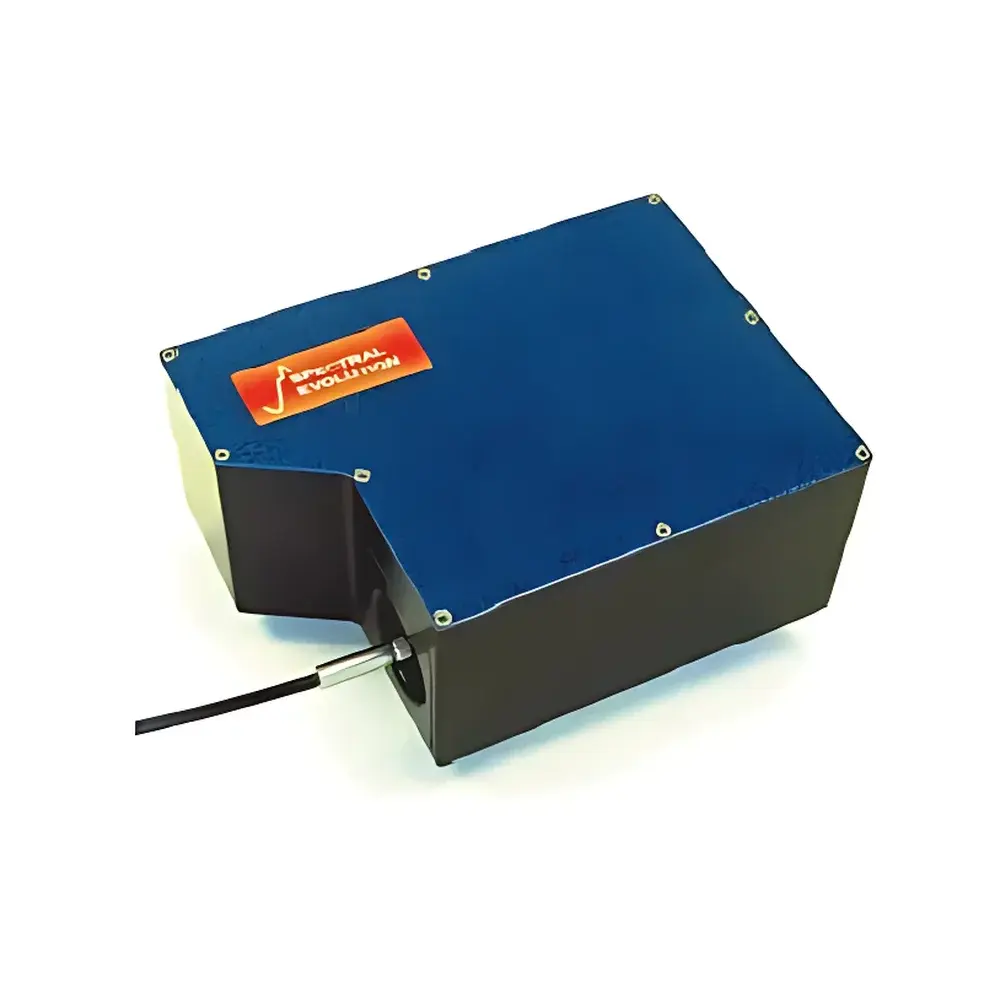
Spectral Evolution LF2500/1250/880 Portable Near-Infrared Spectrometer
| Brand | Spectral Evolution |
|---|---|
| Origin | USA |
| Model | LF2500/1250/880 |
| Instrument Type | Portable Field Spectroradiometer |
| Optical Design | Fixed Holographic Grating + Linear Array Detector (Non-scanning) |
| Wavelength Range | 350–2500 nm (LF2500), 350–1250 nm (LF1250), 350–880 nm (LF880) |
| Spectral Sampling Interval | ≤1.5 nm (LF2500), ≤1.0 nm (LF1250), ≤0.6 nm (LF880) |
| Integration Time | 8 ms – 2000 ms |
| Full-Spectrum Acquisition Speed | ≤100 ms (up to 10 Hz) |
| Measurement Mode | Diffuse Reflectance, Irradiance, Radiance, Transmittance |
| Calibration | NIST-Traceable Absolute Radiometric & Spectral Calibration |
| Software | DARWin SP v5.x (Windows-based, FDA 21 CFR Part 11 compliant audit trail option available) |
| Power | Rechargeable Li-ion Battery (≥8 h field operation) |
| Communication | Integrated Bluetooth 5.0 & USB-C |
| Housing | Anodized Aluminum (IP54 rated, thermal stability ±0.05 nm/°C) |
Overview
The Spectral Evolution LF2500/1250/880 is a high-performance, portable field spectroradiometer engineered for precision spectral measurement across ultraviolet, visible, and near-infrared (UV-VIS-NIR) regions. Unlike scanning monochromator-based systems, it employs a fixed holographic grating coupled with a thermoelectrically stabilized linear array detector—eliminating mechanical moving parts that compromise calibration integrity over time. This non-scanning architecture ensures exceptional spectral reproducibility, long-term radiometric stability, and immunity to misalignment-induced drift. Each unit is factory-calibrated against NIST-traceable standards for both spectral response and absolute radiometric accuracy, enabling quantitative reflectance, irradiance, radiance, and transmittance measurements without post-acquisition correction. Designed for demanding outdoor and laboratory environments, the LF series delivers full-spectrum acquisition in under 100 ms—supporting real-time monitoring of dynamic spectral phenomena such as vegetation phenology, mineral spectral signatures, or solar irradiance variability.
Key Features
- Fixed holographic optical bench with no moving gratings or slits—ensures permanent wavelength registration and eliminates recalibration needs due to mechanical wear
- Thermally stabilized InGaAs (LF2500) or Si (LF1250/LF880) linear array detectors with on-chip cooling for low dark current and high signal-to-noise ratio
- Integrated shutter and drift-lock auto-calibration system: performs real-time dark current subtraction and reference normalization before each measurement
- Laser targeting module for precise spatial registration of measurement footprint (1° field-of-view standard)
- Rugged anodized aluminum chassis with passive thermal management—maintains spectral calibration stability within ±0.05 nm per °C ambient fluctuation
- Bluetooth 5.0 and USB-C interfaces enable seamless integration with Windows laptops, tablets, and industrial PDA platforms
- Hot-swappable, high-capacity lithium-ion battery supporting ≥8 hours of continuous operation in field conditions
Sample Compatibility & Compliance
The LF series supports diffuse reflectance measurements of soils, vegetation canopies, mineral surfaces, painted materials, and biological tissues using standardized contact probes or fiber-optic cosine correctors. For irradiance and radiance applications, optional calibrated integrating spheres and collimating optics comply with ASTM E275, ISO 9050, and USP . All factory calibrations are documented per ISO/IEC 17025 requirements, with full traceability to NIST SRM 2035 (diffuse reflectance) and SRM 1930 (irradiance). Optional DARWin SP software modules support GLP/GMP workflows, including electronic signatures, audit trails, and 21 CFR Part 11-compliant data archiving—validated for regulated pharmaceutical and environmental testing laboratories.
Software & Data Management
DARWin SP v5.x is a modular, Windows-native application providing instrument control, spectral visualization, batch processing, and chemometric analysis. It natively exports spectra in ASTM E131-compliant .jdx format and supports direct import into MATLAB, Python (via SciPy), Unscrambler, and ENVI. Key capabilities include: real-time spectral averaging, automatic exposure optimization, spectral derivative calculation, band depth analysis, NDVI/RENDVI index generation, and user-defined spectral library matching. The software includes built-in spectral smoothing (Savitzky-Golay), baseline correction (asymmetric least squares), and noise reduction algorithms optimized for field-deployed NIR data. Raw data files are stored with embedded metadata (GPS coordinates, timestamp, temperature, integration time, calibration ID), ensuring FAIR (Findable, Accessible, Interoperable, Reusable) data principles.
Applications
- Remote sensing validation and vicarious calibration of airborne/satellite sensors (e.g., Landsat, Sentinel-2, PRISMA)
- Soil organic carbon estimation and moisture content modeling via NIR absorption features (e.g., 1450 nm, 1940 nm)
- Mineral identification and alteration mapping using diagnostic absorption bands (e.g., Al-OH at 2200 nm, Fe-OH at 2300 nm)
- Plant physiological monitoring: chlorophyll content (680 nm), water stress (970 nm, 1450 nm), nitrogen status (1510 nm)
- Forest canopy structure analysis and biomass estimation through hyperspectral vegetation indices
- Inland water quality assessment: chlorophyll-a, suspended sediment, CDOM quantification via continuum-removed reflectance
- Photovoltaic material characterization: spectral responsivity mapping and anti-reflection coating evaluation
- Pharmaceutical tablet assay and blend uniformity verification using NIR diffuse reflectance
FAQ
What is the spectral resolution specification for each model?
The LF2500 achieves ≤1.5 nm FWHM across 350–2500 nm; the LF1250 delivers ≤1.0 nm from 350–1250 nm; the LF880 provides ≤0.6 nm resolution over 350–880 nm—measured per ISO 13694 using mercury-argon emission lines.
Can the instrument be used for absolute irradiance measurements?
Yes—each unit ships with a removable, NIST-traceable cosine corrector (CC-3) calibrated for spectral irradiance (W·m⁻²·nm⁻¹) across its operational range, validated per ASTM E275 Annex A2.
Is DARWin SP compatible with Linux or macOS?
DARWin SP is Windows-only (Windows 10/11, 64-bit); however, exported ASCII or .jdx files are fully cross-platform and scriptable via Python or R.
How is thermal drift managed during extended field deployments?
The optical bench incorporates passive thermal mass design and detector-level thermoelectric stabilization; spectral shift remains below ±0.05 nm over 0–40°C ambient range—verified per IEC 61262-2.
Does the system support automated field scanning protocols?
Yes—DARWin SP’s scripting engine enables programmable measurement sequences (e.g., time-lapse irradiance logging, multi-angle BRDF sampling) with GPS-tagged metadata export.




