
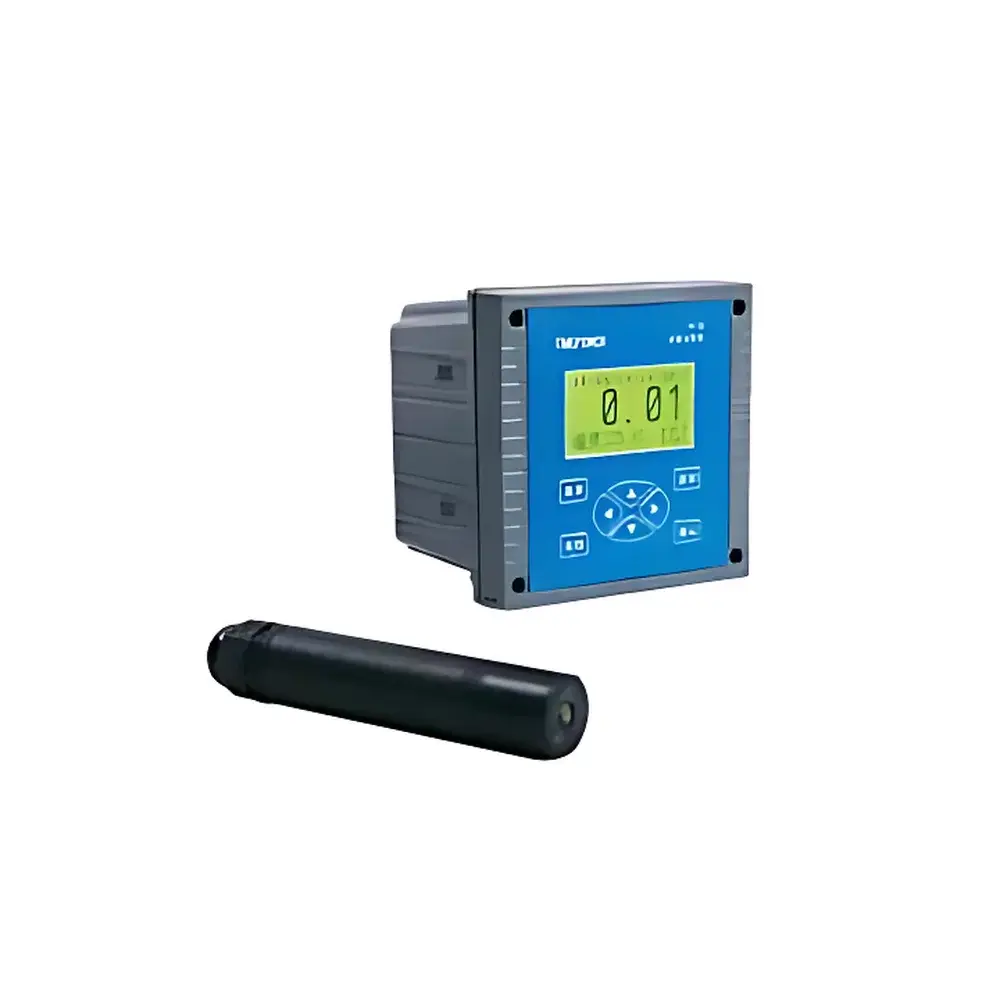
TimePower TP170 Residual Chlorine Analyzer for Swimming Pools and Drinking Water Treatment
| Brand | TimePower |
|---|---|
| Origin | Beijing, China |
| Manufacturer Type | Direct Manufacturer |
| Product Category | Domestic |
| Model | TP170 |
| Instrument Type | Online Analyzer |
| Measurement Principle | Electrochemical Amperometric Sensor |
| Measured Parameter | Free Residual Chlorine |
| Range Options | 0.00–0.5 / 2 / 5 / 10 / 20 / 50 ppm (customizable) |
| Accuracy | ±1.5% F.S. |
| Repeatability | ≤1% |
| Resolution | 0.01 ppm |
| Detection Limit | 1 ppm |
| Response Time (T90) | <1 min at 25°C |
| Temperature Compensation Range | 0–60°C |
| Sample Temperature Range | 5–60°C |
| Ambient Operating Temperature | 5–45°C |
| Relative Humidity | ≤90% RH (non-condensing) |
| Storage/Transport Temp | −25–55°C (electrode excluded |
| Display | 128×64 dot-matrix LCD with Chinese interface |
| Output Signals | Isolated 0–10 mA, 0–20 mA or 4–20 mA (user-selectable, load <300 Ω) |
| Alarm Relays | 2 SPST NO relays (configurable, AC220V/3A or DC30V/3A) |
| Enclosure Rating | IP65 |
| Power Supply | AC 85–265 V, 45–65 Hz |
| Power Consumption | ≤15 W |
| Dimensions (W×H×D) | 145×120×150 mm |
| Panel Cutout | 138×138 mm |
| Weight | 0.64 kg |
| Data Logging | Cyclic memory with auto-overflow overwrite |
| A/D Conversion | 24-bit |
Overview
The TimePower TP170 Residual Chlorine Analyzer is an online electrochemical amperometric instrument engineered for continuous, real-time monitoring of free chlorine concentration in potable water distribution systems, municipal swimming pools, hospital disinfection loops, power plant cooling circuits, and aquaculture recirculation systems. It operates on the principle of diffusion-controlled amperometry: dissolved chlorine molecules permeate a hydrophilic microporous membrane into an internal electrolyte chamber, where they undergo immediate electrochemical reduction at a gold working electrode under a fixed bias voltage. The resulting current—linearly proportional to the chlorine flux across the membrane—is precisely quantified via a 24-bit analog-to-digital converter. This measurement architecture ensures high reproducibility, minimal drift, and immunity to turbidity, color, or pH-induced interference within the operational range (5–60°C sample temperature). Designed for unattended operation in demanding industrial environments, the TP170 complies with fundamental requirements for continuous water quality surveillance under ISO 9001-aligned manufacturing and meets functional safety expectations for Class I, Division 2 hazardous location compatibility when installed per NEC Article 500.
Key Features
- Triple-output analog signal configuration: user-selectable isolated 0–10 mA, 0–20 mA, or industry-standard 4–20 mA current loops (load impedance <300 Ω)
- IP65-rated NEMA-type enclosure with robust polycarbonate housing, suitable for indoor and semi-outdoor deployment near chlorination points
- Integrated 128×64 dot-matrix LCD with full Chinese character support—no external PC required for setup, calibration, or status verification
- High-fidelity signal acquisition using 24-bit A/D conversion, delivering resolution of 0.01 ppm and repeatability ≤1% F.S.
- Dual programmable alarm relays (SPST, NO), independently configurable for low/high limit, maintenance alert, or sensor fault indication
- Non-volatile memory retains calibration coefficients, historical readings, and system settings for >10 years without backup power
- Modular electrode design supporting field-replaceable gold working electrode and Ag/AgCl reference electrode with refillable electrolyte cavity
Sample Compatibility & Compliance
The TP170 is validated for use with clear, low-turbidity aqueous streams containing free residual chlorine generated via sodium hypochlorite, chlorine gas, or electrolytic generation. It is not intended for total chlorine or combined chlorine (chloramines) measurement without prior method validation. The analyzer supports compliance with national drinking water standards (e.g., China’s GB 5749-2022, U.S. EPA Method 334.0 equivalents) and facility-level QA/QC protocols for chlorine residual control. While not certified to IEC 61508 or SIL-2, its architecture aligns with GLP documentation practices through timestamped calibration logs and audit-ready parameter history. Electrode maintenance intervals—including annual electrolyte replacement and membrane cleaning with ethanol-soaked lint-free swabs—are defined in accordance with ASTM D1253-20 guidelines for residual oxidant measurement.
Software & Data Management
No proprietary software or driver installation is required for basic operation. All configuration—including range selection (0.0–0.5 ppm up to 0–50 ppm), temperature compensation slope, relay thresholds, and output scaling—is performed locally via intuitive menu navigation on the front-panel display. Calibrations are executed using standard NIST-traceable chlorine standards (e.g., DPD-based or iodometric titration verified solutions). The unit stores up to 3,200 timestamped data points in circular buffer memory; overflow overwrites oldest entries automatically. Export functionality is limited to manual screen capture via visual inspection—consistent with standalone analyzers deployed in regulated infrastructure where network connectivity introduces cybersecurity and validation overhead.
Applications
- Real-time chlorine residual verification at drinking water treatment plant effluent points and distribution network entry valves
- Automated dosing feedback control in public and commercial swimming pool circulation systems
- Disinfection efficacy monitoring in hospital hot water loops and sterile processing departments
- Corrosion-inhibiting oxidant level tracking in closed-loop cooling water systems of thermal power stations
- Water quality assurance in recirculating aquaculture systems (RAS) where sub-ppm chlorine tolerance is critical for fish health
- Compliance reporting support for municipal utilities subject to local health department sampling mandates
FAQ
What is the recommended electrode activation procedure before first use?
Submerge the assembled electrode in flowing deionized water within the supplied flow cell for a minimum of 24 hours prior to calibration.
How often should the electrolyte solution be replaced?
Annually under normal operating conditions; more frequently if exposed to high-chlorine or high-suspended-solids environments.
Can the TP170 measure combined chlorine (chloramines)?
No—the sensor is optimized for free chlorine only. Combined chlorine requires separate analytical methods such as DPD colorimetry or selective membrane modification.
Is temperature compensation automatic?
Yes—integrated Pt1000 RTD provides continuous compensation across 0–60°C; no manual offset adjustment required.
What is the expected service life of the gold working electrode?
Typical operational lifespan exceeds 24 months with proper maintenance, including regular membrane cleaning and avoidance of abrasive contact.
Related Products







