
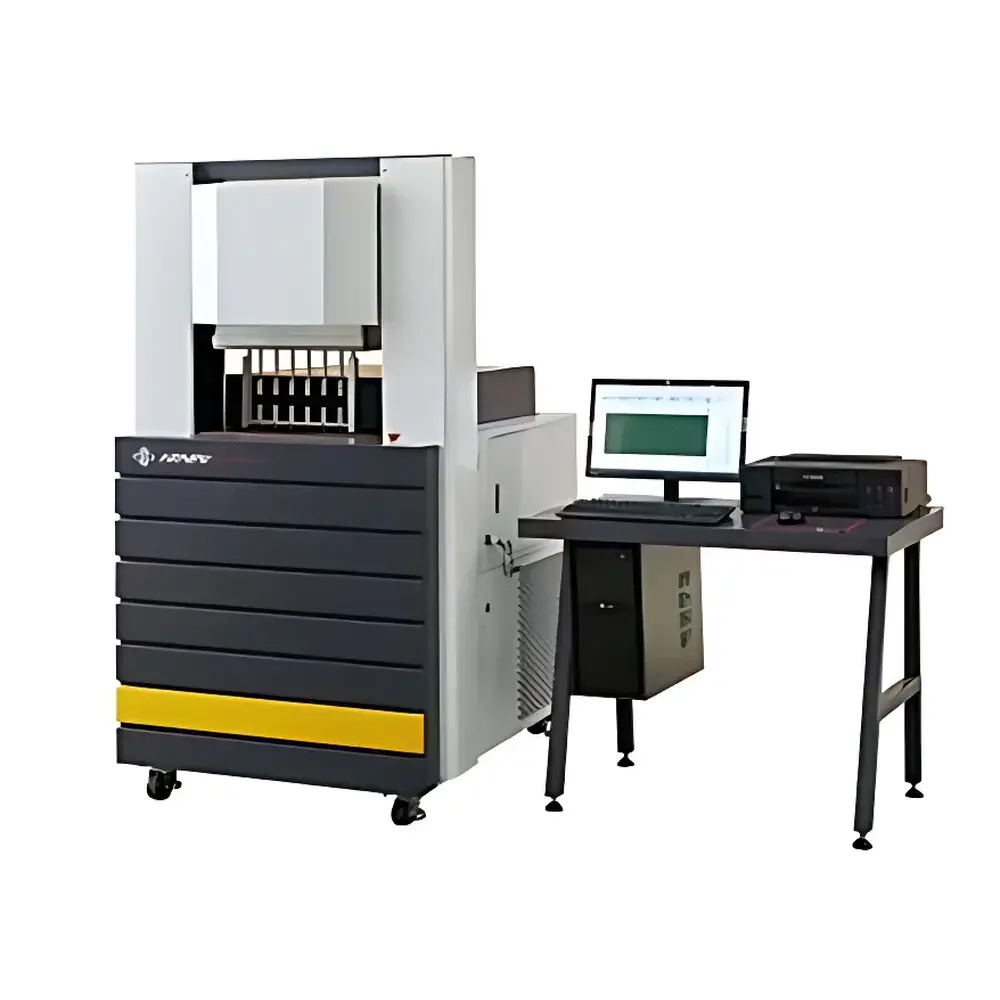
NYX HY-8760 ISO 1432 Gehman Torsion Tester for Rubber Low-Temperature Stiffness and Glass Transition Evaluation
| Brand | NYX |
|---|---|
| Origin | Tianjin, China |
| Manufacturer Type | Direct Manufacturer |
| Origin Category | Domestic (China) |
| Model | HY-8760 |
| Pricing | Available Upon Request |
Overview
The NYX HY-8760 ISO 1432 Gehman Torsion Tester is a precision-engineered instrument designed to quantify the low-temperature viscoelastic behavior of vulcanized rubber and elastomeric compounds in accordance with ISO 1432, GB/T 6036, and JIS K 6261. It operates on the fundamental principle of torsional deformation under controlled thermal conditions: a standardized rubber test strip is clamped vertically and subjected to a defined static torsional moment via calibrated torsion wires. As the specimen cools—using a compressor-based refrigeration system with alcohol as the heat-transfer medium—the angular deflection (twist angle) is continuously measured while temperature is ramped at programmable rates. The resulting twist-angle–temperature curve enables quantitative derivation of key low-temperature performance indicators, including torsional stiffness, torsional modulus, and the inflection-derived glass transition temperature (Tg). This method is grounded in classical polymer physics, where the onset of molecular chain immobilization below Tg manifests directly as a sharp increase in torsional resistance—a critical parameter for applications such as automotive winter tires, aerospace seals, and cryogenic gasket materials.
Key Features
- Compressor-driven cooling system capable of stable operation from ambient temperature down to –75 °C (ISO-specified minimum test point: –73 °C), ensuring compliance with international standard thermal profiles.
- Configurable sample capacity: supports simultaneous testing of either 3 or 6 standardized test specimens, enabling statistical robustness per JIS K 6261 recommendations and reducing inter-test variability.
- High-resolution torsion measurement: angular displacement range 0–180° with 0.01° resolution; three interchangeable torsion wires (0.7, 2.8, and 11.2 mN·m torsional constants) allow optimization across material stiffness ranges.
- Programmable thermal ramping: selectable heating rates of 1 °C/min or discrete 5 °C steps (approx. 5 min/step), facilitating both continuous and stepwise data acquisition protocols.
- Integrated control architecture: dedicated PC-based software provides real-time monitoring of twist angle, temperature, and derived modulus values, with synchronized timestamped data logging.
Sample Compatibility & Compliance
The HY-8760 accommodates rectangular rubber test strips conforming to ISO 1432 (65 mm × 6 mm × 2 mm) and GB/T 6036 dimensions. Specimens must be vulcanized, free of surface defects, and conditioned per ISO 23529 prior to testing. The system meets the mechanical, thermal, and metrological requirements of ISO 1432:2021, GB/T 6036–2006, and JIS K 6261:2017. All torsion wire calibration certificates are traceable to national standards. While not inherently FDA- or GLP-certified, the software architecture supports audit-ready data export (CSV, PDF report generation) and time-stamped event logs—facilitating integration into GMP-aligned QC workflows where raw data integrity and operator accountability are required.
Software & Data Management
The proprietary control software runs on Windows OS and provides full instrument orchestration: temperature setpoint definition, torsion wire selection, angular limit configuration, and ramp rate assignment. Real-time plots overlay twist angle and temperature against time, while post-run analysis tools compute torsional modulus (G = M/θ, where M is applied moment and θ is angular displacement in radians) and automatically identify Tg via first-derivative inflection detection on the θ–T curve. Data files include metadata (operator ID, sample ID, calibration date, environmental conditions) and support batch reporting. Export formats comply with laboratory informatics requirements: ASCII-delimited CSV for LIMS ingestion and print-ready PDFs with embedded calibration traceability statements.
Applications
- Evaluation of compound formulation effects on low-temperature flexibility—e.g., plasticizer type/concentration, filler dispersion, crosslink density.
- Quality control release testing for rubber components destined for cold-climate applications (tires, boots, seals).
- Comparative assessment of synthetic vs. natural rubber blends under sub-zero thermal stress.
- Supporting ASTM D1053, ISO 2231, and MIL-DTL-25908 qualification protocols where torsional rigidity at low temperature is a pass/fail criterion.
- Research into polymer crystallinity, phase separation, and secondary transition behavior in thermoplastic elastomers (TPEs) and TPVs.
FAQ
What refrigerant is required for operation?
Ethanol or isopropyl alcohol (≥99.5% purity) must be supplied by the user as the cooling bath medium; the system does not include refrigerant storage or circulation pumps.
Is the torsion wire calibration performed in-house or by an external lab?
Each torsion wire is supplied with a manufacturer-issued calibration certificate traceable to CNAS-accredited standards; recalibration is recommended annually or after 500 test cycles.
Can the software generate reports compliant with 21 CFR Part 11?
The current version supports electronic signatures, audit trails, and secure user authentication; full Part 11 compliance requires optional validation documentation and IT infrastructure alignment per site-specific SOPs.
What is the typical turnaround time between temperature steps?
At 1 °C/min ramp rate, stabilization at each 5 °C increment takes approximately 4–5 minutes, depending on specimen thermal mass and ambient humidity.
Does the system support automated sample loading?
No—specimen mounting is manual per ISO 1432 requirements to ensure consistent clamping torque and axial alignment; however, the six-position fixture minimizes handling time between runs.





