
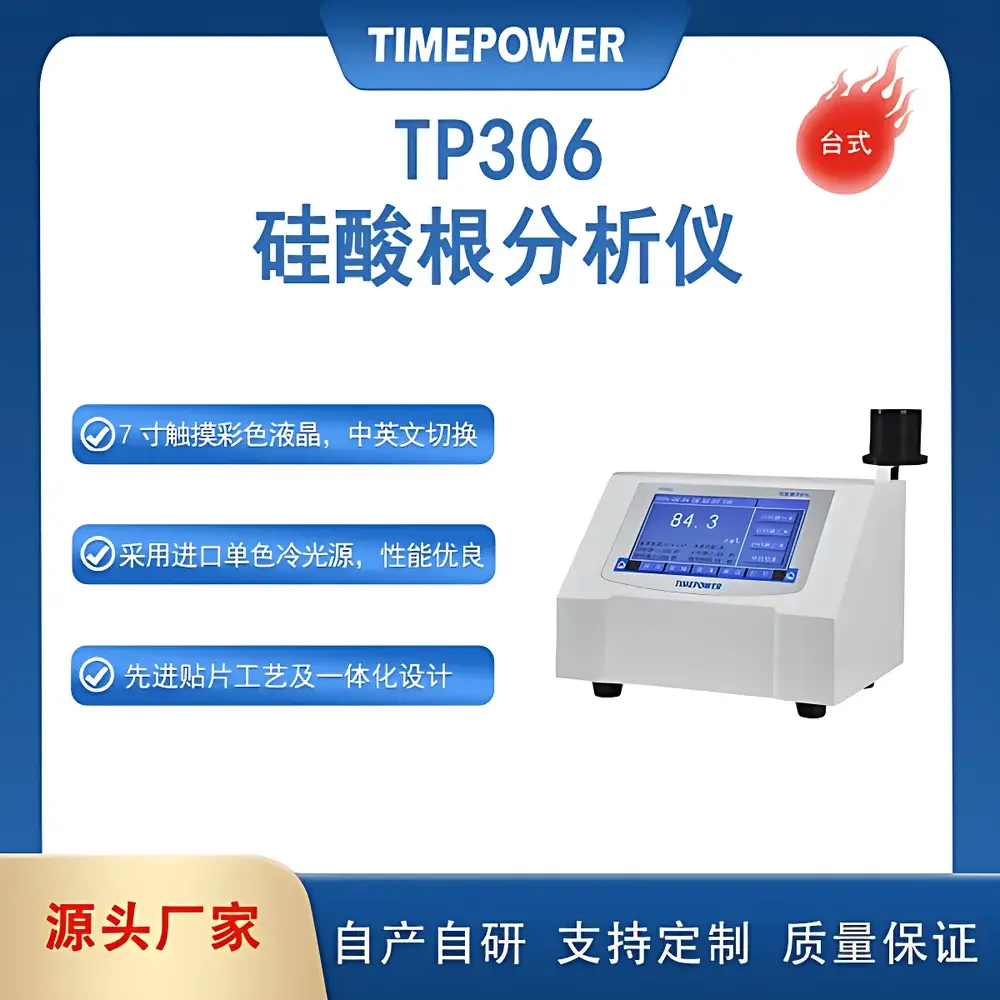
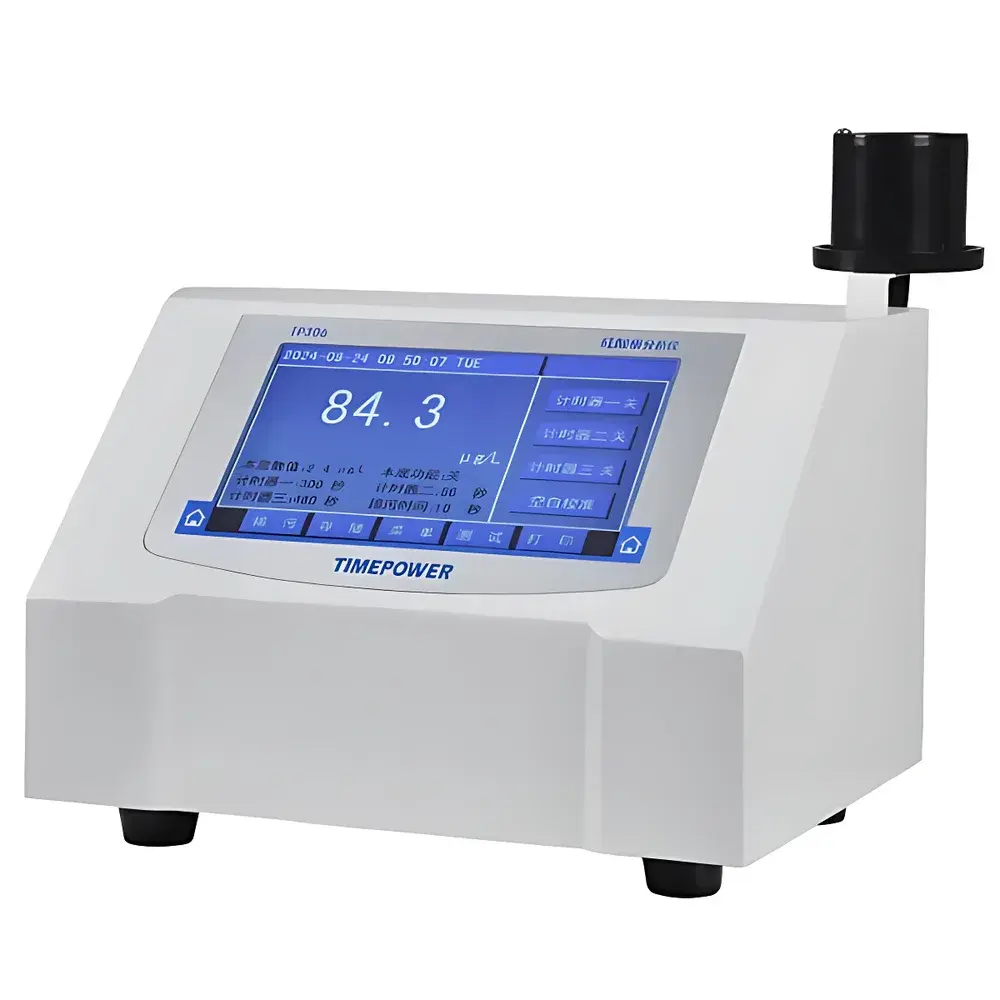
TimePower TP306 Silicate Analyzer – Colorimetric Method per Chinese National Standard (GB/T)
| Brand | TimePower |
|---|---|
| Model | TP306 |
| Type | Benchtop Laboratory Silicate Analyzer |
| Measurement Principle | Colorimetric Analysis (Molybdenum Blue Method) |
| Display | 7.0-inch TFT Touchscreen (Chinese/English Switchable) |
| Range | (0.0–200.0) μg/L or (0.0–2000) μg/L (User-Selectable) |
| Accuracy | ±2.0% F.S. |
| Resolution | 0.01 μg/L |
| Repeatability | ≤1.0% F.S. |
| Stability | ±1% F.S./4 h |
| Operating Temperature | 5–45 °C |
| Relative Humidity | ≤85% RH (non-condensing) |
| Dimensions | 260 × 200 × 180 mm |
| Power Supply | AC 85–265 V, 45–65 Hz |
| Power Consumption | ≤30 W |
| Weight | 3.2 kg |
| Origin | Beijing, China |
| Manufacturer | TimePower Instrument Co., Ltd. |
Overview
The TimePower TP306 Silicate Analyzer is a dedicated benchtop laboratory instrument engineered for precise, trace-level quantification of dissolved silicate (SiO₂ as Si) in water samples using the standardized molybdenum blue colorimetric method—fully compliant with China’s national standard GB/T 12149–2019 “Industrial Circulating Cooling Water and Boiler Water — Determination of Silica”. This method relies on the acid-catalyzed reaction between orthosilicic acid and ammonium molybdate to form heteropoly blue complexes, whose absorbance at 630–650 nm is linearly proportional to silicate concentration. The TP306 integrates optical path stabilization, temperature-compensated photometry, and microprocessor-controlled reagent delivery to ensure high reproducibility in low-concentration regimes critical for high-purity water monitoring in power generation, semiconductor manufacturing, and pharmaceutical water systems.
Key Features
- 7.0-inch high-resolution capacitive touchscreen interface with dual-language support (English/Chinese), enabling intuitive navigation through calibration, measurement, and data review workflows.
- User-selectable dual-range detection: (0.0–200.0) μg/L for ultra-trace boiler feedwater analysis and (0.0–2000) μg/L for condensate or cooling water applications—both with 0.01 μg/L digital resolution.
- Optical system optimized for minimal stray light and thermal drift; includes solid-state LED light source (635 ± 5 nm), precision interference filter, and silicon photodiode detector calibrated against NIST-traceable standards.
- Integrated environmental compensation: real-time correction for ambient temperature fluctuations (5–45 °C) and humidity (≤85% RH, non-condensing) to maintain measurement fidelity without external climate control.
- Benchtop footprint (260 × 200 × 180 mm) and low power draw (≤30 W) enable deployment in QA/QC labs, mobile field laboratories, and cleanroom-adjacent analytical spaces.
- Robust architecture with corrosion-resistant fluidic path components (PTFE tubing, borosilicate glass cuvettes) ensures long-term reliability when handling acidic reagents and low-conductivity samples.
Sample Compatibility & Compliance
The TP306 is validated for use with deionized water, demineralized water, boiler feedwater, condensate, and circulating cooling water matrices. It meets the procedural requirements of GB/T 12149–2019 and aligns with international best practices referenced in ASTM D859–22 (“Standard Test Method for Silica in Water”) and ISO 10530:2003 (“Water quality — Determination of silica — Molybdenum blue spectrophotometric method”). While not inherently 21 CFR Part 11 compliant, its audit-ready operation supports GLP/GMP environments when paired with documented SOPs—including mandatory daily blank calibration and biweekly calibration curve verification per manufacturer protocol. All reagents must be stored in certified polyethylene containers and prepared using Type I ultrapure water (resistivity ≥18.2 MΩ·cm, TOC < 5 ppb) to prevent contamination-induced bias.
Software & Data Management
The embedded firmware provides full local data logging: up to 1,000 measurement records with timestamp, operator ID (optional), range setting, and calibration status flag. Data export is supported via USB 2.0 port (FAT32-formatted flash drive) in CSV format for traceable transfer to LIMS or Excel-based trending tools. No cloud connectivity or proprietary software installation is required—operation is self-contained. Calibration history—including blank values, standard concentrations, and R² of calibration curves—is retained and viewable on-device. Firmware updates are delivered via USB and include version-locked checksum validation to ensure integrity.
Applications
- Thermal power plants: continuous monitoring of silica breakthrough in mixed-bed ion exchange effluents and steam cycle condensate to prevent turbine blade deposition.
- Semiconductor fabs: verification of silica levels in UPW (ultrapure water) distribution loops where >20 μg/L can induce wafer surface defects during wet etching or cleaning.
- Pharmaceutical facilities: compliance testing of purified water (PW) and water for injection (WFI) per ChP/EP/USP general chapters on silica impurities.
- Research laboratories: kinetic studies of silicate polymerization under controlled pH/temperature conditions using programmable measurement intervals.
- Environmental testing labs: analysis of low-silica natural waters (e.g., alpine lakes, rainwater) requiring sub-5 μg/L detection capability and matrix-matched calibration.
FAQ
What reagent purity is required for accurate silicate analysis?
Analytical-grade (≥99.5%) ammonium molybdate, oxalic acid, and reducing agents must be used. All reagents shall be stored in pre-cleaned, labeled polyethylene bottles and replaced within 30 days of preparation when refrigerated at 4 °C.
Why is daily blank calibration mandatory?
Silicate contamination is ubiquitous—even in high-purity water systems. Daily blank calibration corrects for background signal from reagent impurities, cuvette surface adsorption, and optical baseline drift, ensuring measurement accuracy remains within ±2.0% F.S.
Can the TP306 be integrated into an automated sampling system?
No—the TP306 is a manual-batch analyzer requiring operator-initiated sample loading and reagent addition. It does not support auto-samplers, peristaltic pumps, or RS-485/Modbus interfaces.
Is the instrument suitable for seawater or wastewater analysis?
Not without matrix-specific validation. High chloride, suspended solids, or organic content may interfere with the molybdenum blue reaction. Dilution and acid digestion protocols must be validated per ISO 10530 Annex B prior to use.
How often should the optical path be cleaned?
The cuvette chamber and LED/filter assembly require inspection and gentle cleaning with lint-free wipes and spectroscopic-grade methanol every 200 measurements or monthly—whichever occurs first—to prevent residue buildup affecting photometric linearity.







