
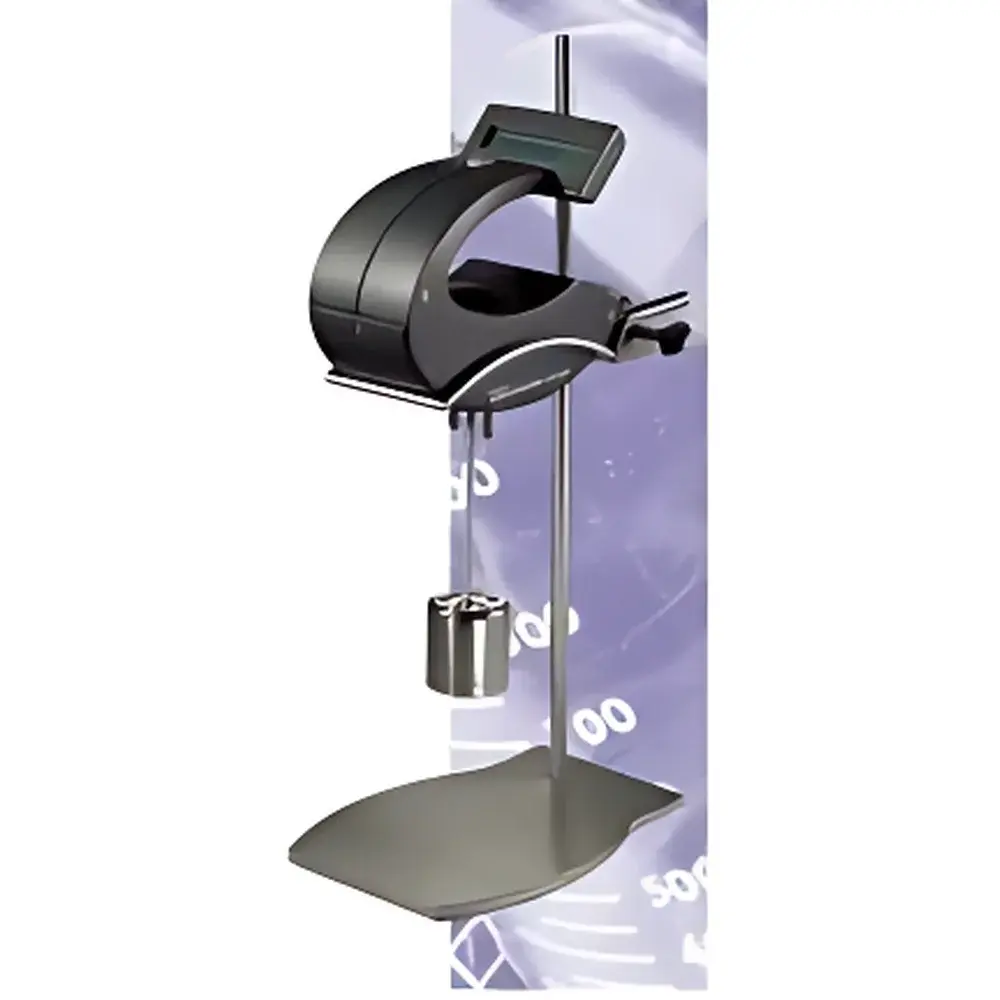
Thermo Fisher Scientific HAAKE Viscotester 1 plus & 2 plus Portable Rotational Viscometers
| Brand | Thermo Fisher Scientific |
|---|---|
| Origin | USA |
| Manufacturer Type | Authorized Distributor |
| Product Origin | Imported |
| Model | HAAKE Viscotester 1 plus & 2 plus |
| Instrument Type | Rotational Viscometer |
| Viscosity Range | 1 plus: 1.5–330 mPa·s |
| 2 plus | 0.3–4000 dPa·s (30–400,000 mPa·s) |
| Rotational Speed | 62.5 rpm |
| Temperature Capability | up to 150 °C |
| Repeatability | ±1% FSD |
| Standard Accuracy | ±5% FSD |
| Optional High-Accuracy Accuracy (VT 2 plus only) | ±1% FSD |
| Display Units | VT 1 plus defaults to mPa·s |
| Unit Conversion | 1 mPa·s = 1 cP |
Overview
The Thermo Fisher Scientific HAAKE Viscotester 1 plus and 2 plus are compact, battery-powered rotational viscometers engineered for precision, portability, and operational robustness in both laboratory and production-floor environments. These instruments operate on the principle of Couette flow rheology: a precisely machined spindle rotates at a fixed speed of 62.5 rpm within the test fluid, and the torque resistance generated by the fluid’s internal friction is transduced into a quantitative viscosity value. This fundamental measurement method ensures high reproducibility across diverse non-Newtonian and Newtonian fluids without requiring complex calibration protocols prior to routine use. Designed for rapid process monitoring—not full rheological profiling—the Viscotester series delivers reliable relative viscosity data for real-time decision-making during batch release, line clearance verification, or formulation adjustment. Its sealed, dust-resistant housing and ergonomic handheld form factor support extended operation in ISO Class 7 cleanrooms, food-grade production zones, and paint mixing bays—environments where cable-free mobility and quick turnaround are critical.
Key Features
- Single-button operation for power-on/off and immediate measurement initiation—no menu navigation required.
- Integrated LCD display with real-time numeric readout eliminates parallax errors associated with analog dial indicators.
- Automatic error diagnostics and context-sensitive service prompts—including recommended recalibration intervals—enhance long-term measurement integrity.
- Battery-powered design enables uninterrupted operation for >8 hours per charge (standard alkaline AA cells), eliminating dependency on AC outlets or extension cords in remote or hazardous locations.
- Two model variants optimized for distinct viscosity domains: VT 1 plus (1.5–330 mPa·s) targets low-to-medium viscosity liquids (e.g., solvents, inks, thin oils); VT 2 plus (30–400,000 mPa·s) accommodates semi-solids such as creams, pastes, thickeners, and polymer dispersions.
- Optional firmware upgrades allow unit switching (e.g., VT 2 plus configured to display mPa·s instead of dPa·s) and enhanced display formatting for compliance-driven workflows.
- High-accuracy option available exclusively for VT 2 plus: improves full-scale accuracy from ±5% FSD to ±1% FSD via traceable transducer calibration and temperature-compensated signal processing.
Sample Compatibility & Compliance
The Viscotester 1 plus and 2 plus accommodate a broad spectrum of industrial and R&D samples without requiring sample conditioning or dilution. Compatible matrices include aqueous emulsions (shampoos, lotions), solvent-based systems (paints, varnishes), thermally stable oils (lubricants, heat-transfer fluids), and shear-thinning gels (food sauces, personal care thickeners). All models comply with ISO 2555 (determination of apparent viscosity using rotational viscometers) and ASTM D2196 (standard test methods for rheological properties of non-Newtonian materials). When used with documented calibration records and controlled environmental monitoring (e.g., ambient temperature logged per ISO/IEC 17025), the instruments support GLP and GMP-aligned quality control procedures. Data output meets basic FDA 21 CFR Part 11 readiness requirements when paired with validated electronic lab notebook (ELN) integration protocols.
Software & Data Management
While the Viscotester operates as a standalone instrument, its digital architecture supports optional RS-232 or USB connectivity for direct data logging into LIMS or statistical process control (SPC) platforms. The embedded firmware stores up to 100 measurement records with timestamps, spindle ID, and unit configuration—enabling retrospective audit trails without external hardware. Exported CSV files include metadata fields compliant with ALCOA+ principles (Attributable, Legible, Contemporaneous, Original, Accurate). No proprietary software installation is required; raw data streams integrate natively with Microsoft Excel, JMP, and Minitab for trend analysis and SPC charting (X-bar/R, Cpk).
Applications
- Inline viscosity verification during coating application to ensure film thickness consistency.
- Batch-to-batch comparison of cosmetic emulsions prior to filling—supporting ICH Q5C stability protocols.
- Rapid screening of edible oil oxidation status via viscosity drift monitoring over storage time.
- QC release testing of industrial adhesives against specification limits defined in internal SOPs or ISO 3219.
- Field validation of lubricant degradation in wind turbine gearboxes under maintenance schedules aligned with ISO 4406.
- Teaching labs: demonstration of Newtonian vs. pseudoplastic behavior using standardized sucrose solutions and xanthan gum dispersions.
FAQ
What spindle configurations are supported?
The Viscotester 1 plus and 2 plus ship with standard LV-type spindles (SC4-18, SC4-21). Optional high-torque spindles (e.g., SC4-27, SC4-31) are available for VT 2 plus to extend low-shear sensitivity in viscous gels.
Can measurements be temperature-controlled?
The instrument itself does not incorporate active heating or cooling. However, it is rated for continuous operation up to 150 °C ambient—enabling compatibility with externally heated sample cups (e.g., HAAKE TC-100) when used with appropriate thermal shielding.
Is calibration traceable to NIST standards?
Yes. Certified calibration fluids (e.g., Cannon-Manning silicone oils, Brookfield standard oils) with NIST-traceable viscosity certificates at 25 °C are recommended for periodic verification. Factory calibration reports include uncertainty budgets per ISO/IEC 17025 Annex A.
How often should recalibration be performed?
Thermo Fisher recommends annual recalibration for regulated environments. In high-use production settings, quarterly verification using reference fluids is advised per ASTM D1200.
Does the device support multi-speed measurement?
No. Both models operate exclusively at 62.5 rpm to maintain metrological stability and simplify operator training. For multi-speed rheological characterization, consider the HAAKE Viscotester iQ or Mars series.
Related Products



