
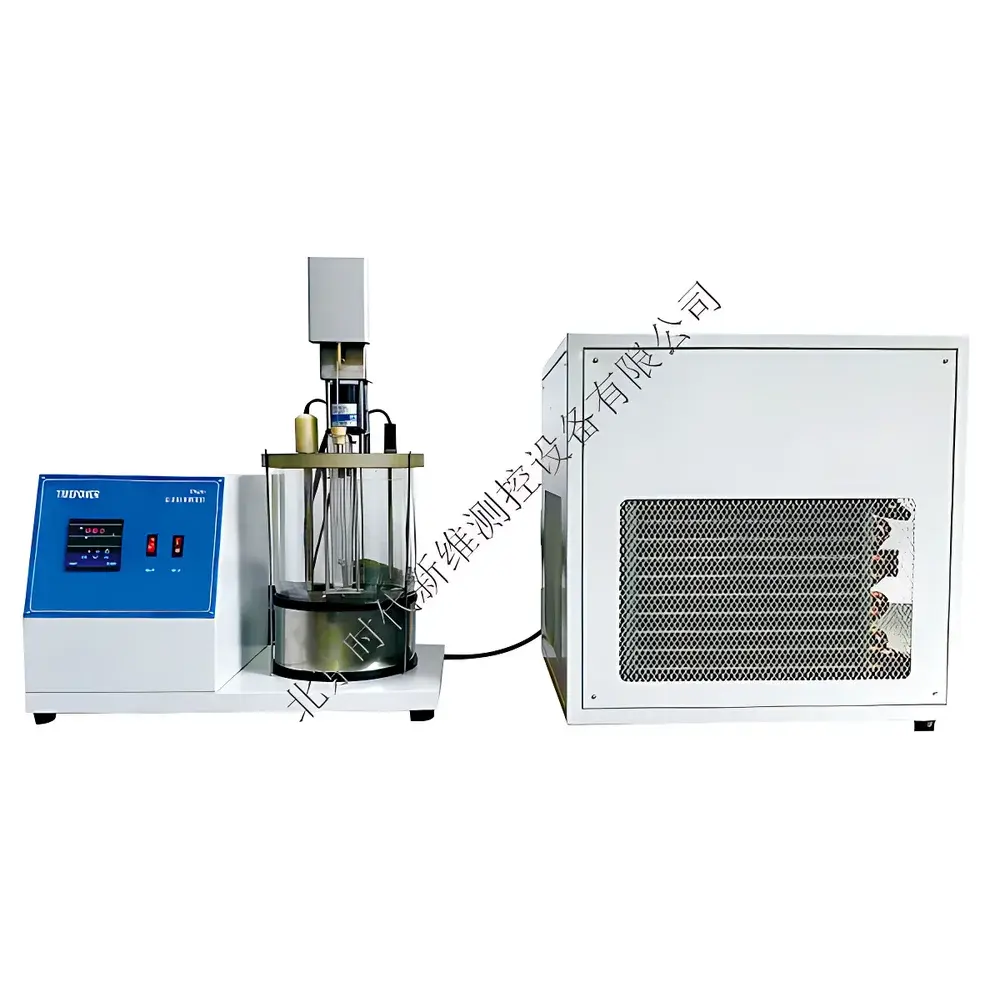
TimePower TP6251 Automatic Kinematic Viscosity Tester
| Brand | TimePower |
|---|---|
| Origin | Beijing, China |
| Manufacturer Type | Manufacturer |
| Model | TP6251 |
| Compliance | GB/T 265, ASTM D445, ISO 3104 |
| Temperature Control Range | −70 °C to +40 °C |
| Temperature Stability | ≤ ±0.1 °C |
| Bath Configuration | Dual-position circular constant-temperature bath (2 capillary mounting stations) |
| Cooling System | Cascade refrigeration with Danfoss compressors |
| Bath Vessel | Vacuum-insulated Dewar-type bath |
| Power Supply | AC 220 V ±10%, 50 Hz ±10% |
| Heating Power | ≤1000 W |
| Cooling Capacity | 400 W / 500 W dual-stage |
| Dimensions (Main Unit) | 400 × 400 × 620 mm |
| Dimensions (Refrigeration Unit) | 500 × 570 × 600 mm |
| Weight | 80 kg |
| Operating Environment | 5–40 °C, RH ≤80% |
Overview
The TimePower TP6251 Automatic Kinematic Viscosity Tester is a precision-engineered instrument designed for the standardized determination of kinematic viscosity in liquid petroleum products and other Newtonian fluids. It operates on the capillary viscometry principle defined in GB/T 265, ASTM D445, and ISO 3104—relying on gravity-driven flow through calibrated glass capillary tubes immersed in a thermally stabilized bath. The measured efflux time is converted to kinematic viscosity (mm²/s, equivalent to centistokes, cSt) using calibration constants traceable to national metrological standards. Unlike manual timing systems, the TP6251 integrates automated timing initiation, real-time temperature monitoring, and post-run calculation—minimizing operator-induced variability while maintaining full compliance with regulatory test protocols used in refinery QC labs, lubricant formulation facilities, and third-party testing centers.
Key Features
- High-stability dual-zone cascade refrigeration system utilizing Danfoss compressors, enabling precise low-temperature operation down to −70 °C—critical for high-viscosity base oils and waxy distillates.
- Vacuum-insulated Dewar-type constant-temperature bath ensures minimal thermal gradient (<0.02 °C/mm) and eliminates frost formation during extended sub-ambient runs.
- Dual-capillary mounting stations allow concurrent conditioning of two samples or duplicate analysis without bath disturbance—improving throughput and inter-run reproducibility.
- Digital PID temperature controller with dual-display interface (setpoint vs. actual bath temperature), supporting ±0.1 °C stability across the full −70 °C to +40 °C range.
- Adjustable leveling feet and rigid circular bath geometry promote uniform heat distribution and mechanical stability during timing cycles.
- Integrated safety architecture includes earth-grounding verification circuitry, over-temperature cutoff, and compressor overload protection—meeting IEC 61010-1 requirements for laboratory electrical equipment.
Sample Compatibility & Compliance
The TP6251 is validated for use with transparent, homogeneous, Newtonian liquids including mineral oils, synthetic lubricants, fuel oils, hydraulic fluids, and transformer oils. It supports standard Ubbelohde, Cannon-Fenske, and micro-Ostwald capillaries (with appropriate calibration certificates). All operational parameters—including bath temperature ramp rate, dwell time prior to flow initiation, and timing window definitions—conform strictly to GB/T 265 and its international harmonized equivalents. Data integrity is reinforced by hardware-synchronized timestamping and non-volatile storage of raw efflux times, ambient conditions, and calibration metadata—enabling full audit trails required under GLP and ISO/IEC 17025-accredited testing environments.
Software & Data Management
While the TP6251 operates as a standalone benchtop instrument with embedded firmware, it provides RS-232 and optional USB interfaces for integration into centralized LIMS or ELN platforms. Raw efflux data (in milliseconds), bath temperature logs (recorded at 1 Hz), and user-entered calibration constants are exportable in CSV format. The firmware enforces mandatory entry of capillary calibration ID and reference fluid batch number before test initiation—supporting traceability per ISO/IEC 17025 clause 7.7. Audit logs retain operator ID (via keypad input), test start/end timestamps, and any parameter overrides—satisfying documentation requirements under FDA 21 CFR Part 11 when paired with validated electronic signature modules.
Applications
- Refinery quality control: Monitoring viscosity changes in crude distillates, naphthas, and vacuum gas oils pre- and post-treatment.
- Lubricant manufacturing: Batch release testing of engine oils, gear oils, and greases according to OEM specifications (e.g., SAE J300, API categories).
- Fuel specification compliance: Verification of diesel and jet fuel kinematic viscosity per ASTM D975 and D1655.
- Research & development: Thermal stability profiling of bio-based lubricants and synthetic esters across wide temperature ranges.
- Contract testing laboratories: Accredited viscosity determinations for ISO/IEC 17025 scope extensions and interlaboratory comparison studies.
FAQ
What capillary viscometers are compatible with the TP6251?
The instrument accepts standard Ubbelohde and Cannon-Fenske types with nominal flow times between 200–600 seconds at test temperature. Capillary calibration certificates must be entered manually prior to analysis.
Is external calibration required for temperature verification?
Yes—users must periodically validate bath temperature uniformity and accuracy using a NIST-traceable platinum resistance thermometer (PRT) per ASTM E77 or ISO 17025 procedures.
Can the TP6251 be operated unattended overnight?
It supports continuous operation within environmental limits (5–40 °C ambient, ≤80% RH), but requires manual capillary loading and efflux initiation; fully automated sample changers are not integrated.
Does the system meet FDA 21 CFR Part 11 requirements?
The base unit provides audit-ready data logging; full Part 11 compliance requires supplemental validation of connected software, electronic signatures, and access controls per organizational SOPs.





