
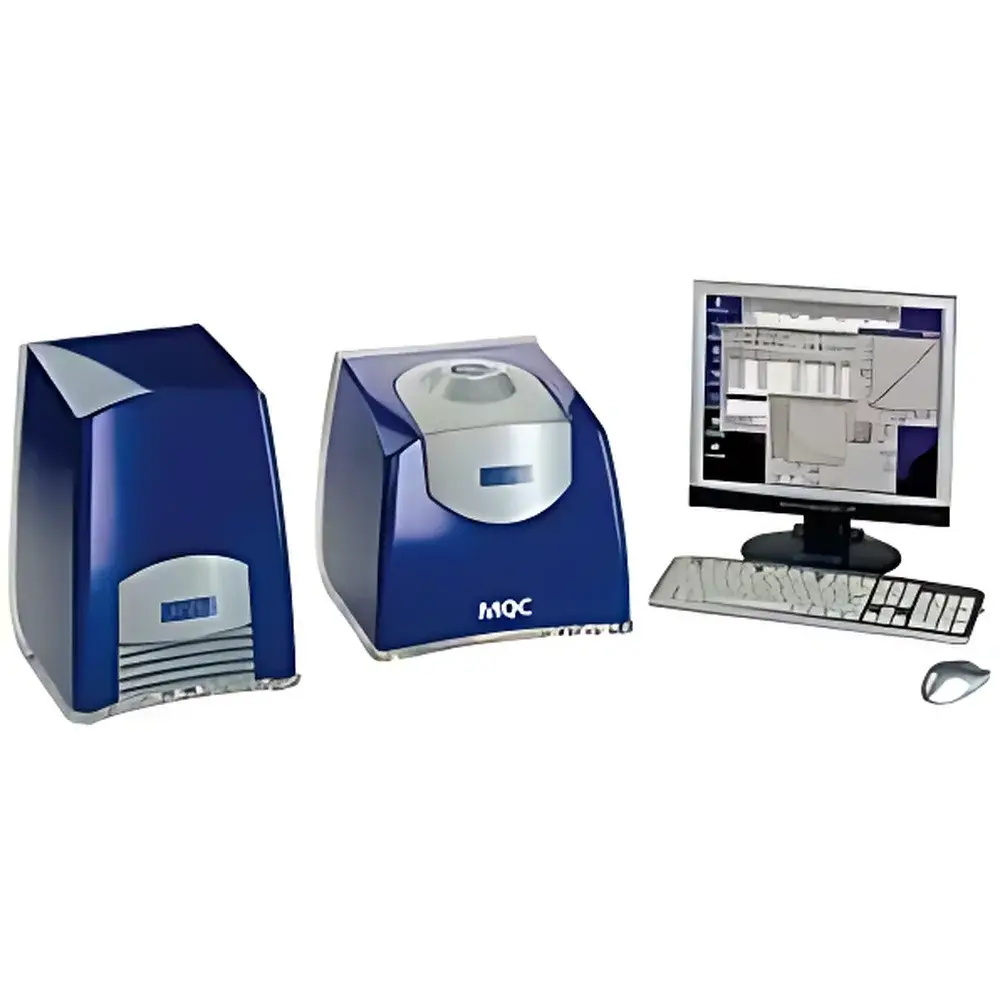
Oxford Instruments MQC Benchtop Low-Field Nuclear Magnetic Resonance Analyzer
| Brand | Oxford Instruments |
|---|---|
| Origin | Germany |
| Instrument Type | Low-Field NMR Analyzer |
| Sample Compatibility | Solid-Liquid Dual Mode |
| Form Factor | Benchtop |
| Control Architecture | Integrated Linux-based embedded system with Windows-compatible GUI software (MultiQuant, EasyCal, RINMR) |
| Probe Technology | HiQ Dynamic Probe Platform |
| Compliance | Designed for GLP-compliant environments |
Overview
The Oxford Instruments MQC is a compact, benchtop low-field nuclear magnetic resonance (LF-NMR) analyzer engineered for rapid, non-invasive, and quantitative analysis of molecular mobility and relaxation behavior in heterogeneous materials. Operating at a fixed Larmor frequency (typically 23 MHz for 1H), the MQC leverages pulsed NMR principles—specifically spin–spin (T2) and spin–lattice (T1) relaxation time measurements—to extract compositional and structural information without chemical derivatization or sample destruction. Unlike high-field superconducting NMR spectrometers, the MQC employs a permanent magnet with optimized field homogeneity and stability, enabling robust performance in non-shielded laboratory or industrial QC environments. Its core measurement paradigm is based on time-domain NMR (TD-NMR), where free induction decay (FID) or CPMG echo train signals are acquired, processed, and correlated to physical properties such as oil content, solid fat content (SFC), polymer crystallinity, moisture distribution, or rubber phase fraction. The system is not a spectroscopic imager but a dedicated relaxometry platform—optimized for routine, high-throughput industrial testing where reproducibility, method transferability, and operational simplicity are critical.
Key Features
- Fully integrated architecture: All control electronics, signal processing hardware, storage (internal SSD/HDD), and embedded Linux real-time OS reside within the instrument—no external PC required for operation.
- HiQ dynamic probe technology: High-sensitivity, low-dead-time RF probe with modular, tool-free exchange capability—enabling rapid adaptation across sample geometries (e.g., 10 mm–50 mm OD tubes) and applications (solid, semi-solid, emulsion, or low-viscosity liquid).
- Zero-consumables design: No cryogens, no deuterated solvents, no disposable components—reducing total cost of ownership and eliminating hazardous waste streams.
- Sub-minute analysis cycle: Typical T2 decay acquisition completed in 30–120 seconds, supporting >100 samples per shift in production QA workflows.
- Non-destructive, non-ionizing measurement: No sample preparation beyond standard containment; compatible with intact seeds, polymer pellets, food matrices, or fiber bundles.
- Remote diagnostics & firmware updates: Secure SSH-based access enables proactive technical support and calibration verification without onsite intervention.
- Standardized Windows-native GUI: MultiQuant, EasyCal, and RINMR software packages provide intuitive, wizard-driven calibration, model building, batch reporting, and export to CSV/Excel—fully compliant with ISO/IEC 17025 documentation requirements.
Sample Compatibility & Compliance
The MQC accommodates diverse physical states—including powders, gels, viscous liquids, emulsions, and heterogeneous solids—within standardized glass or PTFE sample tubes. Its T2 relaxation analysis is insensitive to sample color, opacity, or electrical conductivity, eliminating interference common in optical or NIR methods. The system meets essential regulatory expectations for routine quality control instrumentation: data integrity is preserved via timestamped raw FID storage, user-access logs, and configurable electronic signatures. When deployed with validated methods and appropriate SOPs, the MQC supports compliance with ASTM D6443 (SFC by NMR), ISO 16584 (oil content in seeds), USP (NMR-based assay validation), and GMP/GLP documentation frameworks. Optional 21 CFR Part 11 readiness includes audit trail generation, role-based access control, and electronic record retention protocols.
Software & Data Management
MultiQuant provides automated T2 spectrum inversion and multi-component fitting using singular value decomposition (SVD) or non-negative least squares (NNLS). EasyCal guides users through linear or polynomial calibration curve development using reference standards—supporting both single-point and multi-point quantification. RINMR delivers advanced pulse sequence selection (e.g., CPMG, IR, STIR), parameter optimization, and raw data visualization. All software modules store metadata (operator ID, date/time, instrument ID, method version) with each acquisition. Data export supports .csv, .txt, and .nmr formats; network connectivity allows direct upload to LIMS or shared drives via SMB or FTP. Software language packs include English, German, French, Spanish, and Chinese—ensuring global deployment consistency.
Applications
- Food Science: Solid fat content (SFC) profiling in cocoa butter, margarine, and dairy fats per AOAC 987.02; oil content in nuts, seeds, and fried snacks; moisture migration in baked goods.
- Polymer & Petrochemicals: Isotacticity index in polypropylene (ASTM D5492); xylene-soluble fraction quantification; rubber phase content in thermoplastic elastomers; crosslink density in vulcanized rubbers.
- Textiles & Fibers: Spin finish/oil-up determination on polyester, nylon, and acrylic fibers; lubricant distribution uniformity assessment.
- Agricultural Research: Oil yield prediction in rapeseed, soybean, and sunflower breeding programs; seed viability screening via water mobility mapping.
- Pharmaceuticals: Excipient hydration state analysis; tablet coating uniformity; polymorph differentiation in amorphous dispersions.
FAQ
Is the MQC suitable for regulatory submission data?
Yes—when operated under validated methods, documented SOPs, and with enabled audit trails, MQC-generated data meet ALCOA+ principles and support submissions to FDA, EMA, and PMDA.
Can I upgrade the magnetic field strength post-purchase?
No—the permanent magnet is factory-optimized and not field-tunable; however, probe and software upgrades are supported throughout the instrument’s lifecycle.
What sample volume is required for reliable T2 measurement?
Minimum fill volume depends on probe geometry: 0.5 mL for 10 mm probes; 3–5 mL for 25 mm configurations—ensuring full RF coil coverage and signal-to-noise stability.
Does the MQC require magnetic shielding or special facility modifications?
No—its self-shielded magnet design complies with ICNIRP static field exposure limits; installation requires only standard 110–240 V AC power and ambient temperature control (15–30 °C).
How is calibration traceability maintained?
Oxford provides NIST-traceable reference standards (e.g., doped water phantoms, calibrated polymer samples); users perform periodic system suitability checks using built-in reference sequences.






