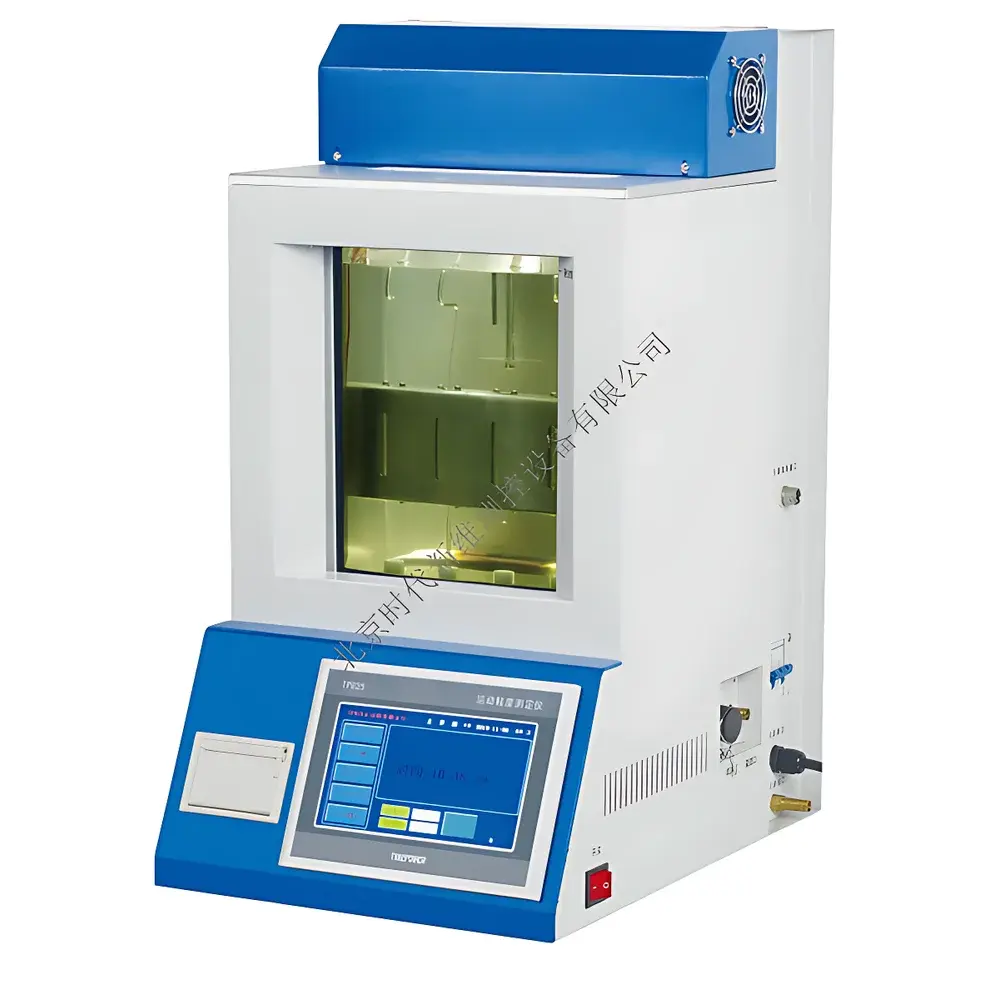
Timepower TP825 Automated Kinematic Viscosity Tester
| Brand | Timepower |
|---|---|
| Origin | Beijing, China |
| Manufacturer Type | Direct Manufacturer |
| Product Origin | Domestic (China) |
| Model | TP825 |
| Pricing | Available Upon Request |
| Display | LCD |
| Ambient Temperature | 5–40 °C |
| Relative Humidity | ≤85% |
| Power Supply | AC 220 V ±10%, 50 Hz ±1 Hz |
| Power Consumption | ≤1500 W |
| Dimensions (W×D×H) | 320 mm × 440 mm × 600 mm |
| Weight | 30 kg |
| Temperature Control Range | Ambient to 100 °C |
| Temperature Stability | ±0.01 °C |
| Temperature Resolution | 0.01 °C |
| Kinematic Viscosity Measurement Range | 0.75–27,000 mm²/s |
| Viscosity Resolution | 0.00001 mm²/s |
| Bath Volume | ~10 L |
| Test Positions | 4 independent capillary viscometer stations |
| Real-time Clock | Yes (battery-backed, retains time during power loss) |
| Sample Types | Transparent and opaque liquids including crude oil, fuel oils (light/heavy), lubricants, additives, and used oils |
Overview
The Timepower TP825 Automated Kinematic Viscosity Tester is a precision-engineered instrument designed for the standardized determination of kinematic viscosity in petroleum products and related hydrocarbon-based fluids. It operates on the capillary flow principle defined in ASTM D445, ASTM D7279-06, ISO 3104, and GB/T 265–1988 — measuring the time required for a fixed volume of liquid to flow under gravity through a calibrated glass capillary tube immersed in a thermostatically controlled bath. The instrument calculates kinematic viscosity (ν) in mm²/s (equivalent to centistokes, cSt) using the formula ν = C × t, where C is the viscometer constant and t is the efflux time. Its dual-CPU architecture enables synchronized thermal regulation and real-time timing acquisition across four independent test positions, ensuring high reproducibility and compliance with method-defined repeatability limits (e.g., ≤0.35% RSD per ASTM D445 Section 13). The system is engineered for laboratory environments requiring routine QC testing in power generation, refinery operations, lubricant formulation, and third-party inspection agencies.
Key Features
- Four-channel asynchronous measurement capability: Each station accommodates standard Ubbelohde or Cannon-Fenske capillary viscometers, enabling parallel analysis without cross-contamination or thermal interference.
- High-stability temperature control: Digital PID-regulated oil bath (±0.01 °C accuracy over 0–100 °C range) with motor-driven circulation to minimize axial and radial thermal gradients; verified per ASTM D446 Annex A2 requirements for bath uniformity.
- Automated workflow execution: Integrated optical sensors detect meniscus passage; microsecond-resolution timing captures efflux duration; automatic calculation, unit conversion, and pass/fail evaluation against method-specified repeatability criteria.
- Dual-CPU embedded control system: One processor manages thermal dynamics and safety interlocks; the other handles data acquisition, algorithmic processing, and user interface responsiveness.
- Ergonomic human-machine interface: Backlit LCD display with touch-sensitive, proximity-activated keys; multilingual menu support (English default); real-time clock with non-volatile memory retention.
- Integrated maintenance functions: Self-diagnostic routines for sensor integrity, heater performance, and fluid level detection; dedicated drain port for safe oil bath servicing; energy-efficient LED illumination for visual monitoring of capillary flow.
Sample Compatibility & Compliance
The TP825 supports kinematic viscosity measurement of both transparent and opaque Newtonian and near-Newtonian liquids within the specified range of 0.75–27,000 mm²/s. Validated sample matrices include crude oil, gasoline, diesel, jet fuel (Jet A-1, JP-8), residual fuel oils (IFO 180/380), base oils (Group I–III), finished lubricants (engine oils, hydraulic fluids, gear oils), biodiesel blends (B5–B20), and service-aged industrial oils. All measurements conform to the procedural rigor of ASTM D445 (Standard Test Method for Kinematic Viscosity of Transparent and Opaque Liquids), ASTM D7279 (Standard Practice for Determining Viscosity of Used Engine Oils by Automated Capillary Viscometers), NB/SH/T 0956–2017 (Chinese standard for automated kinematic viscosity of lubricating oils), and GB/T 11137–1989 (determination of kinematic viscosity of dark petroleum products). Instrument design adheres to IEC 61010-1 safety standards for electrical equipment used in laboratory environments.
Software & Data Management
The TP825 operates without external PC dependency but supports optional USB data export in CSV format for traceable recordkeeping. All test parameters — date/time stamp, bath temperature, efflux times, calculated viscosity values, operator ID, and pass/fail status — are stored locally with timestamped audit trails. The internal memory retains ≥1,000 test records with cyclic overwrite protection. For regulated environments (e.g., ISO/IEC 17025-accredited labs, GLP-compliant facilities), the system permits manual annotation of deviations and supports printed reports with calibration certificate references. While not natively 21 CFR Part 11 compliant, its deterministic timing engine, non-editable raw-data logging, and hardware-enforced thermal stability provide foundational elements for validation under FDA or EU Annex 11 frameworks.
Applications
- Power sector: Monitoring turbine oil degradation and verifying viscosity grade compliance per ISO 8573 and ASTM D4378.
- Petroleum refining: In-process quality control of distillate fractions and final product certification against API RP 14E and ASTM D975.
- Lubricant manufacturing: Batch release testing per OEM specifications (e.g., SAE J300, ACEA C3) and additive package compatibility assessment.
- Commercial inspection: Third-party verification for customs clearance, contract arbitration, and ISO 8217 marine fuel certification.
- Research & development: Screening of bio-based lubricants, synthetic esters, and nanofluid formulations under variable shear history conditions.
FAQ
What capillary viscometer types are compatible with the TP825?
Ubbelohde, Cannon-Fenske Routine, and Ostwald-type viscometers meeting ASTM D446 dimensional tolerances may be installed; each station accepts standard 0.4–2.0 mm capillary bore diameters.
Does the instrument support automatic cleaning between runs?
No — the TP825 does not include solvent-based auto-cleaning; manual rinsing per ASTM D445 Section 8.3 is required between samples using approved solvents (e.g., toluene, xylene, or heptane).
How is temperature uniformity verified across the 4-position bath?
The system employs distributed PT100 sensors and active stirring to maintain ≤0.02 °C spatial deviation at setpoint; users may validate via NIST-traceable probe mapping per ASTM D446 Annex A2.
Can the TP825 be integrated into a LIMS environment?
Yes — through optional RS-232 or USB-to-serial emulation, enabling ASCII-based data streaming to middleware systems supporting ASTM E1384 or HL7 messaging protocols.
What is the recommended calibration frequency for routine use?
Annual verification using certified reference oils (e.g., NIST SRM 2786, 2787, or 2789) is advised; daily verification with a mid-range check oil is recommended per ISO/IEC 17025 Clause 7.7.
Related Products