
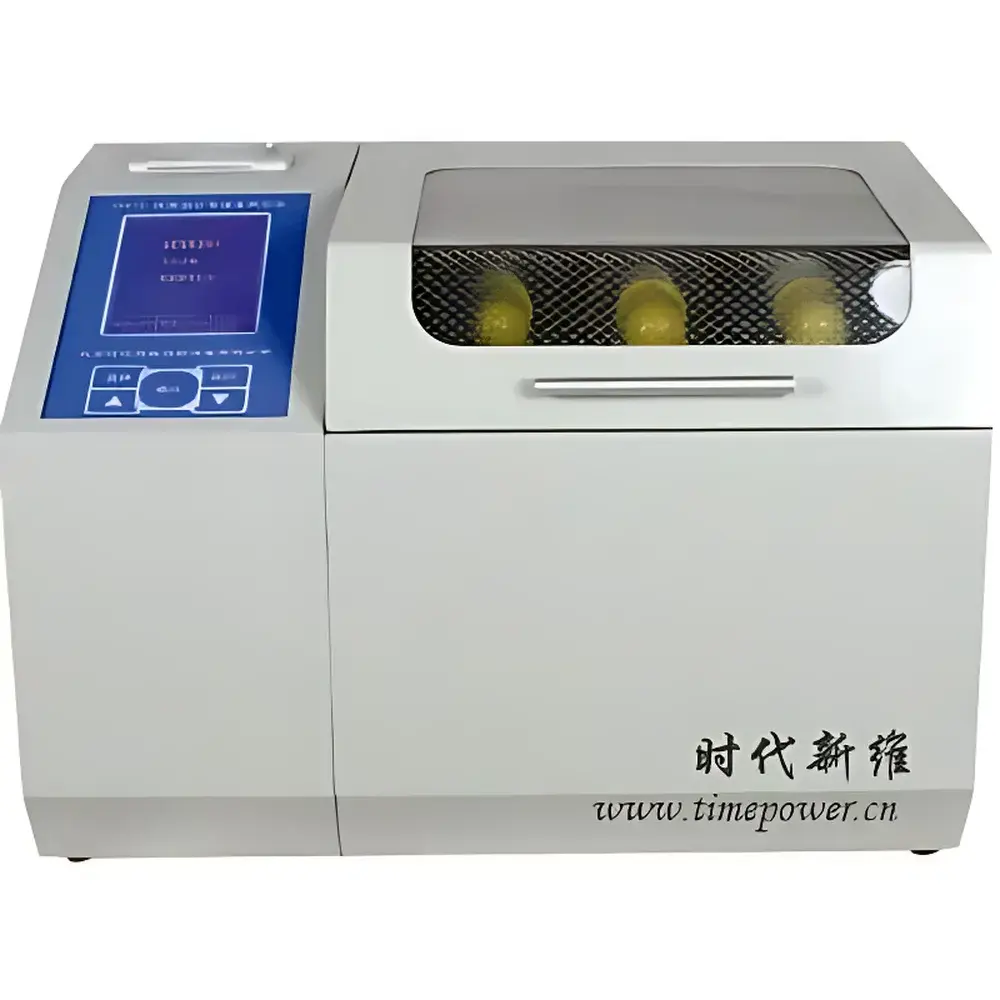
TimePower TP672 Triple-Cup Insulating Oil Dielectric Strength Tester
| Brand | TimePower |
|---|---|
| Origin | Beijing, China |
| Manufacturer Type | OEM Manufacturer |
| Country of Origin | China |
| Model | TP672 |
| Quotation | Upon Request |
| Dielectric Strength Measurement Range | 0–80 kV |
| Voltage Ramp Rates | 2.0 ± 0.2 kV/s and 3.0 ± 0.2 kV/s |
| Accuracy | ±2% |
| Resolution | 0.01 kV |
| Test Repetition | 1–9 cycles (default 6) |
| Stirring Method | Magnetic stirring |
| Standby Time | 0–59 min (default 15 min) |
| Inter-test Interval | 0–9 min (default 3–5 min) |
| Display | LCD |
| Power Supply | AC 220 V ±10%, 50 Hz ±10% |
| Operating Temperature | 5–40 °C |
| Relative Humidity | ≤85% RH |
| Dimensions | 610 × 410 × 425 mm |
| Weight | 45 kg |
Overview
The TimePower TP672 Triple-Cup Insulating Oil Dielectric Strength Tester is a fully automated, microprocessor-controlled instrument engineered for precise and repeatable determination of the dielectric breakdown voltage (BDV) of insulating oils used in high-voltage power equipment. It operates on the principle of controlled AC voltage ramping across standardized test gaps—per ASTM D877, IEC 60156, and aligned with GB/T 507 and DL/T 429.9—wherein a uniform sinusoidal waveform is applied at programmable rates (2.0 or 3.0 kV/s) until electrical breakdown occurs. The device employs three independent, interchangeable oil cups to enable sequential testing without manual intervention, significantly improving throughput and minimizing operator-induced variability. Its core architecture integrates a dry-type high-voltage transformer module, ensuring stable output, low thermal drift, and compact footprint—critical for routine laboratory and field-deployed quality control environments.
Key Features
- Dual-CPU embedded control system enabling synchronized execution of voltage ramping, magnetic stirring, cup rotation, zero-return, data acquisition, and thermal protection
- Programmable voltage ramp rates: 2.0 ± 0.2 kV/s and 3.0 ± 0.2 kV/s, compliant with multiple international standards for insulating oil qualification
- Triple-cup configuration with automatic cup indexing—eliminates manual cup handling between tests and reduces cross-contamination risk
- Integrated magnetic stirring with adjustable stand-by time (0–59 minutes) and inter-test interval (0–9 minutes), supporting standardized moisture equilibration per IEC 60156 Annex A
- Comprehensive safety architecture including overvoltage cutoff, overcurrent shutdown, automatic return-to-zero, and real-time arc detection
- High-resolution LCD interface with intuitive menu navigation; all test parameters, results, and timestamps stored internally with non-volatile memory
- Compact dry-type HV transformer assembly—no oil cooling required, minimal maintenance, and reduced electromagnetic interference
Sample Compatibility & Compliance
The TP672 is validated for use with mineral-based, synthetic, and bio-derived insulating oils—including naphthenic and paraffinic transformer oils, silicone fluids, and ester-based dielectrics. It accommodates standard ASTM D877 and IEC 60156 test cells (6-mm gap, 25-mm diameter electrodes) and supports optional electrode calibration kits traceable to NIST-equivalent reference standards. All firmware and operational logic comply with GLP documentation requirements, and test logs include full audit trails (operator ID, timestamp, cup ID, ramp rate, breakdown voltage, and pass/fail status). The instrument meets CE marking requirements for electromagnetic compatibility (EN 61326-1) and low-voltage safety (EN 61010-1), and its design facilitates integration into ISO/IEC 17025-accredited laboratories.
Software & Data Management
Test data are stored onboard with capacity for ≥500 test records, each containing breakdown voltage (kV), ramp rate (kV/s), stir time (s), standby duration (min), ambient temperature (°C), and pass/fail classification. Internal memory retains data during power loss. Optional RS-232 or USB interface enables direct export to LIMS or Excel-compatible CSV files. No proprietary software installation is required—data retrieval uses standard terminal emulation or simple ASCII commands. Audit trail integrity is preserved through immutable timestamping and no user-editable fields. While not FDA 21 CFR Part 11-certified out-of-the-box, the system supports manual SOP-driven validation protocols for regulated utility QA/QC workflows.
Applications
This instrument serves as a primary diagnostic tool in substation maintenance labs, transformer manufacturing QC departments, third-party oil analysis service providers, and R&D facilities developing next-generation dielectric fluids. Typical use cases include: incoming inspection of new oil batches prior to transformer filling; periodic monitoring of in-service oil in power transformers, reactors, and circuit breakers; evaluation of oil reclamation effectiveness after filtration or vacuum dehydration; and comparative assessment of alternative dielectric fluids under accelerated aging conditions. Its triple-cup capability makes it especially suitable for statistical process control (SPC) programs requiring replicate measurements per ASTM D1816 or internal QA sampling plans.
FAQ
What standards does the TP672 comply with?
It conforms to GB/T 507, DL/T 429.9, ASTM D877, and IEC 60156 for dielectric strength testing of insulating oils.
Can the instrument be calibrated externally?
Yes—high-voltage output is traceable to national metrology institutes via external HV calibrators using certified voltage dividers; calibration certificates are issued per ISO/IEC 17025.
Is electrode cleaning and conditioning supported in the workflow?
The instrument does not automate cleaning, but its programmable stir/standby intervals align with standard electrode conditioning procedures outlined in IEC 60156 Clause 6.3.
Does the TP672 support remote operation or network connectivity?
It features RS-232 and optional USB ports for local data transfer; Ethernet or Wi-Fi integration requires external industrial gateways and is not natively supported.
What maintenance is required for long-term reliability?
Annual verification of HV output accuracy, visual inspection of cup electrodes for pitting, and replacement of silicone O-rings every 24 months are recommended per manufacturer guidelines.
Related Products




