
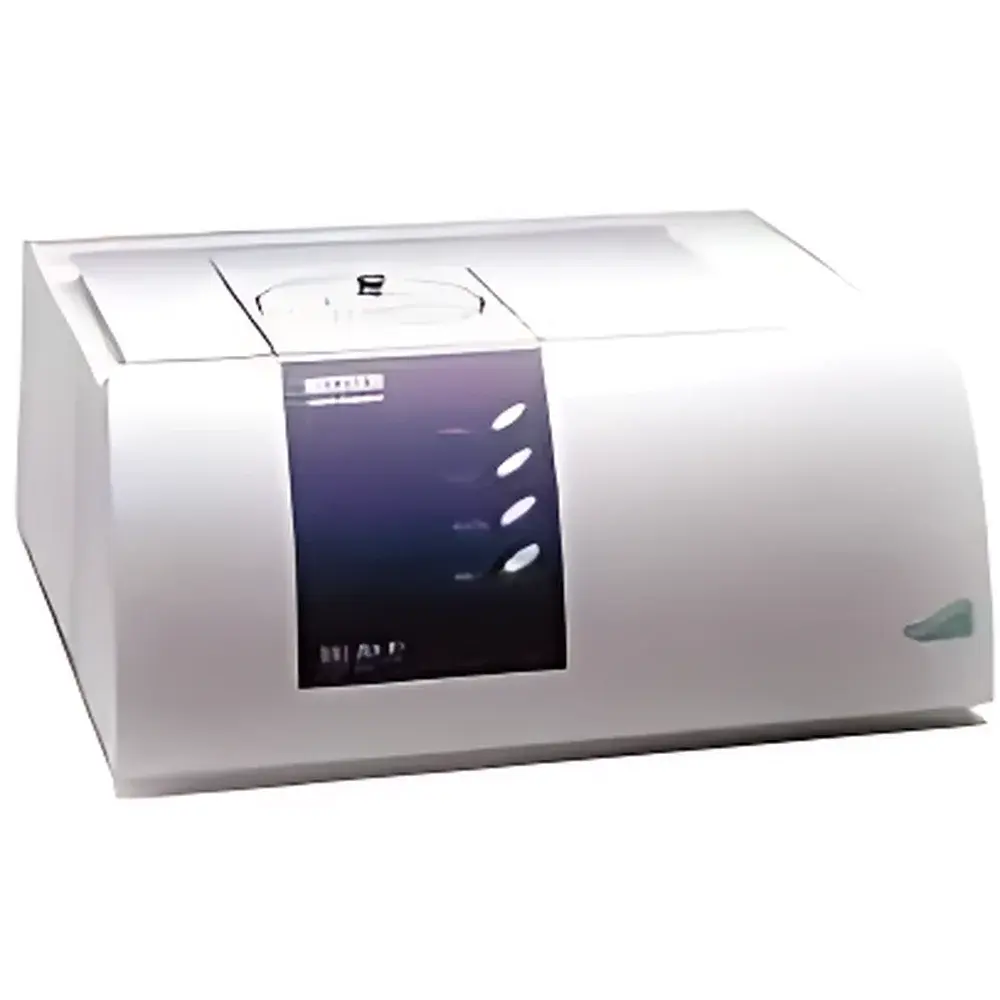
Netzsch DSC 204 F1 Phoenix® Advanced Differential Scanning Calorimeter
| Brand | Netzsch |
|---|---|
| Origin | Germany |
| Model | DSC 204 F1 |
| Temperature Range | −180 °C to 700 °C |
| Heating/Cooling Rate | 0–200 K/min |
| Sensor Options | τ-type (time constant: 0.6 s), μ-type (ultra-high sensitivity) |
| Cooling Options | Liquid nitrogen (LN₂), mechanical refrigeration (−85 °C to 600 °C), compressed air, cooling cup |
| Gas Control | Dual purge + single protective gas channels with integrated mass flow controllers |
Overview
The Netzsch DSC 204 F1 Phoenix® is a high-performance differential scanning calorimeter engineered for precision thermal analysis across academic research, pharmaceutical development, polymer science, food technology, and advanced materials engineering. Operating on the heat-flux principle, it measures the difference in heat flow between a sample and an inert reference as both are subjected to identical, programmable temperature profiles. Its core innovation lies in the cylindrical 3D silver furnace—designed for exceptional thermal conductivity and uniformity—enabling reproducible measurements across extreme temperature ranges (−180 °C to 700 °C) and rapid heating/cooling rates (0–200 K/min). The instrument’s hermetically sealed furnace architecture supports direct coupling to Fourier-transform infrared (FTIR) spectrometers or quadrupole mass spectrometers (QMS) for evolved gas analysis (EGA), facilitating mechanistic interpretation of decomposition, oxidation, or curing events. Unlike conventional DSC systems constrained by thermal lag or baseline drift, the DSC 204 F1 integrates real-time thermal resistance compensation (Tau-R mode) and polynomial-based BeFlat® baseline optimization—both essential for resolving overlapping transitions in complex formulations such as amorphous pharmaceuticals or multi-phase polymers.
Key Features
- Cylindrical 3D silver furnace with embedded heating elements and external cooling interfaces—ensuring <±0.1 °C temperature homogeneity across the sensor plane
- Dual-sensor architecture: standard τ-type sensor (0.6 s time constant) for high-resolution separation of closely spaced thermal events; optional μ-type sensor offering >10× enhanced sensitivity for sub-milligram samples in biopharmaceutical or lipid studies
- Four independent cooling configurations: liquid nitrogen (full range: −180 °C to 700 °C, in both liquid and gas modes), mechanical refrigeration (−85 °C to 600 °C), compressed air (700 °C to ambient), and passive cooling cup
- Triple-gas management system: two independently controlled purge gas channels and one protective gas channel, each regulated via integrated thermal mass flow controllers (MFCs) with software-settable flow rates (0–200 mL/min)
- Hermetic furnace design rated to 2 bar overpressure—enabling quantitative EGA coupling without signal attenuation or condensation artifacts
- Optional 64-position automatic sample changer (ASC) with integrated macro scripting support for unattended batch analysis under ISO 11357 and ASTM E794 compliance protocols
- UV-curing accessory for in situ photopolymerization studies under controlled thermal environments
Sample Compatibility & Compliance
The DSC 204 F1 accommodates standard crucibles (aluminum, gold-plated aluminum, stainless steel, ceramic) and specialized high-pressure cells (up to 100 bar) for reactive or volatile samples. It meets critical regulatory requirements for quality-controlled environments: Proteus® software includes audit-trail logging, electronic signatures, and user-access-level configuration—fully compliant with FDA 21 CFR Part 11, EU Annex 11, and ICH Q5C stability guidelines. Instrument qualification follows IQ/OQ/PQ protocols aligned with ASTM E1363 (thermal calibration), ISO 11357-1 (general principles), and USP (thermal analysis in pharmaceuticals). All sensor calibrations are traceable to NIST-certified standards, and baseline stability is verified per ASTM E967 (temperature calibration) and E968 (enthalpy calibration).
Software & Data Management
Proteus® software—developed exclusively for Netzsch thermal analyzers—runs natively on Windows® 10/11 and supports both online acquisition and offline analysis. Core analytical functions include automated peak detection (onset, peak, inflection, endset), multi-baseline selection (tangent, linear, spline), partial integration, crystallinity quantification (via enthalpy ratio methods), glass transition determination (Tg onset, midpoint, offset), specific heat capacity (Cp) measurement using sapphire calibration, and kinetic modeling (ASTM E698, Ozawa-Flynn-Wall). Advanced modules include TM-DSC deconvolution (reversible vs. irreversible heat flow), peak deconvolution (Gaussian/Lorentzian fitting), purity assessment (van’t Hoff method), and isoconversional kinetics (Friedman, Kissinger-Akahira-Sunose). Data export complies with ASTM E1447 (CSV), ASTM E1592 (XML), and PDF/A-1b archival standards.
Applications
- Pharmaceuticals: Polymorph screening, hydrate/anhydrate transitions, excipient compatibility, lyophilization cycle validation, and accelerated stability testing per ICH Q1A(R2)
- Polymers: Melting/crystallization kinetics, crosslink density estimation, oxidative induction time (OIT), and degradation onset analysis
- Food Science: Solid-fat content (SFC) profiling, starch gelatinization, chocolate tempering behavior, and lipid oxidation monitoring
- Electrochemical Materials: SEI layer formation in Li-ion battery anodes, cathode thermal runaway thresholds, and electrolyte decomposition pathways
- Inorganics & Ceramics: Phase transformations in oxides, eutectic melting points in alloys, and dehydration kinetics in clays or MOFs
FAQ
What cooling options are available—and how do they affect measurement range and resolution?
Liquid nitrogen enables the full −180 °C to 700 °C range with optimal signal-to-noise below −100 °C; mechanical refrigeration provides robust −85 °C operation without consumables, ideal for routine QA/QC.
Can the DSC 204 F1 be used for cGMP-regulated pharmaceutical testing?
Yes—Proteus® includes 21 CFR Part 11-compliant user management, audit trails, electronic signatures, and configurable electronic lab notebook (ELN) export.
Is TM-DSC supported natively—or is it a hardware upgrade?
TM-DSC is a software-enabled feature requiring no additional hardware; it operates on standard DSC data using proprietary modulation algorithms embedded in Proteus®.
How does BeFlat® differ from conventional baseline subtraction methods?
BeFlat® applies multivariate polynomial regression across multiple heating rates to model and subtract instrument-specific thermal lag effects—improving baseline flatness by up to 70% compared to single-rate tangent subtraction.
What sample mass range is recommended for the μ-type sensor?
Optimal performance is achieved with 0.5–5 mg samples; masses below 0.2 mg may require extended acquisition times to maintain signal integrity.



