
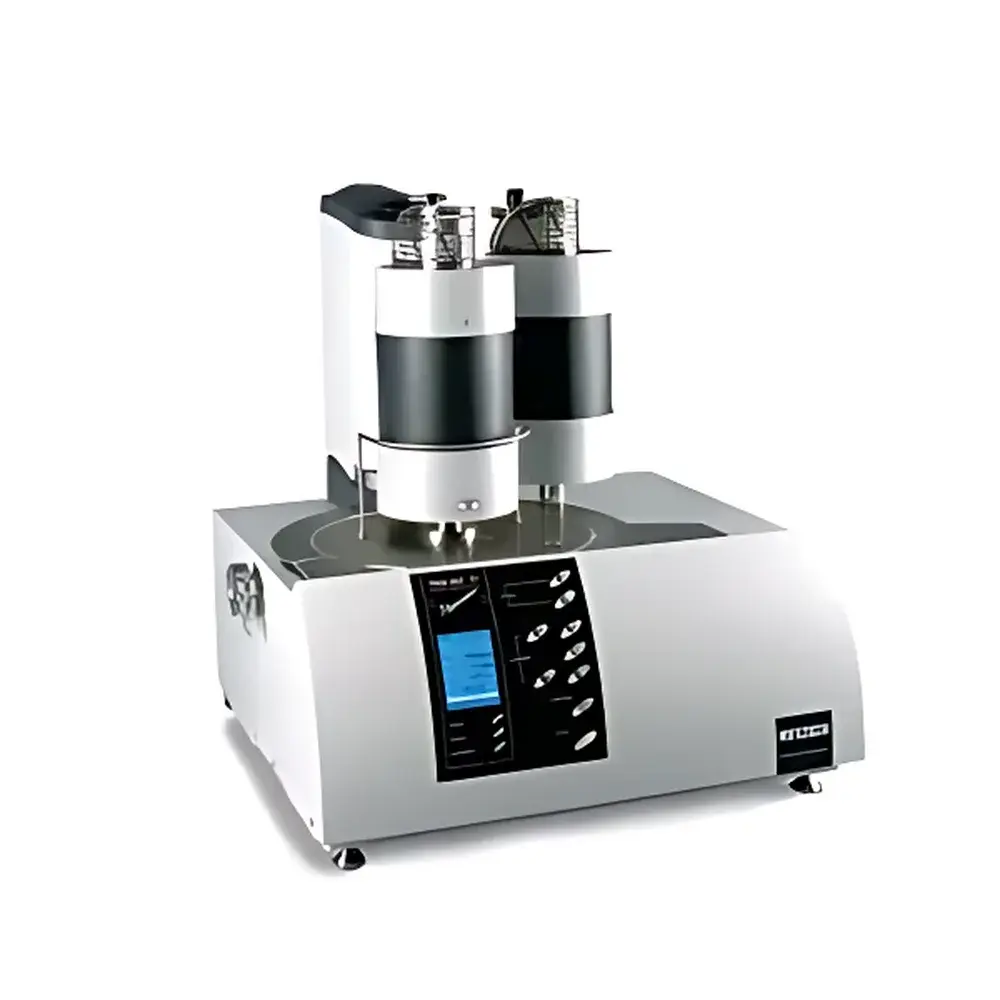
Netzsch DMA 242 E Artemis Dynamic Mechanical Analyzer
| Brand | Netzsch |
|---|---|
| Origin | Germany |
| Model | DMA 242 E |
| Instrument Type | Dynamic Mechanical Analyzer (DMA/DMTA) |
| Temperature Range | −170 °C to 600 °C |
| Temperature Accuracy | ±0.1 °C |
| Static Force Range | 12 N (up to 24 N with optional configuration) |
| Dynamic Force Range | 12 N (up to 24 N with optional configuration) |
| Displacement Range | 20 mm |
| Frequency Range | 0.01–100 Hz |
| Strain Control Range | ±240 µm |
| Modulus Range | 10⁻³–10⁶ MPa |
| Damping Factor (tan δ) Range | 0.005–100 |
| Cooling Options | Liquid Nitrogen (to −170 °C) or Vortex-Tube Compressed Air (to 0 °C) |
| Deformation Modes | 3-Point Bending, Single/Double Cantilever, Shear, Tension, Compression/Indentation |
| Additional Modes | TMA, Creep/Relaxation, Stress/Strain Sweep |
Overview
The Netzsch DMA 242 E Artemis is a high-precision, modular dynamic mechanical analyzer engineered for rigorous viscoelastic characterization of polymeric, composite, ceramic, metallic, and biological materials across extreme thermal conditions. Operating on the fundamental principle of forced oscillatory deformation under controlled temperature, frequency, and stress conditions, the instrument quantifies time- and temperature-dependent mechanical responses—including storage modulus (E′), loss modulus (E″), and damping factor (tan δ)—in accordance with ASTM D4065, ISO 6721-4, and ISO 11357-7 standards. Its dual-force architecture supports both high-load rigidity testing (up to 24 N static/dynamic force) and ultra-sensitive measurements (4 N high-resolution mode), enabling reliable analysis from soft elastomers to engineering thermoplastics and structural composites. The vertical sample-loading design ensures rapid, repeatable fixture exchange—critical for laboratories performing multi-modal qualification in compliance with GLP, GMP, and FDA 21 CFR Part 11 workflows.
Key Features
- Modular platform with interchangeable fixtures: over 30 standardized and application-specific sample holders—including bending, cantilever, shear, tensile, compression, and indentation geometries—supporting specimen dimensions up to 60 mm × 12 mm × 5 mm (3-point bending) and accommodating liquids, powders, films, fibers, and bulk solids.
- Ultra-broad thermal range: programmable from −170 °C (liquid nitrogen cooling) to 600 °C with linear ramp control (0.01–20 K/min) and ±0.1 °C accuracy, validated per ISO 11357-1 calibration protocols.
- High-fidelity actuation system: stepper-motor-driven displacement stage with 20 mm travel and ±240 µm strain control, enabling precise TMA-mode expansion coefficient calculation, creep/recovery profiling, and static relaxation experiments.
- Dual-atmosphere capability: mass-flow-controlled inert (N₂, Ar) or oxidative (air, O₂) environments ensure reproducible thermal transfer and oxidation-state monitoring during elevated-temperature DMA scans.
- Configurable cooling: choice between cryogenic liquid nitrogen system (−170 °C endpoint) or energy-efficient vortex-tube compressed air unit (0 °C endpoint), minimizing operational cost without sacrificing low-temperature resolution.
Sample Compatibility & Compliance
The DMA 242 E Artemis accommodates diverse material classes—including thermosets, filled rubbers, shape-memory alloys, hydrogels, pharmaceutical excipients, and fiber-reinforced composites—through geometry-optimized fixtures and load-range adaptability. Its mechanical design conforms to IEC 61000-6-3 (EMC) and CE safety directives. Data acquisition and reporting meet regulatory requirements for audit trails, electronic signatures, and secure data integrity as defined in FDA 21 CFR Part 11 and EU Annex 11. Calibration traceability follows NIST-traceable reference materials (e.g., polyethylene, polystyrene, and indium standards), supporting ISO/IEC 17025-accredited laboratory operations.
Software & Data Management
Controlled by the Windows-based Proteus® software suite, the DMA 242 E Artemis delivers integrated measurement, real-time visualization, and advanced post-processing. The interface supports multi-parameter plotting (up to four Y-axes), time–temperature–frequency superposition via Williams-Landel-Ferry (WLF) modeling, Cole-Cole analysis, activation energy estimation (Arrhenius/Eyring), and 3D surface mapping of modulus dispersion. Raw data files (.par/.dat) are structured for long-term archival and interoperability with third-party analytics platforms (MATLAB®, Python pandas, OriginLab). Optional modules enable full creep/relaxation curve fitting, stress–strain sweep hysteresis analysis, and simultaneous dielectric analysis (DEA) when coupled with the Netzsch DEA accessory. All software versions undergo annual validation for GxP environments, including version-controlled change logs and user-access-level permissions.
Applications
- Characterization of glass transition (Tg) broadening and secondary relaxations in amorphous polymers and copolymers.
- Viscoelastic lifetime prediction of automotive sealants and aerospace adhesives under thermal cycling.
- Quantification of crosslink density and network homogeneity in vulcanized rubber compounds.
- Thermo-mechanical stability assessment of battery separator membranes and solid electrolytes.
- Creep resistance evaluation of high-performance thermoplastics used in medical device housings.
- Linear thermal expansion coefficient (CTE) determination for hybrid packaging substrates in microelectronics.
- Time–temperature superposition (TTS) modeling for predictive rheological behavior beyond experimental frequency limits.
FAQ
What cooling options are available for sub-ambient operation?
The DMA 242 E Artemis supports two independent cooling systems: a liquid nitrogen cryostat for operation down to −170 °C, and a vortex-tube compressed air system capable of reaching 0 °C—ideal for routine low-temperature screening without cryogen handling.
Can the instrument perform thermomechanical analysis (TMA) alongside DMA?
Yes. The same displacement sensor and temperature-controlled furnace support standalone TMA mode, delivering quantitative CTE, softening point, and dimensional stability data under zero-load or constant-load conditions.
Is the software compliant with 21 CFR Part 11 requirements?
Proteus® includes configurable audit trail logging, electronic signature enforcement, role-based access control, and data encryption—fully validated for use in regulated pharmaceutical and medical device development labs.
How many deformation modes does the system support natively?
Five core mechanical configurations are supported: 3-point bending, single/dual cantilever, shear, tension, and compression/indentation—with dedicated fixtures optimized for each geometry and calibrated per ISO 6721-4 Annex A.
What is the minimum measurable tan δ value, and how is signal-to-noise maintained at low damping?
The system achieves tan δ detection down to 0.005 through adaptive force feedback control, high-stiffness transducers, and digital lock-in amplification—ensuring robust resolution even in highly elastic, low-damping materials such as crystalline thermoplastics or ceramics.
Related Products



