
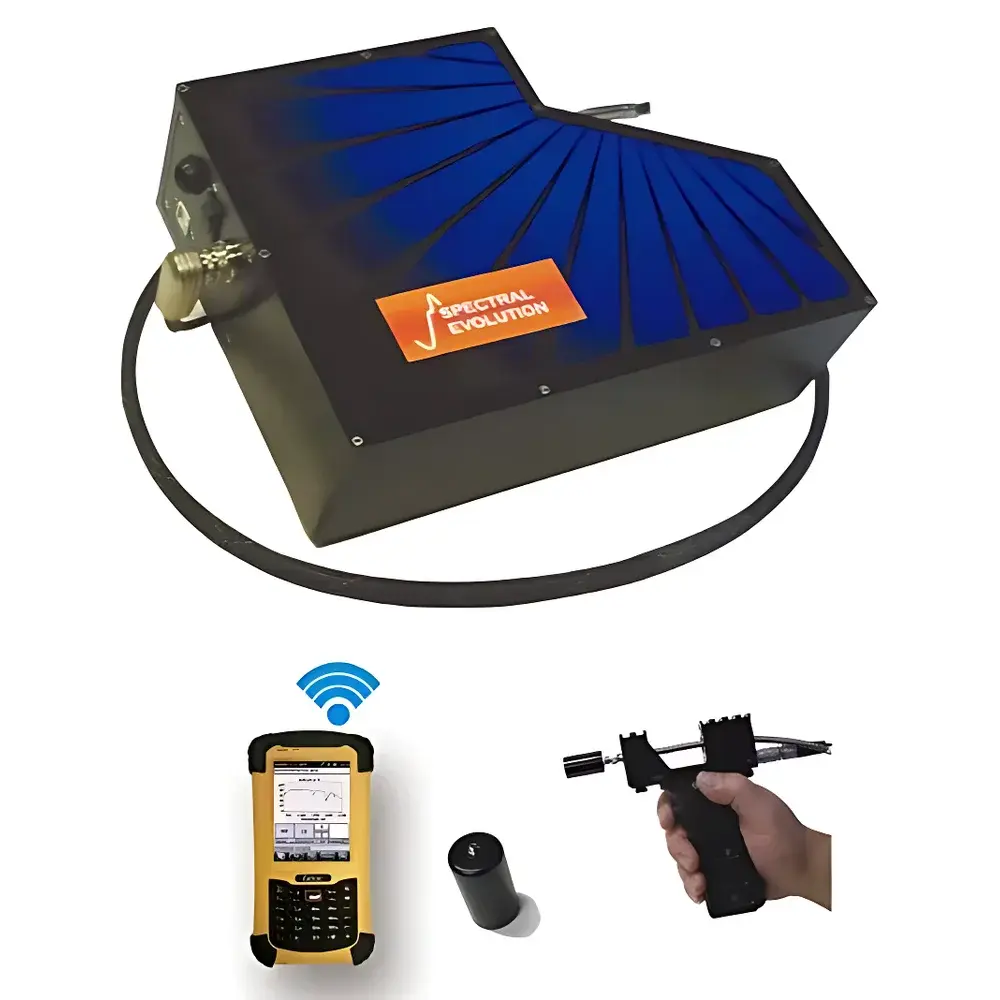
SEI SR-3500 Portable Field Spectroradiometer
| Brand | SEI |
|---|---|
| Origin | USA |
| Model | SR-3500 |
| Spectral Range | 350–2500 nm |
| Spectral Resolution | 3.5 nm (350–1000 nm), 7 nm (1900–2100 nm), 10 nm (1500 nm) |
| Spectral Bandwidth | 1.5 nm (350–1000 nm), 2.5 nm (1900–2100 nm), 3.8 nm (1500 nm) |
| Detector Configuration | 512-pixel Si array (350–1000 nm) |
| FOV Options | 4°, 8°, 14° lenses |
| NEΔL | 0.8×10⁻⁹ W/cm²/nm/sr @ 400 nm |
| Integration Time | 7.5–1000 ms |
| Wavelength Repeatability | ±0.1 nm |
| Wavelength Accuracy | ±0.5 nm |
| Frame Rate | Up to 10 Hz (full spectrum in ≤100 ms) |
| Interface | USB 2.0 and Bluetooth 4.2 |
| Dimensions | 21.6 × 29.2 × 8.9 cm |
| Weight | 3.3 kg (7.3 lbs) |
| Battery | Rechargeable Li-ion, 7.4 V, >2 h continuous operation |
| Calibration | NIST-traceable factory calibration |
Overview
The SEI SR-3500 Portable Field Spectroradiometer is a high-performance, filter-based spectroradiometric instrument engineered for precise, field-deployable measurement of spectral reflectance, transmittance, radiance, and irradiance across the ultraviolet–visible–near-infrared–shortwave infrared (UV-VNIR-SWIR) range (350–2500 nm). Unlike scanning or moving-grating spectrometers, the SR-3500 employs a fixed holographic grating and three synchronized linear detector arrays—silicon (Si) for 350–1000 nm and two thermoelectrically cooled indium gallium arsenide (InGaAs) arrays for 970–1910 nm and 1900–2500 nm—enabling simultaneous full-spectrum acquisition without mechanical motion. This architecture eliminates wavelength drift, reduces calibration sensitivity to thermal or mechanical perturbation, and ensures long-term radiometric stability under variable ambient conditions. Designed explicitly for terrestrial remote sensing, precision agriculture, environmental monitoring, mineralogical surveying, and vegetation biophysical parameter retrieval, the SR-3500 delivers laboratory-grade spectral fidelity in a rugged, hand-carried platform compliant with ASTM E275, ISO 9001, and USGS Field Spectroscopy Protocols.
Key Features
- Fixed-grating, all-linear-array optical design with no moving parts—ensures mechanical robustness and long-term wavelength registration stability
- NIST-traceable factory calibration with documented uncertainty budgets for radiance, irradiance, and reflectance modes
- Integrated auto-shutter and drift-lock reference channel for real-time dark-current compensation and spectral baseline stabilization
- Intelligent exposure control: automatic integration time selection based on scene radiance, enabling consistent signal-to-noise ratio across heterogeneous targets
- Dual-mode optical interface: interchangeable fore-optics (4°, 8°, 14° field-of-view lenses) and fiber-coupled configurations (25° fiber, cosine corrector, or integrating sphere)
- Onboard Bluetooth 4.2 and USB 2.0 connectivity for wireless instrument control, real-time data streaming, and firmware updates
- Lightweight aluminum chassis with passive thermal management—optimized for operation across –10°C to +45°C ambient ranges
- Ergonomic nylon carry handle and low-center-of-gravity form factor for extended handheld or tripod-mounted deployment
Sample Compatibility & Compliance
The SR-3500 supports direct measurement of natural and engineered surfaces—including soils, vegetation canopies, water bodies, asphalt, painted materials, and geological outcrops—under ambient solar illumination or controlled artificial lighting. Its modular fore-optics system allows seamless transition between contact, proximal, and stand-off measurement geometries. All optical components comply with RoHS and REACH directives. The instrument’s spectral calibration is traceable to NIST Standard Reference Materials (SRMs) 2020, 2030, and 2065, and its data output structure adheres to the NASA-supported SPECCHIO metadata schema. For regulated environments requiring auditability, DARWin SP software supports 21 CFR Part 11-compliant electronic signatures, user access logs, and immutable raw-data archiving—meeting GLP and GMP documentation requirements.
Software & Data Management
The SR-3500 operates natively with DARWin SP (Spectroscopy Platform), a Windows-based application providing real-time spectral preview, multi-channel synchronization, and batch processing workflows. DARWin SP enables automated geometric correction (e.g., sun-angle normalization), atmospheric compensation via MODTRAN-derived look-up tables, and export to ENVI, MATLAB, Python (via HDF5 or ASCII), and ArcGIS-compatible formats (BIL, BSQ). Optional DARWin Compact CE Mobile runs on ruggedized Windows CE PDA devices—featuring integrated GPS geotagging, 3-MP imaging, capacitive touchscreen UI, and offline spectral library matching. All raw spectra are stored with embedded metadata: GPS coordinates, UTC timestamp, integration time, detector temperature, and calibration file ID—ensuring full experimental reproducibility.
Applications
- Vegetation phenotyping: chlorophyll content estimation (NDVI, PRI, MCARI), water stress detection (NDWI, NIRv), and leaf area index (LAI) modeling
- Soil characterization: organic carbon quantification, iron oxide mapping, and moisture content inference using SWIR absorption features
- Mineral identification: diagnostic absorption band analysis at 1400, 1900, and 2200 nm for clay, carbonate, sulfate, and hydroxide species
- Environmental monitoring: snow albedo tracking, coastal water turbidity assessment, and oil-spill spectral fingerprinting
- Calibration/validation of airborne and satellite sensors (e.g., Sentinel-2, Landsat 9, PRISMA) through vicarious calibration protocols
- Material science QA/QC: pigment stability testing, coating uniformity verification, and photovoltaic cell spectral response profiling
FAQ
What spectral calibration standards are used for the SR-3500?
The SR-3500 is calibrated against NIST-traceable sources including SRM 2020 (diffuse reflectance), SRM 2030 (irradiance), and SRM 2065 (radiance), with full uncertainty propagation reported in the certificate of calibration.
Can the SR-3500 be used for absolute irradiance measurements?
Yes—the instrument includes an optional cosine-corrected irradiance head with angular response <±2% from 0–80° incidence, validated per ISO/CIE 19476:2013.
Is spectral data compatible with ENVI or Python-based analysis pipelines?
All exported spectra include header metadata conforming to the SPECCHIO standard and are natively readable by ENVI, GDAL, SciPy, and scikit-learn via HDF5 or tab-delimited ASCII formats.
How does the drift-lock function maintain measurement stability during prolonged field sessions?
A dedicated internal reference channel continuously monitors detector baseline offset and gain drift, applying real-time correction coefficients to each acquired spectrum without interrupting measurement flow.
What battery life can be expected under typical field use?
With active Bluetooth telemetry and moderate integration times (20–100 ms), the rechargeable Li-ion battery sustains >2.2 hours of continuous operation at 25°C; battery health and remaining runtime are displayed in real time within DARWin SP.




