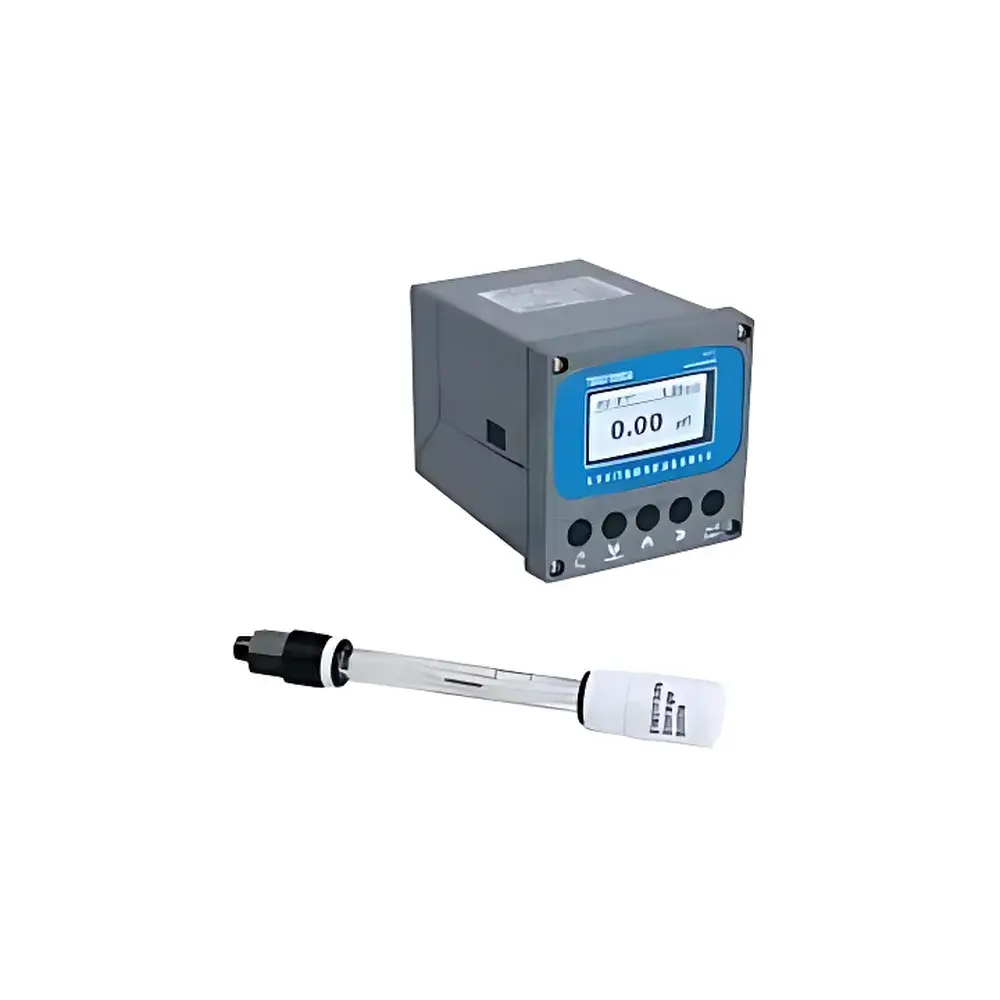
Timepower TP111 Online pH Analyzer
| Brand | Timepower |
|---|---|
| Model | TP111 |
| Type | Online pH Analyzer and Acidity Meter |
| Measurement Principle | Potentiometric (Electrochemical Cell with pH-Sensitive Glass Electrode and Reference Electrode) |
| pH Range | 0.00–14.00 |
| Accuracy | ±0.02 pH |
| Resolution | 0.01 pH |
| Input Impedance | ≥1×10¹² Ω |
| Repeatability | ≤1% |
| Temperature Compensation | Manual/Automatic (Pt1000 sensor, 0–60 °C) |
| Sample Temp. Range | 5–60 °C |
| Ambient Temp. | 5–45 °C |
| Humidity | ≤90% RH (non-condensing) |
| Display | 128×64 Dot-Matrix LCD (Bilingual: English/Chinese) |
| Output Signals | Isolated 0–10 mA / 0–20 mA / 4–20 mA (selectable, load <300 Ω) |
| Relay Outputs | 2 SPST (AC220V/3A or DC30V/3A), programmable alarm thresholds |
| Data Storage | Internal logging with historical trend display |
| Power Supply | AC 85–265 V or 24 VDC |
| Power Consumption | ≤15 W |
| Enclosure Rating | IP65 |
| Dimensions | 98×130×98 mm (H×W×D) |
| Panel Cutout | 94×94 mm |
| Weight | 0.5 kg |
| Storage Temperature | −25–55 °C |
| Data Retention on Power Loss | >10 years |
Overview
The Timepower TP111 Online pH Analyzer is an industrial-grade, continuous-monitoring potentiometric instrument engineered for stable, long-term pH measurement in process streams and aqueous systems. It operates on the fundamental Nernst equation principle—converting hydrogen ion activity in solution into a measurable millivolt signal via a high-impedance electrochemical cell composed of a pH-sensitive glass sensing electrode and a stable reference electrode (typically Ag/AgCl/KCl). The analyzer integrates a three-in-one composite electrode architecture—combining measuring, reference, and temperature-sensing elements—minimizing junction potential drift and ensuring consistent response across variable conductivity conditions. Designed for deployment in demanding environments—including water treatment plants, power generation facilities, pharmaceutical manufacturing, food & beverage processing, and chemical synthesis lines—the TP111 delivers traceable, repeatable measurements compliant with routine operational requirements under ISO 5725 (accuracy and precision) and aligned with ASTM D1293 (standard test method for pH of water). Its robust isolation design and wide operating temperature range support uninterrupted operation in fluctuating ambient and process conditions.
Key Features
- High-input-impedance (>1×10¹² Ω) analog front-end ensures minimal loading error when interfacing with high-resistance pH electrodes, critical for low-conductivity samples such as ultrapure water or boiler feedwater.
- Bilingual (English/Chinese) 128×64 dot-matrix LCD with intuitive menu navigation enables rapid configuration and real-time diagnostics without external software.
- Programmable automatic temperature compensation using integrated Pt1000 sensor (0–60 °C), supporting both linear and non-linear algorithms per IUPAC-recommended pH vs. temperature relationships.
- Dual relay outputs configurable for high/low alarms, pump control, or valve actuation—each independently assignable to pH thresholds with hysteresis adjustment.
- Isolated current output (4–20 mA default, selectable 0–10/0–20 mA) meets industrial automation standards (IEC 61000-6-2/4 for EMC immunity) and interfaces directly with DCS, PLC, or SCADA systems.
- Onboard data logging retains time-stamped pH values and temperature readings; historical trends are viewable directly on the display or exportable via optional communication modules.
- IP65-rated enclosure ensures protection against dust ingress and water jets—suitable for wall-mounted or panel-integrated installation in humid or washdown-prone areas.
Sample Compatibility & Compliance
The TP111 supports a broad spectrum of aqueous matrices through interchangeable three-composite pH electrodes—optimized for specific applications including low-conductivity pure water (≥1 µS/cm), municipal wastewater (high suspended solids), high-ionic-strength brines, and elevated-temperature sterilization loops (up to 121 °C with optional autoclavable variant). Electrode selection follows ISO 3696 (water for analytical laboratory use) and USP guidance for pharmaceutical water systems. The analyzer’s hardware and firmware architecture facilitate audit-ready operation: event logs record calibration timestamps, parameter changes, and alarm activations—supporting GLP/GMP documentation workflows. While not inherently 21 CFR Part 11 compliant out-of-the-box, its data integrity features (tamper-resistant memory, timestamped records, password-protected configuration) provide a foundation for validation under regulated environments when deployed with appropriate procedural controls.
Software & Data Management
No proprietary PC software is required for basic operation; all configuration, calibration, and diagnostics occur via the front-panel interface. For centralized monitoring, optional RS485 Modbus RTU communication allows integration into existing plant-wide data historians. Logged data (pH, temperature, timestamp) can be retrieved in CSV-compatible format via serial interface or SD card module (accessory). Calibration history—including buffer values, slope (%), offset (mV), and asymmetry potential—is retained with full traceability. The system supports two-point calibration (e.g., pH 4.01/7.00 or 7.00/10.01) with automatic recognition of standard IUPAC-certified buffers. All stored parameters survive power interruption for over ten years via non-volatile EEPROM.
Applications
- Real-time pH monitoring in reverse osmosis permeate loops, deionized water distribution networks, and steam condensate return systems in thermal power plants.
- Process control of neutralization reactors in chemical manufacturing and electroplating effluent treatment.
- Continuous verification of cleaning-in-place (CIP) rinse cycles in biopharmaceutical production suites.
- Regulatory compliance tracking for EPA NPDES discharge permits in municipal wastewater treatment facilities.
- Quality assurance of pH-critical formulations in dairy processing, brewing, and beverage bottling lines.
FAQ
What electrode types are compatible with the TP111?
The analyzer is designed for direct connection to industry-standard three-composite pH electrodes with BNC or DIN connectors—including variants optimized for pure water, wastewater, flat-surface mounting, and high-temperature sterilization.
Does the TP111 support automatic calibration?
No—it requires manual two-point calibration using certified buffer solutions; however, calibration data (slope, offset, date/time) is automatically stored and retrievable.
Can the device operate on DC power only?
Yes—dual power input accepts either AC 85–265 V or 24 VDC, enabling flexible deployment in battery-backed or solar-powered remote installations.
Is the unit suitable for outdoor installation?
With its IP65 rating and −25–55 °C storage tolerance, it may be installed outdoors if protected from direct solar radiation and precipitation; wall-mount or weatherproof enclosure recommended.
How is temperature compensation implemented?
Using a built-in Pt1000 RTD sensor, the analyzer applies automatic temperature correction based on the Nernst equation’s theoretical slope (−59.16 mV/pH at 25 °C), adjusted dynamically for actual sample temperature.
Related Products