
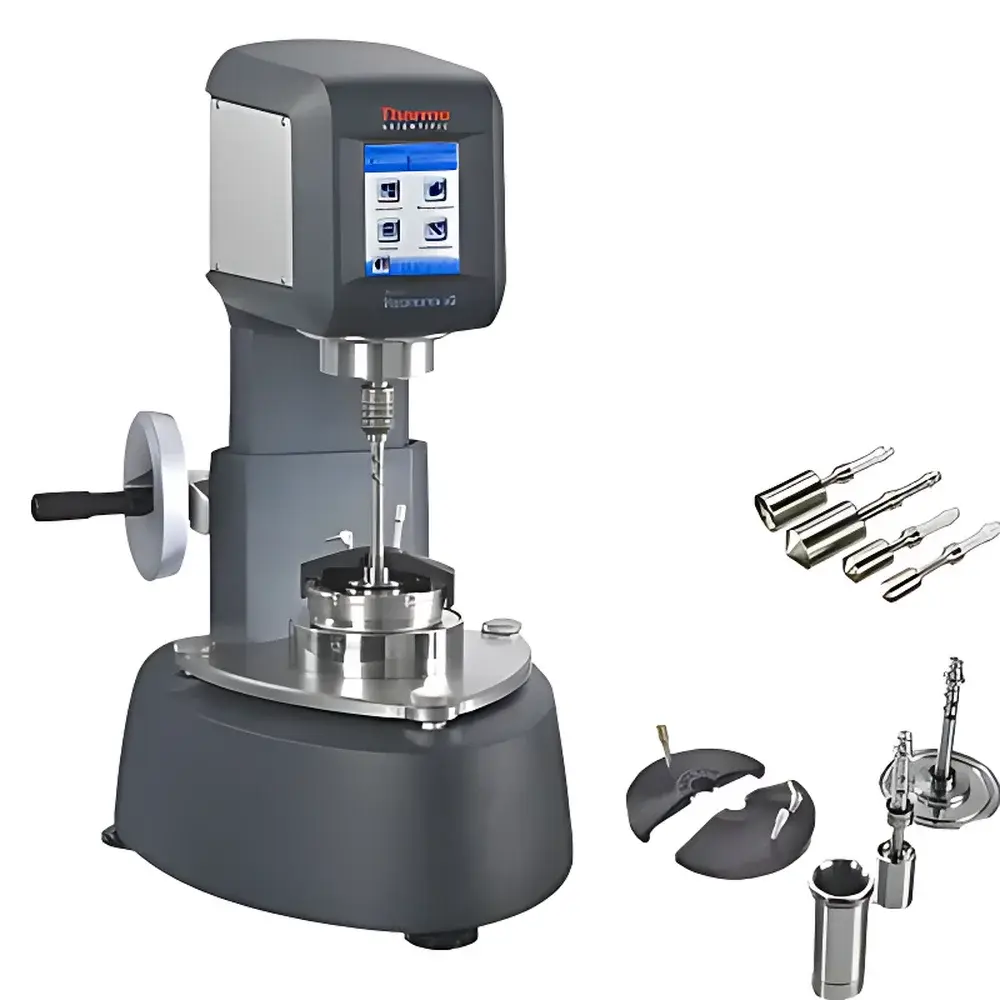
Thermo Fisher Scientific HAAKE Viscotester iQ Portable Rotational Rheometer
| Brand | Thermo Fisher Scientific |
|---|---|
| Origin | USA |
| Manufacturer Type | Authorized Distributor |
| Origin Category | Imported |
| Model | Viscotester iQ |
| Instrument Type | Rotational Rheometer |
| Bearing Type | Mechanical Bearing |
| Minimum Angular Velocity | 0.001 rad/s |
| Frequency Range | 0.1 Hz – 20 Hz |
| Maximum Angular Velocity | 157 rad/s |
| Maximum Torque | 100 mNm |
| Torque Resolution | 0.01 mNm |
Overview
The Thermo Fisher Scientific HAAKE Viscotester iQ is a compact, benchtop rotational rheometer engineered for precision viscoelastic characterization under both steady-state and dynamic oscillatory conditions. Based on Couette flow geometry and controlled-stress/controlled-rate rotational principles, it delivers high reproducibility in viscosity, shear stress, shear rate, and complex modulus measurements across a broad range of materials—from low-viscosity Newtonian fluids to structured non-Newtonian suspensions and gels. Its integrated Peltier temperature control system (TM-PE-C) enables rapid thermal equilibration and accurate sample temperature monitoring during measurement, supporting compliance with ASTM D2196, ISO 3219, and USP for viscosity testing in regulated environments. Designed for laboratory portability without compromising metrological integrity, the Viscotester iQ operates as a standalone instrument via its built-in touchscreen interface or integrates seamlessly into networked QA/QC workflows via TCP/IP or USB.
Key Features
- Modular hardware architecture enabling rapid interchange of measuring systems—including coaxial cylinder, cone-and-plate, and parallel-plate geometries—without recalibration.
- Integrated semiconductor-based Peltier temperature control (TM-PE-C) with real-time temperature feedback; supports temperature ranges from −5 °C to 160 °C (coaxial cylinder) and 0 °C to 140 °C (cone/plate), meeting GLP-compliant thermal stability requirements.
- Touchscreen HMI with intuitive RheoApp interface for immediate parameter setup, real-time curve visualization, and one-click report generation—no external PC required for routine viscosity screening.
- Dual operational modes: Controlled Rate (CR) for shear-thinning/thickening analysis and Controlled Stress (CS) for yield stress determination and linear viscoelastic region (LVER) identification.
- Oscillatory measurement capability (0.1–20 Hz frequency sweep) enabled via optional firmware activation—eliminates need for external air compressors or recirculating chillers typically required by conventional rheometers.
- Portable form factor (270 × 500 × 500 mm; 18 kg) with ruggedized carry case, facilitating field deployment for in-line process verification or multi-site comparative studies.
Sample Compatibility & Compliance
The Viscotester iQ accommodates diverse sample classes including aqueous and organic dispersions, polymer melts, food emulsions, pharmaceutical gels, coatings, and drilling muds. Its wide torque range (0.2–100 mNm) and angular velocity span (0.001–157 rad/s) ensure reliable measurement across apparent viscosities from 1 mPa·s to 600 kPa·s. All transducers and geometry sensors are auto-recognized upon attachment, minimizing operator error and ensuring traceable configuration logging per 21 CFR Part 11 audit trail requirements. Temperature-controlled modules comply with IEC 61000-4-3 for electromagnetic compatibility and meet ISO/IEC 17025 calibration traceability standards when used with certified reference oils (e.g., NIST SRM 2490 series).
Software & Data Management
The instrument supports three software interaction layers: (1) Embedded RheoApp for direct touchscreen operation with preconfigured test templates (e.g., ASTM D1200, ISO 2555); (2) USB-hosted RheoApp extension for advanced scripting, custom protocol development, and batch export to CSV/PDF; (3) Full-featured desktop RheoWin software (Windows-based) for G′/G″ time sweeps, frequency sweeps, creep-recovery analysis, and statistical comparison across datasets. All software modules enforce role-based access control, electronic signatures, and immutable data archiving—fully aligned with FDA 21 CFR Part 11 and EU Annex 11 validation frameworks.
Applications
- Food & Beverage: Texture profiling of sauces, dairy products, and plant-based alternatives under simulated pumping/shearing conditions.
- Pharmaceuticals: Gel strength evaluation of topical formulations, suspension stability assessment, and injectable viscosity verification per USP .
- Coatings & Inks: Shear-thinning behavior quantification for spray application optimization and film formation modeling.
- Polymer Processing: Melt flow index correlation, crosslinking kinetics monitoring, and filler dispersion quality control.
- Oilfield Chemistry: Rheological response of bentonite slurries and synthetic-based drilling fluids under downhole temperature gradients.
FAQ
Can the Viscotester iQ perform time-sweep tests for gelation kinetics?
Yes—it supports time-dependent oscillatory measurements (G′, G″, tan δ) at fixed frequency and strain amplitude, with data logging intervals configurable from 0.1 s to 3600 s.
Is third-party calibration support available?
Yes—Thermo Fisher Scientific provides accredited calibration services traceable to NIST standards, including torque, angular displacement, and temperature sensor verification.
Does the instrument require compressed air or external cooling units for oscillatory mode?
No—the integrated Peltier system and brushless DC motor eliminate dependency on auxiliary utilities, enabling true field-deployable rheology.
How is data integrity ensured during networked operation?
All TCP/IP communications use TLS 1.2 encryption; RheoWin software implements automatic checksum validation, digital watermarking of exported reports, and synchronized timestamping across distributed instruments.
What geometries are included standard with the base configuration?
The standard kit includes one coaxial cylinder set (CC27) and one cone-and-plate geometry (CP40-2), both equipped with integrated temperature sensors and automatic geometry ID recognition.



