
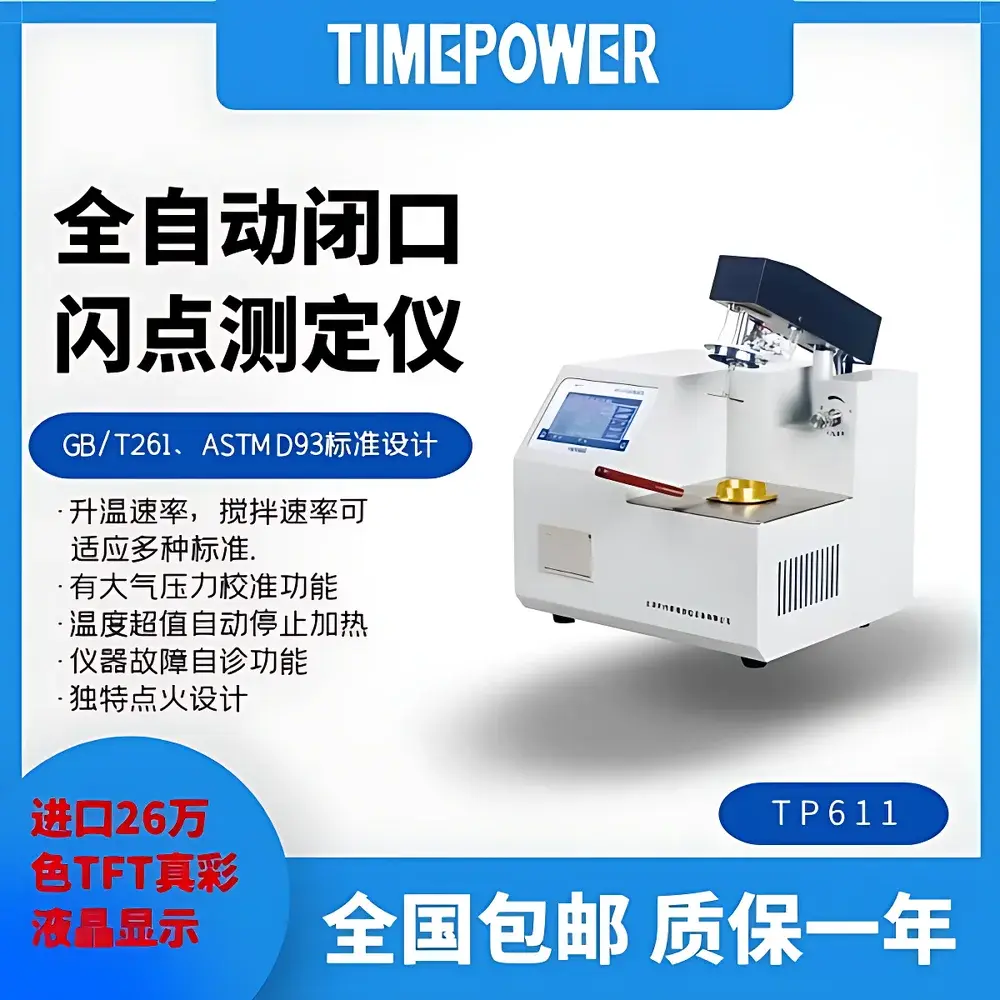
TimePower TP611 Automated Closed-Cup Flash Point Analyzer
| Brand | TimePower |
|---|---|
| Origin | Beijing, China |
| Manufacturer Type | Manufacturer |
| Country of Origin | Domestic (China) |
| Model | TP611 |
| Detection Method | Closed-Cup (Pensky-Martens) |
| Operation Mode | Fully Automatic |
| Applicable Standards | GB/T 261, ASTM D93 |
| Repeatability | ≤4 °C |
| Ignition Methods | Fully automatic electronic arc, gas flame, electric spark, pilot flame, and manual ignition modes |
| Temperature Range | −25 °C to 400 °C |
| Measurement Range | 40 °C to 370 °C |
| Accuracy | ±1 °C for flash point <110 °C |
| Resolution | 0.1 °C |
| Ambient Operating Conditions | 5–40 °C, ≤85% RH |
| Power Supply | AC 220 V ±10%, 50 Hz ±10% |
| Power Consumption | <500 W |
| Display | 260K-color TFT LCD (480×272) |
| Cooling Method | Integrated forced-air cooling |
| Printer | Thermal printer (36-character Chinese/English support) |
| Dimensions | 350 × 310 × 300 mm |
| Weight | 13.5 kg |
Overview
The TimePower TP611 Automated Closed-Cup Flash Point Analyzer is a precision-engineered instrument designed for the accurate and reproducible determination of flash point in petroleum products, lubricants, solvents, and other flammable liquids using the Pensky-Martens closed-cup method. It operates in strict compliance with internationally recognized test standards—including GB/T 261 (Chinese National Standard) and ASTM D93 (Standard Test Method for Flash Point by Pensky-Martens Closed Cup Tester)—ensuring data integrity across regulatory, quality control, and R&D environments. The analyzer employs a thermoelectrically stabilized heating system, programmable ramp-rate control, and real-time vapor concentration monitoring via integrated temperature-synchronized ignition sequencing. Its fully automated workflow eliminates operator-dependent variability in cup sealing, temperature ramping, stirring speed modulation, ignition timing, and endpoint detection—critical for GLP-compliant laboratories requiring audit-ready traceability.
Key Features
- Fully automated operation sequence: lid closure, temperature ramping, sample stirring, vapor accumulation, ignition triggering, flash detection, and result reporting—all executed without manual intervention.
- Dual-mode ignition architecture supporting electronic arc, regulated propane flame, and user-selectable pilot flame scanning—enabling method flexibility across diverse sample matrices and laboratory safety protocols.
- Integrated atmospheric pressure compensation algorithm, dynamically adjusting flash point calculation in real time based on local barometric readings (optional external sensor or manual input).
- High-resolution 260K-color TFT display (480×272 pixels) with intuitive icon-driven interface, multilingual menu navigation (English/Chinese), and on-screen real-time graphing of temperature vs. time profiles.
- Self-diagnostic firmware with fault logging, error-code display, and stepwise troubleshooting prompts—reducing instrument downtime and service dependency.
- Forced-air active cooling system enabling rapid thermal recovery between tests, improving throughput in high-volume QC labs.
- Thermal cutoff protection and overtemperature lockout ensure compliance with IEC 61010-1 safety requirements for laboratory electrical equipment.
Sample Compatibility & Compliance
The TP611 accommodates standard ASTM D93 and GB/T 261 test cups (typically 70 mL capacity) and supports viscous, volatile, and low-flash-point samples—including diesel fuels, jet fuels, base oils, biodiesel blends, cleaning solvents, and halogenated hydrocarbons. Its sealed measurement chamber minimizes vapor loss and cross-contamination during analysis. All operational parameters—including heating rate (0.5–10 °C/min), stir speed (90–120 rpm), and ignition interval (every 0.5–2 °C)—are programmable to align with specific standard annexes or internal SOPs. Data output meets ISO/IEC 17025 documentation requirements, and the instrument’s firmware architecture supports future integration with LIMS via RS232/USB virtual COM port. While not inherently 21 CFR Part 11 compliant out-of-the-box, its audit trail capabilities (timestamped event logs, user ID tagging, and immutable result storage) provide foundational infrastructure for GMP/GLP validation.
Software & Data Management
The TP611 stores up to 1,000 test records internally, each containing full metadata: sample ID, operator ID, date/time stamp, ambient pressure, measured flash point, pass/fail status against specification limits, and raw temperature-ignition event logs. Results export via USB to CSV or PDF formats—with embedded Chinese/English bilingual reporting templates. Optional PC-based TimePower LabLink software enables remote instrument control, batch report generation, statistical process control (SPC) charting (X̄-R, Cp/Cpk), and deviation alerting based on configurable tolerance bands. All data fields are write-protected post-analysis to prevent tampering—a prerequisite for regulatory submissions under CNAS or API Q1 frameworks.
Applications
- Refinery QC: Routine flash point verification of crude distillates, naphthas, kerosenes, and fuel oils prior to shipment.
- Lubricant manufacturing: Stability assessment of base stocks and formulated greases under thermal stress conditions.
- Chemical distribution: Certificate-of-analysis generation for solvent shipments subject to UN TDG Class 3 hazard classification.
- Aviation fuel testing: Compliance verification per ASTM D1655 Annex A1 for Jet A/A-1 certification.
- Academic research: Kinetic modeling of vapor-phase ignition thresholds in alternative fuel formulations.
- Third-party testing labs: Accredited flash point determinations supporting ISO 8217, EN 590, and GB 17930 regulatory filings.
FAQ
What standards does the TP611 officially support?
It is validated for GB/T 261 and ASTM D93. Optional firmware updates may extend compatibility to ISO 2719 and IP 34, subject to local metrological verification.
Can the TP611 be used for open-cup flash point testing?
No—it is engineered exclusively for closed-cup methodology. Open-cup applications require dedicated Cleveland Open Cup (COC) instruments per ASTM D92.
Is external pressure sensor integration mandatory?
Not mandatory, but strongly recommended for laboratories operating at altitudes >500 m above sea level to maintain measurement accuracy per ASTM D93 Annex A1.
How is calibration verified?
Users perform periodic verification using certified reference materials (e.g., n-decane, xylene, or cyclohexane) traceable to NIST or BAM standards; no field calibration is required due to factory-trimmed RTD and PID controller tuning.
Does the instrument support network connectivity?
Native Ethernet or Wi-Fi is not included, but RS232-to-Ethernet converters enable seamless integration into existing lab networks for centralized data aggregation.




