
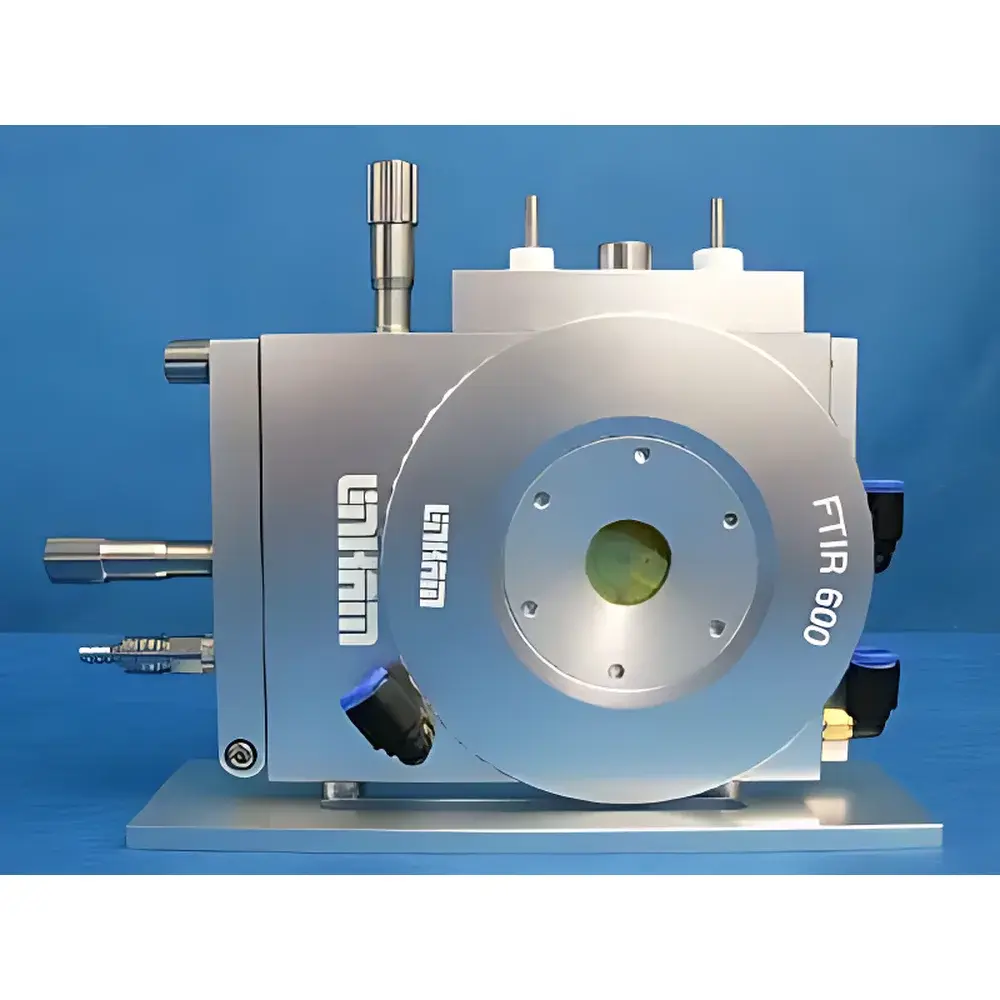
Linkam FTIR600 Infrared Heating and Cooling Stage
| Brand | Linkam |
|---|---|
| Origin | United Kingdom |
| Model | FTIR600 |
| Temperature Range | −196 °C to 600 °C |
| Temperature Stability | < 0.1 °C |
| Temperature Accuracy | ±0.1 °C |
| Optical Aperture Diameter | 2.4 mm |
| Sample X–Y Translation Range | 16 mm |
| Heating Area | 22 mm² |
| Heating/Cooling Rate | 0.1–150 °C/min |
| Window Thickness (CaF₂) | 0.17 mm |
| Condenser Angle | 85° |
| Objective Angle | 116° |
| Minimum Working Distance (Objective/Condenser) | 4.5 mm / 12.5 mm |
| Chamber | Sealed, Gas-Purged Compatible |
| Dimensions (L×W×H) | 137 × 92 × 22 mm |
Overview
The Linkam FTIR600 is a high-precision, cryogenic-to-high-temperature infrared (IR) stage engineered for in situ spectroscopic analysis under controlled thermal conditions. Designed as an evolution of Linkam’s benchmark geological heating–cooling stages, the FTIR600 integrates rigorous thermal metrology with optical optimization for Fourier-transform infrared (FTIR) microscopy and benchtop spectrometry. Its core functionality relies on resistive heating and liquid nitrogen cooling within a hermetically sealed chamber, enabling uninterrupted IR transmission across the mid-IR spectral range (typically 4000–400 cm⁻¹). The stage operates on the principle of dynamic thermal control—maintaining setpoint stability via PID-regulated feedback from calibrated platinum resistance thermometers (PRTs)—while preserving optical throughput through minimized window absorption and optimized beam geometry. This architecture supports real-time observation of phase transitions, crystallization kinetics, polymer degradation, hydrate formation, and pharmaceutical solid-state transformations—all while retaining full compatibility with commercial FTIR microscopes and cabinet-style spectrometers.
Key Features
- Wide operational temperature range from −196 °C (liquid nitrogen cooling) to +600 °C, with ramp rates programmable from 0.1 to 150 °C/min for kinetic studies.
- Thermal accuracy of ±0.1 °C and stability better than 0.1 °C over extended dwell periods—critical for reproducible quantitative spectral acquisition.
- Optimized optical path: 2.4 mm central aperture with 0.17 mm-thick calcium fluoride (CaF₂) windows, selected for broad IR transmission and minimal phonon absorption.
- Angular alignment engineered for IR optics: 85° condenser angle and 116° objective angle ensure maximum light collection efficiency without vignetting or stray reflection.
- Compact footprint (137 × 92 × 22 mm) and low-profile design facilitate integration into confined optical paths—including vertical mounting in FTIR cabinets and horizontal coupling to inverted or upright microscopes.
- Gas-tight sample chamber with dual gas inlets enables inert (N₂, Ar) or reactive (CO₂, H₂O vapor) atmosphere control—essential for oxidation-sensitive materials or humidity-dependent phase studies.
- Motorized X–Y translation (16 mm range) allows precise spatial mapping of heterogeneous samples without stage repositioning or microscope recalibration.
Sample Compatibility & Compliance
The FTIR600 accommodates standard 16–22 mm diameter sample discs, thin films, powder pellets (KBr or polyethylene), single crystals, and microtomed sections. Its 22 mm² heating zone ensures uniform thermal distribution across typical IR sampling areas. The stage complies with ISO/IEC 17025 requirements for thermal calibration traceability when used with accredited PRT probes. While not certified per se, its architecture supports GLP/GMP workflows through audit-ready temperature logging (via optional TMS94 software), electronic signature capability, and full traceability of thermal profiles—aligning with FDA 21 CFR Part 11 expectations for regulated environments. It is routinely deployed in laboratories adhering to ASTM E1970 (standard practice for temperature calibration of thermal analyzers) and USP (infrared spectroscopy).
Software & Data Management
Control and data acquisition are managed through Linkam’s TMS94 platform, a Windows-based application supporting synchronized temperature ramping, dwell scheduling, and real-time spectral triggering via TTL or analog I/O. The software records timestamped temperature, rate, and status metadata alongside external spectrometer data streams (e.g., OPUS, OMNIC, or Spectragryph exports), ensuring full experimental provenance. All logs are stored in open CSV/ASCII format for third-party analysis; optional encryption and user-access controls meet institutional IT security policies. Audit trails include operator ID, parameter changes, and system error flags—facilitating compliance reviews without proprietary lock-in.
Applications
- Polymorph screening and thermal stability assessment of active pharmaceutical ingredients (APIs) under variable humidity and temperature gradients.
- In situ monitoring of polymer melting, recrystallization, and crosslinking reactions using time-resolved FTIR.
- Mineralogical phase transitions in geochemical samples, including clay dehydration and carbonate decomposition pathways.
- Hydrate formation/dissociation kinetics in energy-related materials (e.g., clathrates, MOFs) under controlled p–T conditions.
- Thin-film degradation mechanisms in organic photovoltaics and OLED architectures during accelerated thermal aging.
- Protein secondary structure changes (amide I/II bands) during thermal denaturation in buffered aqueous environments.
FAQ
Can the FTIR600 be used with synchrotron IR beamlines?
Yes—the compact form factor, low-emission CaF₂ windows, and absence of ferromagnetic components make it compatible with most synchrotron IR endstations requiring minimal background contribution.
Is vacuum operation supported?
No—the FTIR600 is designed for gas-purged or ambient-pressure operation only; vacuum compatibility requires the separate Linkam TS1500V model.
What is the maximum recommended sample thickness?
For optimal thermal response and IR transmission, samples should not exceed 500 µm in thickness when using standard 0.17 mm CaF₂ windows; thicker samples require custom window configurations.
Does the stage support automated spectral acquisition triggers?
Yes—TMS94 provides configurable digital output signals (TTL) synchronized to temperature events (e.g., start-of-ramp, dwell initiation), enabling hardware-triggered spectral acquisition on supported spectrometers.
How is temperature calibration verified?
Calibration is performed using NIST-traceable PRTs at three points (−100 °C, 25 °C, 400 °C); certificates of calibration are available upon request and conform to ISO/IEC 17025 standards when executed by Linkam-accredited service centers.




