
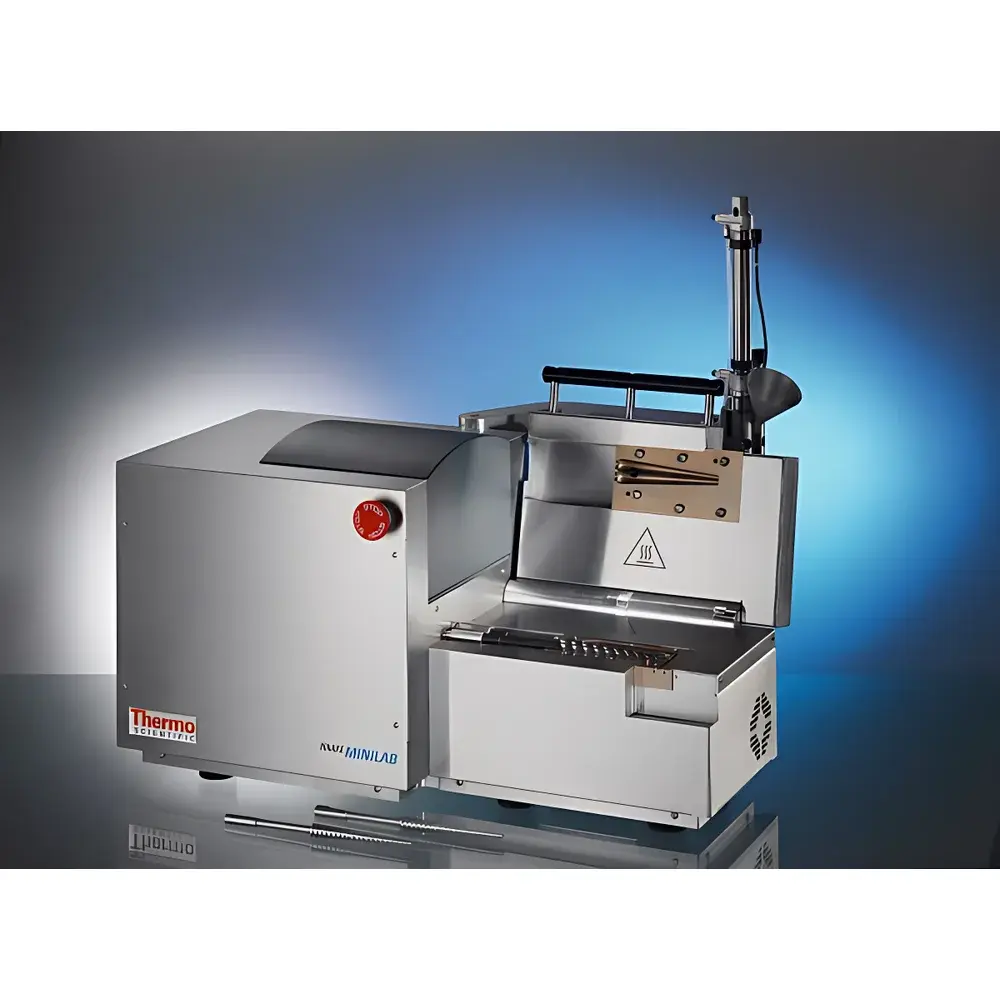
Thermo Fisher HAAKE MiniLab II Micro Compounder and Capillary Rheometer
| Brand | Thermo Fisher |
|---|---|
| Origin | Germany |
| Model | HAAKE MiniLab II |
| Instrument Type | Torque Rheometer |
| Screw Configuration | Co-rotating and Counter-rotating Conical Twin-Screw |
| Minimum Speed | 1 rpm |
| Maximum Speed | 360 rpm |
| Frequency Range | 0.1–37.7 rad/s |
| Maximum Torque | 300 N·m |
| Torque Resolution | 0.1 N·m |
| Motor Power | 400 W |
| Barrel Volume | 7 cm³ (≈5 g PE) |
| Max Temperature | 350 °C (optional 420 °C) |
| Max Pressure | 200 bar |
| Barrel Material | Stainless Steel (HRC55) |
| Screw Material | Stainless Steel 1.4122 |
| Cooling Method | Air/Water (350 °C version), Air-only (420 °C version) |
| Integrated Bypass Valve | Automated |
Overview
The Thermo Fisher HAAKE MiniLab II is a benchtop micro compounder and capillary rheometer engineered for integrated polymer processing and real-time rheological characterization under controlled thermal and mechanical conditions. Unlike conventional torque rheometers, the MiniLab II employs a conical twin-screw architecture—capable of both co-rotating and counter-rotating motion—to generate precise shear histories within a 7 cm³ barrel volume. Its operational principle combines melt mixing, residence time control via an integrated recirculation loop, and simultaneous torque-based viscoelastic measurement. The system operates on the Couette flow principle in rotational mode and transitions seamlessly to capillary extrusion for extensional or pressure-driven rheology. Designed for material-limited research, it enables reproducible experiments with as little as 3–5 g of sample—critical for nanocomposites, biopolymers, pharmaceutical polymers, and specialty elastomers where raw material cost or scarcity precludes large-batch testing.
Key Features
- Conical twin-screw geometry with selectable co-rotating or counter-rotating operation for tailored shear intensity and distributive/dispersive mixing balance
- Integrated recirculation loop and automated bypass valve enabling precise control of residence time distribution (RTD) and seamless transition from mixing to extrusion
- Horizontal barrel opening mechanism allowing full visual access during operation, real-time observation of melt homogeneity, and in-process addition of liquid additives or inert gas (e.g., N₂) purging
- High-torque drive system (300 N·m max, 0.1 N·m resolution) coupled with 400 W motor and speed range of 1–360 rpm (0.1–37.7 rad/s angular frequency)
- Temperature-controlled barrel system with maximum operating temperature of 350 °C (optionally up to 420 °C), supported by dual-mode cooling (air/water or air-only depending on configuration)
- Stainless steel (grade 1.4122) screws and HRC55-hardened stainless steel barrel for corrosion resistance and dimensional stability under high-pressure (up to 200 bar) melt processing
- Dedicated sensor interfaces for integration of pressure transducers, melt temperature probes, and inline spectroscopic or dielectric sensors for reaction monitoring
Sample Compatibility & Compliance
The HAAKE MiniLab II supports thermoplastic polymers (e.g., PP, PE, PS, PC, PA), thermoplastic elastomers, filled systems (glass/carbon fiber, nanoclays), reactive monomers (for in situ polymerization), and heat-sensitive biopolymers (PLA, PHA). Its compact geometry minimizes thermal lag and degradation risk during short-duration experiments. The system complies with ISO 11443 (determination of melt mass-flow rate), ASTM D3835 (standard test method for determination of melt viscosity), and supports GLP/GMP-aligned workflows through audit-trail-capable software logging. Optional configurations meet requirements for USP analytical instrument qualification and FDA 21 CFR Part 11 compliance when paired with validated Thermo Fisher RheoWin software.
Software & Data Management
RheoWin software provides synchronized acquisition of torque, temperature, pressure, screw speed, and motor current with timestamped metadata. Real-time plotting includes viscosity vs. shear rate, storage/loss modulus vs. frequency, and power consumption profiles. Experimental protocols—including multi-step temperature ramps, speed gradients, and valve-triggered extrusion sequences—are programmable and repeatable. Data export conforms to ASTM E1447 and ISO/IEC 17025 reporting standards. Raw data files are stored in vendor-neutral HDF5 format, ensuring long-term readability and compatibility with third-party analysis tools (e.g., Python-based rheological modeling libraries).
Applications
- Formulation screening of polymer blends and nanocomposites using sub-gram quantities
- Reaction injection molding (RIM) and reactive extrusion kinetics studies (e.g., polyurethane curing, transesterification)
- Thermal stability assessment via programmed heating under shear (melt degradation onset detection)
- Processing window mapping for new biopolymer grades under industrially relevant shear rates
- Development of medical-grade polymer compounds requiring strict lot-to-lot consistency validation
- In-line rheological fingerprinting of melt state prior to filament extrusion for additive manufacturing feedstock qualification
- Correlation of laboratory-scale torque profiles with industrial twin-screw extruder output using dimensionless scaling (e.g., specific mechanical energy, SME)
FAQ
Can the HAAKE MiniLab II perform both mixing and capillary rheometry in a single run?
Yes—the integrated bypass valve enables automatic switching between closed-loop recirculation (for mixing and rheological measurement) and open extrusion (for capillary flow analysis), all under continuous data acquisition.
Is the barrel temperature uniform across its length?
The barrel features independently controlled heating zones with PID regulation and embedded Pt100 sensors; axial temperature deviation is ≤±1.5 °C at steady state.
What sample volume is required for a valid rheological measurement?
A minimum of 3 g ensures adequate melt fill in the 7 cm³ barrel while maintaining representative shear field geometry; results below this threshold may exhibit wall-slip artifacts.
Can I monitor chemical reactions in real time during extrusion?
Yes—via optional ports for FTIR, Raman, or dielectric spectroscopy probes, enabling in situ tracking of functional group evolution, crosslink density, or crystallinity development.
Does the system support GMP-compliant documentation?
When configured with RheoWin IQ/OQ/PQ packages and electronic signature modules, it meets FDA 21 CFR Part 11 requirements for regulated environments.
Related Products



