
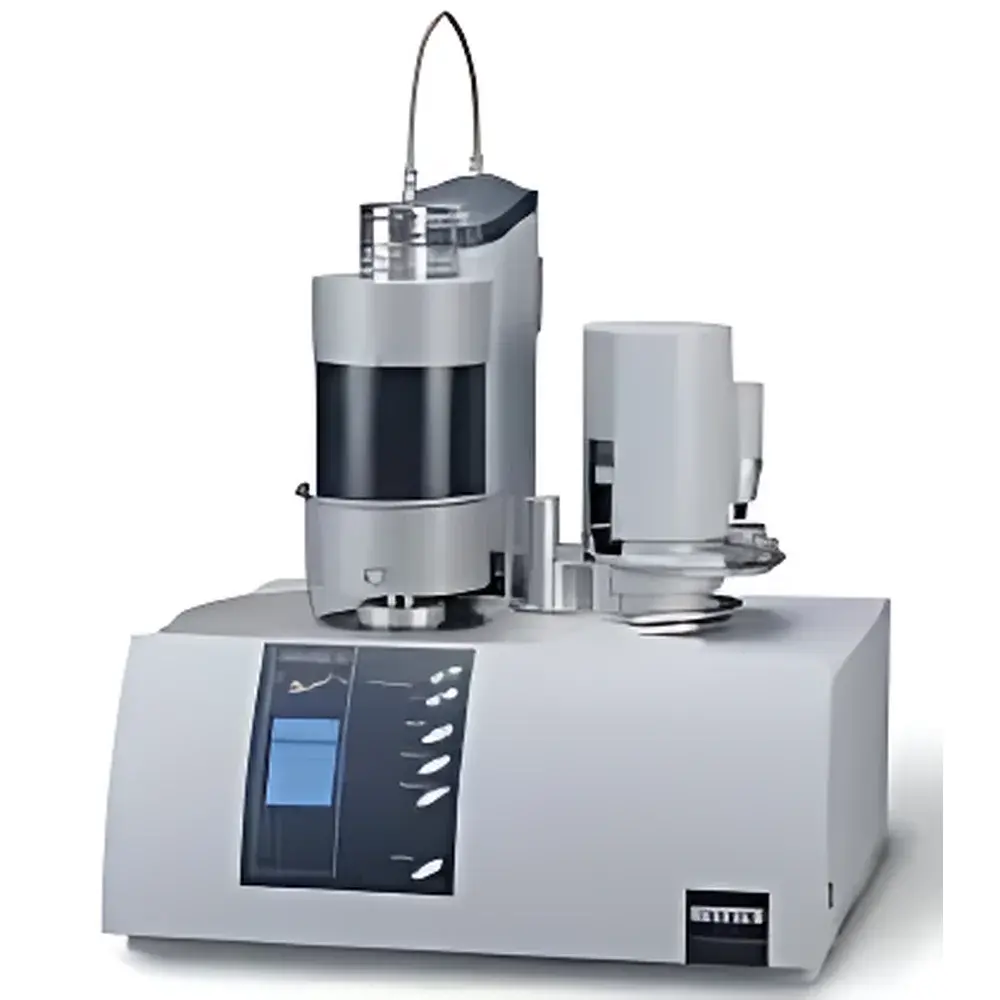
Netzsch DSC 404 F1 Pegasus® High-Temperature Differential Scanning Calorimeter
| Brand | Netzsch |
|---|---|
| Origin | Germany |
| Model | DSC 404 F1 |
| Temperature Range | −150 °C to 1000 °C (extendable to 2000 °C with optional furnaces) |
| Heating/Cooling Rate | 0.001–50 K/min (up to 20 K/min for Rh furnace) |
| Vacuum Capability | Down to 10⁻⁴ mbar |
| Sensor Types | DSC (Cp-optimized up to 1600 °C), DTA (up to 2000 °C with W/Re thermocouples) |
| Compliance | ASTM E793, E1269, ISO 11357, USP <1158>, GLP/GMP-ready with audit trail (Proteus® software) |
Overview
The Netzsch DSC 404 F1 Pegasus® is a high-precision, modular heat-flux differential scanning calorimeter engineered for rigorous thermal analysis across extreme temperature ranges—from cryogenic conditions at −150 °C up to 2000 °C under controlled vacuum or inert atmospheres. Based on the proven F1 platform, it employs dual-sensor architecture and a thermally symmetric, vacuum-sealed furnace chamber to deliver exceptional baseline stability, low time constant response, and high signal-to-noise ratio. Its core measurement principle relies on quantifying differential heat flow between sample and reference crucibles as a function of temperature or time—enabling accurate determination of enthalpy changes (ΔH), specific heat capacity (Cp), phase transition temperatures (e.g., melting, crystallization, glass transition), and kinetic parameters. The instrument’s design prioritizes metrological integrity at operational extremes: even at 1500 °C, Cp measurement uncertainty remains ≤2.5%—a benchmark validated per ISO 11357-4 and ASTM E1269. Its fully sealed stainless-steel gas delivery system—including metal-housed mass flow controllers (MFCs)—ensures oxygen-sensitive samples (e.g., amorphous metals, reactive ceramics, shape-memory alloys) remain uncompromised during analysis.
Key Features
- Modular furnace system: Interchangeable low-temperature (−150 °C to 1000 °C), Pt-based (RT–1500 °C), SiC (RT–1550 °C), Rh (RT–1650 °C), and graphite/W–Re (up to 2000 °C DTA) options
- Cp-optimized DSC sensor calibrated for high-accuracy specific heat measurements up to 1600 °C
- Ultra-high vacuum compatibility (≤10⁻⁴ mbar) with leak-tight ceramic–metal seals and integrated turbomolecular pumping options
- Thermally balanced, radially symmetric furnace geometry ensuring uniform heat flux distribution to the sensor—critical for reproducible onset detection and peak resolution
- Low thermal inertia sensors with type E (low-T), K (Pt-furnace), S (SiC/Rh), and B (Rh/W–Re) thermocouples matched to respective operating ranges
- Optional 20-position automated sample changer (ASC) with programmable cooling/heating sequences and full traceability
- Robust mechanical design compliant with CE, UL, and EMC directives; suitable for Class 1000 cleanroom integration
Sample Compatibility & Compliance
The DSC 404 F1 accommodates diverse sample forms—including powders, bulk metals, thin films, fibers, and encapsulated organics—using crucibles fabricated from Al2O3, Pt, Ir, graphite, or sapphire. Its vacuum-tight construction and inert gas purging capability (N2, Ar, He) prevent oxidation and volatilization artifacts in air-sensitive materials such as Zr-based bulk metallic glasses, NiTi shape-memory alloys, and SiC/Si3N4 composites. Regulatory alignment includes full support for GLP and GMP workflows: Proteus® software provides 21 CFR Part 11-compliant electronic signatures, user-level access control, and immutable audit trails for all method parameters, raw data, and post-processing steps. Calibration protocols adhere to ASTM E793 (enthalpy), E1269 (Cp), ISO 11357-2/-4 (transition temperature and heat capacity), and USP for pharmaceutical thermal stability assessment.
Software & Data Management
Controlled by the Windows-native Proteus® software suite, the DSC 404 F1 supports both online acquisition and offline analysis. Core functionalities include automated peak detection (onset, peak, inflection, endset), multi-baseline selection (tangent, linear, spline), partial integration, Tg analysis with step-height correction, crystallinity quantification via enthalpy ratio, and OIT (oxidation induction time) evaluation per ASTM D3895. Optional modules extend capabilities: BeFlat® for dynamic baseline optimization, TM-DSC for reversing/non-reversing heat flow separation, kinetics modeling (ASTM E698, Ozawa–Flynn–Wall), purity assessment (van’t Hoff), and peak deconvolution. All data files are stored in vendor-neutral ASCII format with embedded metadata (instrument ID, operator, timestamp, calibration history), enabling seamless import into LIMS or statistical analysis platforms (e.g., JMP, Python/Pandas).
Applications
- High-temperature Cp characterization of refractory ceramics (Al2O3, ZrO2, SiC) and superalloys (Inconel®, Hastelloy®)
- Phase diagram validation for intermetallic systems and high-entropy alloys
- Thermal stability and decomposition kinetics of battery cathode materials (NMC, LFP) under argon
- Glass transition and relaxation behavior in oxide and chalcogenide glasses
- Oxidation resistance screening of TiAl-based alloys using isothermal OIT protocols
- Crystallization kinetics of amorphous ribbons (Fe-, Co-, Zr-based) via non-isothermal DSC
- Thermo-oxidative aging studies of carbon–carbon composites in aerospace applications
FAQ
What is the maximum temperature for high-accuracy specific heat (Cp) measurement?
Cp accuracy ≤2.5% is guaranteed up to 1600 °C using the dedicated Cp-optimized DSC sensor.
Can the instrument operate under high vacuum without compromising sensor stability?
Yes—the vacuum chamber is hermetically sealed with metal–ceramic feedthroughs; base pressure of 10⁻⁴ mbar is maintained without drift in baseline or sensitivity.
Is automatic calibration supported for temperature and enthalpy?
Proteus® includes certified calibration routines using high-purity standards (In, Sn, Zn, Ag, Au) per ASTM E794 and E1269, with full traceability to NIST.
How does the furnace design minimize thermal lag during rapid heating?
The radially symmetric, low-mass furnace combined with optimized sensor geometry reduces effective time constant to <1.2 s—enabling reliable data capture at 50 K/min.
Are software updates and regulatory documentation provided for audit readiness?
Netzsch supplies validated software release packages, IQ/OQ/PQ protocols, and 21 CFR Part 11 implementation guides upon request.



