
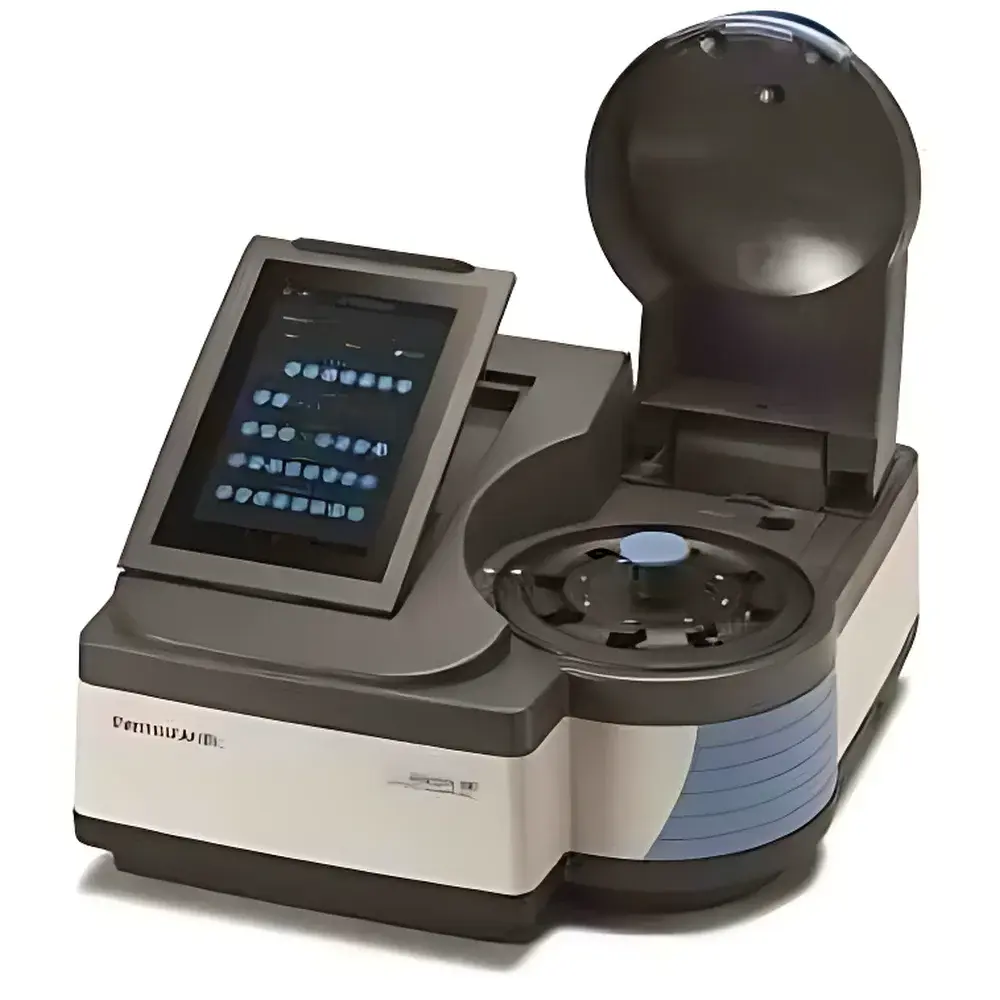
Thermo Fisher GENESYS 140 Visible Spectrophotometer
| Brand | Thermo Fisher |
|---|---|
| Origin | USA |
| Distributor Type | Authorized Distributor |
| Product Origin | Imported |
| Model | GENESYS 140 Visible Spectrophotometer |
| Optical Design | Pseudo-Double-Beam |
| Detector Type | Photodiode Array (PDA) |
| Wavelength Range | 325–1100 nm |
| Wavelength Accuracy | ±0.5 nm |
| Spectral Bandwidth | 5 nm |
| Stray Light | <0.05% T at 340 nm and 400 nm |
| Automation Level | Automatic Wavelength Scanning |
| Connectivity | Integrated Wi-Fi, USB, Ethernet |
Overview
The Thermo Fisher GENESYS 140 Visible Spectrophotometer is a high-performance, pseudo-double-beam instrument engineered for routine quantitative analysis in visible spectral regions. Operating on the principle of absorbance measurement via Beer–Lambert law compliance, it delivers robust photometric stability and high reproducibility across daily QC/QA workflows in pharmaceutical, food & beverage, environmental, and academic laboratories. Its optical architecture employs a fixed grating monochromator coupled with a photodiode array detector, enabling rapid full-spectrum acquisition without mechanical scanning—thus minimizing drift and enhancing measurement repeatability. Designed for regulatory readiness, the system supports traceable calibration protocols and integrates seamlessly into GLP- and GMP-aligned environments through audit-ready data handling and method validation capabilities.
Key Features
- 7-inch high-resolution, tilt-adjustable touchscreen interface—optimized for glare-free operation under varied lighting conditions and enabling intuitive local control without external PC dependency.
- Pseudo-double-beam optical design—compensates for source intensity fluctuations and detector drift in real time, improving baseline stability and long-term measurement fidelity.
- Front-access large sample compartment—accommodates standard 10 mm cuvettes, multi-cell holders, and optional accessories such as temperature-controlled Peltier cells or fiber-optic probes.
- Native Wi-Fi, USB 2.0, and Ethernet connectivity—enables secure wireless transfer of methods, spectra, and reports to networked storage or printers; supports remote firmware updates and configuration synchronization.
- Full compatibility with Thermo Fisher’s ecosystem of accessories—including automated sample changers (e.g., GENESYS AutoSampler), Peltier temperature controllers (±0.1 °C stability), intelligent liquid handlers, and UV/VIS fiber-optic probes for remote or in-process measurements.
Sample Compatibility & Compliance
The GENESYS 140 accepts standard rectangular quartz or glass cuvettes (10 mm pathlength), semi-micro and micro-volume cells (down to 50 µL), and disposable plastic cuvettes for high-throughput screening. It meets critical performance criteria outlined in ASTM E275, ISO 6223, and USP for spectrophotometric instrumentation validation. Stray light performance (<0.05% T at 340 nm and 400 nm) ensures accurate quantitation of low-transmittance samples—particularly relevant for colored dyes, biological chromophores, and turbid suspensions. Wavelength accuracy (±0.5 nm) and spectral bandwidth (5 nm) comply with pharmacopeial requirements for assay validation and dissolution testing.
Software & Data Management
Local operation is fully managed via the embedded touchscreen OS, supporting method creation, calibration curve generation (linear, quadratic, or cubic), kinetic and multi-wavelength scans, and direct report printing. For advanced analytical workflows, optional VISIONlite software (Windows®-based) provides expanded functionality—including spectral deconvolution, derivative spectroscopy, custom macro scripting, and full 21 CFR Part 11 compliance with electronic signatures, role-based access control, and immutable audit trails. All data files are saved in vendor-neutral CSV or XML formats, ensuring interoperability with LIMS and ELN platforms. Method and result archives support timestamped versioning and export encryption per organizational IT security policies.
Applications
- Pharmaceutical QA/QC: Active pharmaceutical ingredient (API) concentration verification, excipient purity screening, and cleaning validation swab extract analysis.
- Food & Beverage: Colorimetric determination of additives (e.g., tartrazine, carotenoids), total phenolic content (Folin–Ciocalteu), and enzymatic reaction kinetics (e.g., glucose oxidase assays).
- Environmental Testing: Nitrate/nitrite quantification via diazotization, phosphate detection using molybdenum blue, and heavy metal complexometry (e.g., Fe²⁺/1,10-phenanthroline).
- Academic Research: Teaching labs for fundamental spectroscopy principles, enzyme kinetics, equilibrium constant determination, and polymer degradation monitoring.
FAQ
What is the difference between pseudo-double-beam and true double-beam optics?
Unlike true double-beam systems that split light continuously between sample and reference paths, the GENESYS 140 uses a single-beam architecture with rapid alternating measurement of reference and sample—achieving comparable drift correction while simplifying optical alignment and reducing maintenance complexity.
Can the GENESYS 140 perform kinetic measurements?
Yes—it supports time-resolved absorbance monitoring at user-defined intervals (100 ms to 60 s per point) over durations up to 24 hours, with automatic slope calculation and endpoint detection.
Is the instrument compliant with FDA 21 CFR Part 11?
When operated with VISIONlite software and configured with appropriate administrative controls (e.g., password policies, electronic signatures, audit trail activation), the system meets core Part 11 requirements for electronic records and signatures.
Does it support wavelength scanning in absorbance, transmittance, and %T modes?
Yes—all three photometric modes are available during full-spectrum scans (325–1100 nm), with real-time switching and overlay capability for comparative analysis.
What calibration standards are recommended for routine verification?
NIST-traceable holmium oxide and didymium filters are recommended for wavelength accuracy verification; potassium dichromate solutions (in 0.005 M H₂SO₄) are used for photometric linearity and absorbance accuracy checks per USP .
Related Products






