
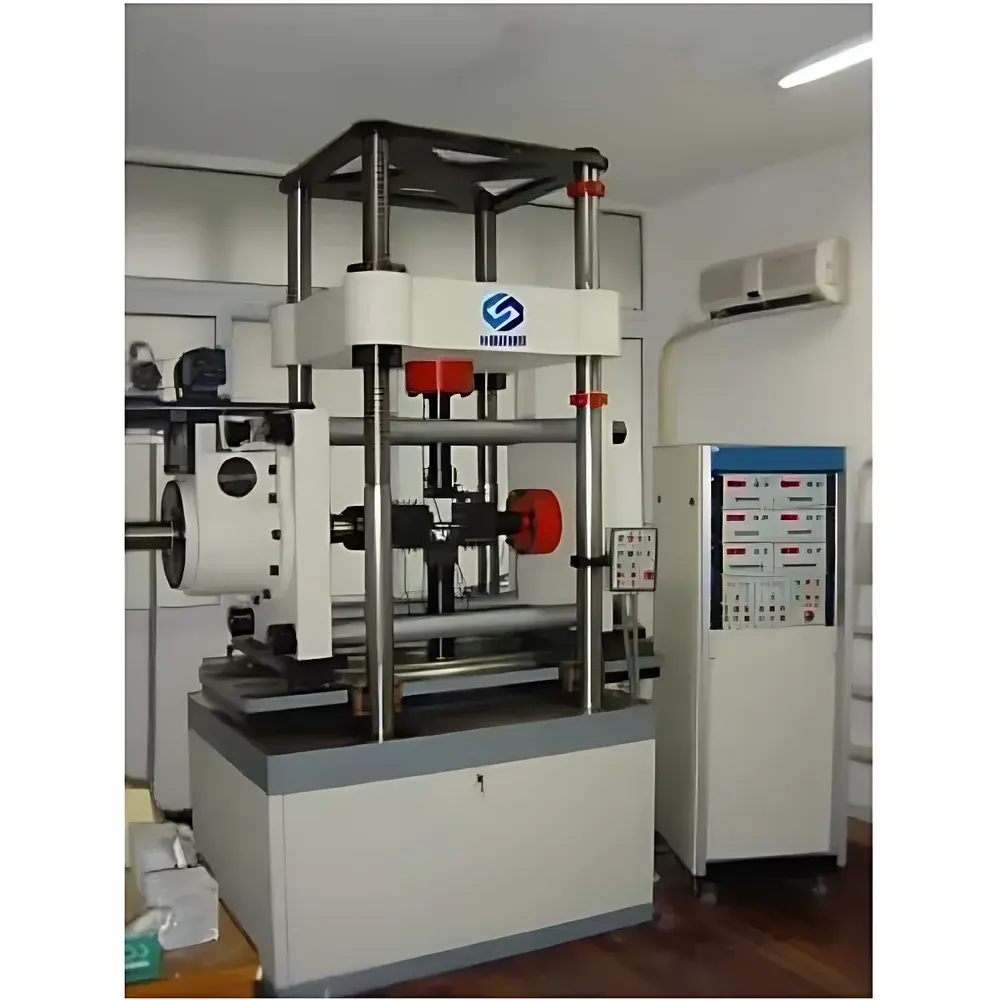
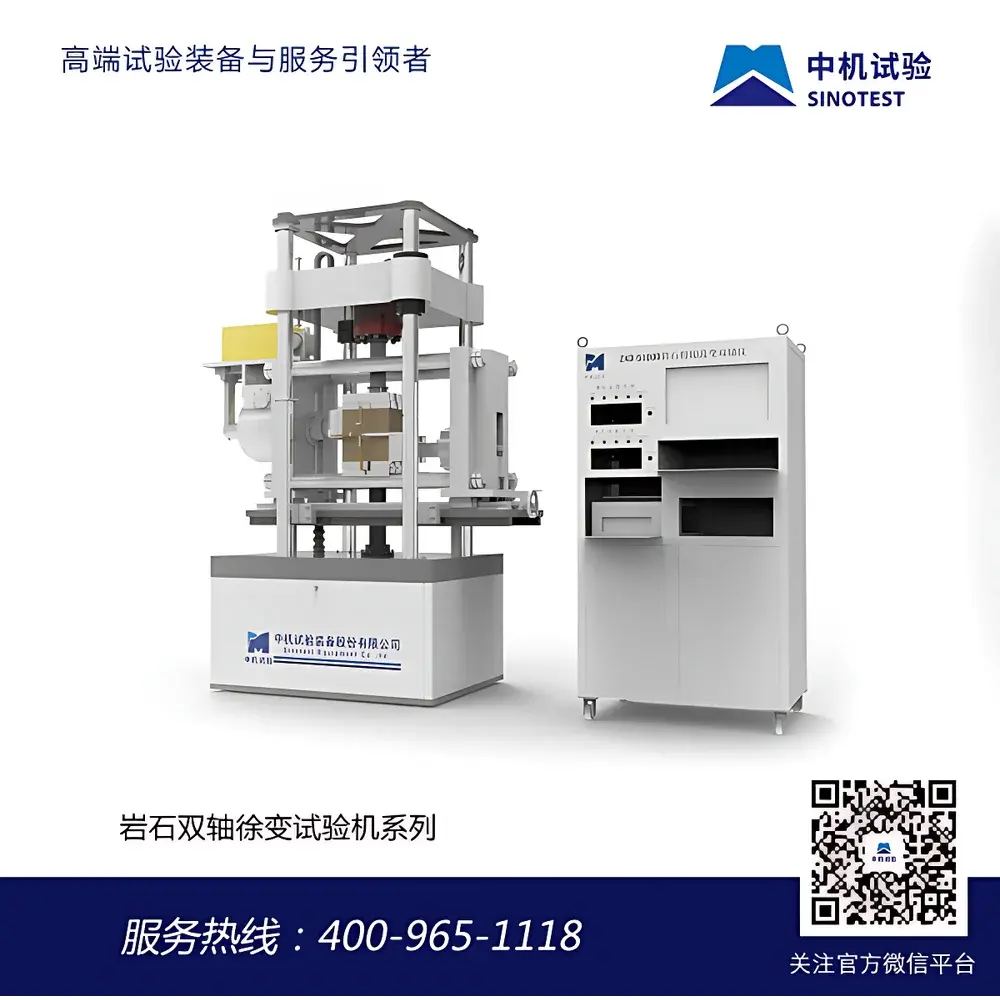
SINOTEST ZXB-S500200/300 Biaxial Creep Testing Machine for Concrete and Rock
| Brand | SINOTEST |
|---|---|
| Origin | Jilin, China |
| Manufacturer Type | Direct Manufacturer |
| Model | ZXB-S500200/300 |
| Vertical Load Capacity | 500 kN (compression) / 200 kN (tension) |
| Horizontal Load Capacity | 300 kN (compression) |
| Load Measurement Accuracy | ±0.5% of reading |
| Deformation Measurement Range | 0–5 mm |
| Deformation Accuracy | ±0.5% of reading |
| Loading Rate | 2–200 kN/min or 0.001–10 mm/min |
| Control Precision | ±0.5% |
| Specimen Dimensions (Compression) | 100×100×100 mm or 200×200×400 mm |
| Specimen Gauge Length | Adjustable from 60 mm to 100 mm |
| Specimen Dimensions (Tension) | Central cross-section 150×200 mm |
| Actuation System | Ball-screw + AC servo motor + gearbox |
| Force Transduction | High-precision load cells (500 kN vertical tensile/compressive, 300 kN horizontal compressive) |
| Deformation Sensing | LVDT-based dual-axis displacement measurement on both sides of specimen |
| Horizontal Floating Frame | Mechanically decoupled sliding carriage with rolling-contact loading platens |
| Software | Proprietary Windows-based control & data acquisition platform compliant with GLP audit trail requirements |
Overview
The SINOTEST ZXB-S500200/300 Biaxial Creep Testing Machine is an engineered test system designed for long-term mechanical characterization of quasi-brittle geomaterials—specifically concrete and rock—under sustained multiaxial stress states. It implements true biaxial loading architecture, enabling independent and simultaneous application of axial (vertical) and lateral (horizontal) loads in controlled combinations: axial compression + lateral compression, axial tension + lateral compression, or uniaxial loading modes. The system operates on the principle of force-controlled and displacement-controlled creep testing, where either load or deformation is held constant over time while high-resolution measurements capture time-dependent strain evolution under defined boundary conditions. This capability supports fundamental research into time-dependent deformation mechanisms—including microcrack propagation, interfacial slip, and viscoelastic-viscoplastic coupling—in cementitious and lithic materials under realistic geotechnical or structural loading scenarios.
Key Features
- True biaxial actuation architecture with independent vertical and horizontal loading trains, each driven by precision ball-screw mechanisms coupled to AC servo motors and planetary gearboxes—ensuring low power consumption, thermal stability, and minimal long-term drift during multi-month tests.
- Dual-load-cell configuration: a 500 kN bi-directional (tension/compression) sensor for vertical axis and a 300 kN compression-only sensor for horizontal axis, both calibrated to ±0.5% full-scale accuracy per ISO 376 and traceable to national metrological standards.
- LVDT-based biaxial deformation measurement: four differential transformers—two mounted vertically and two horizontally—measure strain across adjustable gauge lengths (60–100 mm), capturing symmetric deformation profiles on both specimen faces to eliminate bending artifacts.
- Horizontally floating loading frame with rolling-contact interface between platen and specimen, mechanically isolating lateral load application from vertical reaction forces—minimizing parasitic moments and ensuring uniform stress distribution.
- Self-aligning arc-surface tensile grips with passive centering geometry, eliminating misalignment-induced eccentricity in axial tension tests—a critical factor for reliable long-term creep data in reinforced or plain concrete specimens.
- Integrated real-time control firmware with closed-loop PID regulation for both force and displacement channels, achieving ≤0.5% setpoint deviation under static hold conditions over durations exceeding 1,000 hours.
Sample Compatibility & Compliance
The ZXB-S500200/300 accommodates standard concrete and rock specimens conforming to ASTM C469, ASTM C496, ISO 10119, and GB/T 50081. Compression specimens include 100 mm cubes and 200×200×400 mm prisms; tension specimens feature a central 150×200 mm cross-section with variable gauge length. Optional shear fixtures extend functionality to biaxial shear creep protocols. All hardware and software comply with GLP documentation requirements: electronic records include timestamped metadata, user authentication logs, and immutable audit trails. Data export formats (CSV, XML, PDF) support integration into LIMS environments and satisfy minimum documentation criteria under ISO/IEC 17025 and FDA 21 CFR Part 11 for regulated laboratories conducting durability assessments of infrastructure materials.
Software & Data Management
The proprietary SINOTEST TestControl Suite runs natively on Windows OS and provides full lifecycle test management—from parameter definition and sequence programming to real-time visualization, automated pass/fail evaluation, and report generation. Users define multistage creep protocols (e.g., ramp-hold-relax cycles) with programmable dwell times, target loads, and deformation limits. All analog signals (load, displacement, temperature if equipped) are sampled at ≥10 Hz with 24-bit resolution and stored with millisecond timestamps. Raw data files retain full calibration coefficients and sensor IDs. Post-test analysis includes time-strain curve fitting (Burgers, Findley, or generalized Maxwell models), derivative-based creep rate calculation, and compliance function derivation. Reports adhere to ASTM E2921 formatting guidelines and include digital signatures, instrument certification references, and uncertainty budgets per GUM (JCGM 100).
Applications
- Long-term deformation modeling of concrete dams, nuclear containment structures, and deep-borehole linings under combined hydrostatic and thermal stresses.
- Calibration of micromechanical constitutive models for cement paste, fiber-reinforced concrete, and alkali-activated binders under biaxial confinement.
- Interfacial creep behavior assessment at aggregate–paste interfaces and steel–concrete bond zones under sustained shear-normal coupling.
- Time-dependent strength degradation studies in carbonated or sulfate-exposed concrete subjected to multiaxial restraint conditions.
- Rock mechanics investigations including time-dependent failure envelopes for shale, sandstone, and granite under true triaxial proxy loading (via sequential biaxial holds).
FAQ
What types of creep tests can be performed on this machine?
It supports uniaxial compression creep, uniaxial tension creep, biaxial compression creep, biaxial tension-compression creep, stress relaxation, and optional biaxial shear creep with add-on fixtures.
Is the system suitable for automated unattended operation over extended periods?
Yes—the electromechanical architecture, thermal-stable sensor design, and watchdog-timer–enabled firmware allow continuous operation for up to 12 months without manual intervention, provided environmental conditions remain within specified limits (20±2°C, RH <65%).
Can test data be exported for third-party analysis in MATLAB or Python?
All raw time-series data are exported in ASCII-delimited CSV format with header metadata, fully compatible with Pandas, NumPy, and MATLAB’s readtable() functions.
Does the software support regulatory compliance for quality assurance in construction material certification?
Yes—the system implements ALCOA+ principles (Attributable, Legible, Contemporaneous, Original, Accurate, Complete, Consistent, Enduring, Available) and generates 21 CFR Part 11–compliant electronic records when configured with role-based access control and digital signature modules.
What maintenance intervals are recommended for long-term reliability?
Ball-screw lubrication and LVDT calibration verification are scheduled every 6 months; annual full-load verification against traceable deadweight standards is required for ISO/IEC 17025 accreditation.



