
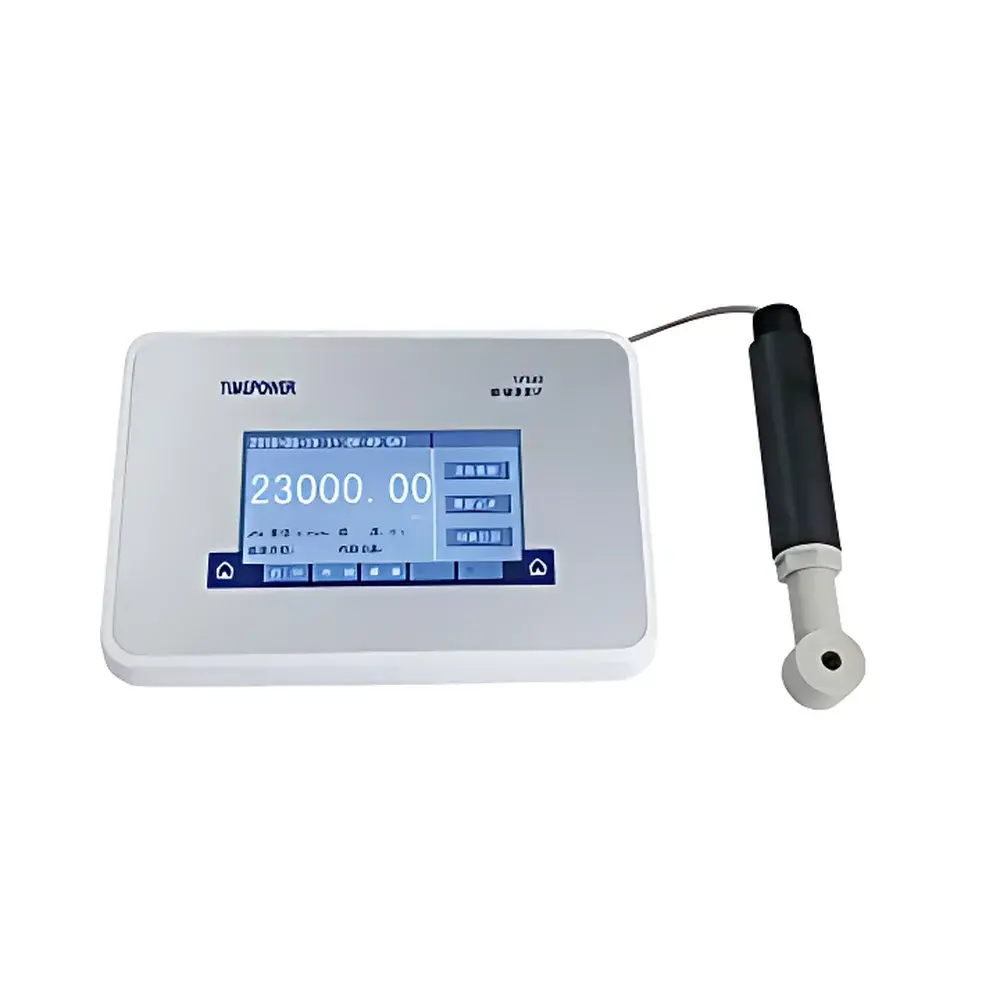
Timepower TP-340 Benchtop Acid & Alkali Concentration Meter
| Brand | Timepower |
|---|---|
| Origin | Beijing, China |
| Manufacturer Type | Direct Manufacturer |
| Model | TP-340 |
| Measurement Principle | Conductivity-based concentration determination via molar conductivity correlation |
| Measuring Range (selectable) | HCl (0–10.00%), NaOH (0–10.00%), H₂SO₄ (0–20.00%), NaCl (0–20.00%), HNO₃ (0–15.00%), Na₂CO₃ (0–10.00%) |
| Accuracy | ±2% FS |
| Resolution | 0.01% |
| Repeatability | ≤1% |
| Stability | ±1% FS / 4 h |
| Temperature Compensation | PT1000 sensor, 0–60 °C |
| Sample Temp. Range | 5–50 °C |
| Ambient Temp. | 5–45 °C |
| Humidity | ≤90% RH (non-condensing) |
| Storage Temp. | −25–55 °C |
| Power Supply | AC 85–265 V, 45–65 Hz |
| Power Consumption | ≤5 W |
| Dimensions | 200 mm × 200 mm × 85 mm |
| Weight | 2.1 kg |
| Display | 5.0″ capacitive color touchscreen, Chinese UI |
| Data Storage | Cyclic memory with auto-overflow management |
| Electrode | Corrosion-resistant conductive cell (included) |
| Compliance | Designed for industrial process QC per ISO/IEC 17025-aligned laboratory practices |
Overview
The Timepower TP-340 Benchtop Acid & Alkali Concentration Meter is a dedicated conductivity-based analytical instrument engineered for precise, non-titrative quantification of strong acid and base concentrations in aqueous industrial process streams. It operates on the fundamental electrochemical principle that the electrical conductivity of a solution is linearly proportional to its ionic strength — and, for fully dissociated electrolytes (e.g., HCl, NaOH, H₂SO₄), directly correlated to molar concentration via empirically calibrated molar conductivity relationships. Unlike pH meters, which measure activity of H⁺ ions, the TP-340 determines bulk concentration by measuring solution conductance across a fixed-cell geometry, applying temperature-compensated algorithms derived from standardized reference data (e.g., IUPAC recommended molar conductivities at 25 °C). Its design targets routine, high-reproducibility monitoring in environments where rapid, operator-independent verification of acid/alkali dosing, regeneration endpoints, or neutralization completeness is critical — particularly where titration is impractical due to time, safety, or throughput constraints.
Key Features
- Corrosion-resistant, platinum-coated stainless steel or graphite conductivity cell optimized for aggressive media including hydrochloric, sulfuric, nitric, and caustic solutions.
- High-precision 24-bit analog-to-digital conversion with automatic zero and span calibration routines, ensuring long-term measurement stability within ±1% FS over 4 hours.
- Integrated PT1000 temperature sensor with automatic compensation across 0–60 °C, minimizing thermal drift in real-world plant conditions.
- Capacitive 5.0-inch color touchscreen interface with intuitive Chinese-language menu navigation — no external PC required for operation or configuration.
- Embedded microcontroller architecture featuring low-power consumption (<5 W) and robust electromagnetic interference (EMI) shielding for use in electrically noisy industrial settings.
- Cyclic data logging with timestamped entries; memory automatically overwrites oldest records upon overflow, supporting traceability without manual file management.
Sample Compatibility & Compliance
The TP-340 is validated for use with clear, low-turbidity aqueous solutions containing fully dissociated strong electrolytes. It supports pre-programmed calibration curves for HCl, NaOH, H₂SO₄, NaCl, HNO₃, and Na₂CO₃ — each traceable to NIST-traceable conductivity standards. While not certified to FDA 21 CFR Part 11, its data integrity features (timestamped storage, no editable logs, fixed firmware logic) align with GLP/GMP documentation expectations for non-regulated QC applications. The instrument meets IEC 61000-4 immunity standards for industrial environments and complies with CE marking requirements for EMC and low-voltage directives. Electrical safety conforms to IEC 61010-1 for laboratory and light industrial use.
Software & Data Management
No proprietary software installation is required. All configuration, calibration, and data review occur locally via the onboard touchscreen interface. Calibration is performed using two-point standardization (e.g., deionized water zero and a certified KCl or HCl reference solution). The system stores up to 1,000 measurement records with date/time stamps; export is not supported via USB or network — consistent with closed-system design for operational simplicity and cybersecurity hardening in plant-floor deployment. Audit trails are implicit in the immutable log structure: each entry includes measured value, temperature, selected analyte mode, and system timestamp. Firmware updates are performed exclusively via secure manufacturer-provided USB dongle under controlled service protocols.
Applications
- Power generation: Monitoring HCl concentration during ion exchange resin regeneration cycles in demineralized water treatment systems.
- Chemical & metallurgical processing: Real-time control of pickling bath acidity (H₂SO₄/HCl) in steel surface treatment lines; alkali concentration verification in leaching or precipitation stages.
- Pharmaceutical manufacturing: Verification of NaOH concentration in CIP (clean-in-place) solutions and acid concentration in passivation baths — supporting equipment qualification per ASTM E2500 and ISPE baseline guides.
- Food & beverage production: Quantitative assurance of citric or phosphoric acid levels in formulation tanks and NaOH concentration in sanitizing solutions, aligned with SQF and BRCGS hygiene protocol requirements.
- Environmental labs: Rapid screening of acid/alkali content in industrial effluents prior to neutralization — complementing titrimetric analysis for throughput optimization.
FAQ
Does the TP-340 require daily calibration?
No. Under stable operating conditions, a two-point calibration every 24–48 hours is sufficient. More frequent calibration is recommended when switching between analytes or after exposure to highly contaminated samples.
Can the instrument measure mixed acid solutions (e.g., HCl + HNO₃)?
No. The TP-340 assumes single-analyte composition. Mixed electrolytes introduce non-linear conductance contributions and invalidate the built-in calibration models.
Is the electrode suitable for suspended solids or viscous samples?
No. The conductivity cell requires homogeneous, low-viscosity, particle-free solutions. Slurries, emulsions, or high-solids streams must be filtered and diluted prior to analysis.
What maintenance does the conductivity cell require?
Rinse thoroughly with deionized water after each use. Periodically clean with dilute nitric acid (for scale) or mild detergent (for organics), followed by DI water rinse. Avoid abrasive cleaning tools or ultrasonic baths unless specified in the service manual.
Does the device support RS-232 or Modbus communication?
No. The TP-340 is a standalone benchtop analyzer without digital output interfaces. For integration into SCADA or DCS systems, external analog signal converters (4–20 mA) must be used.






