
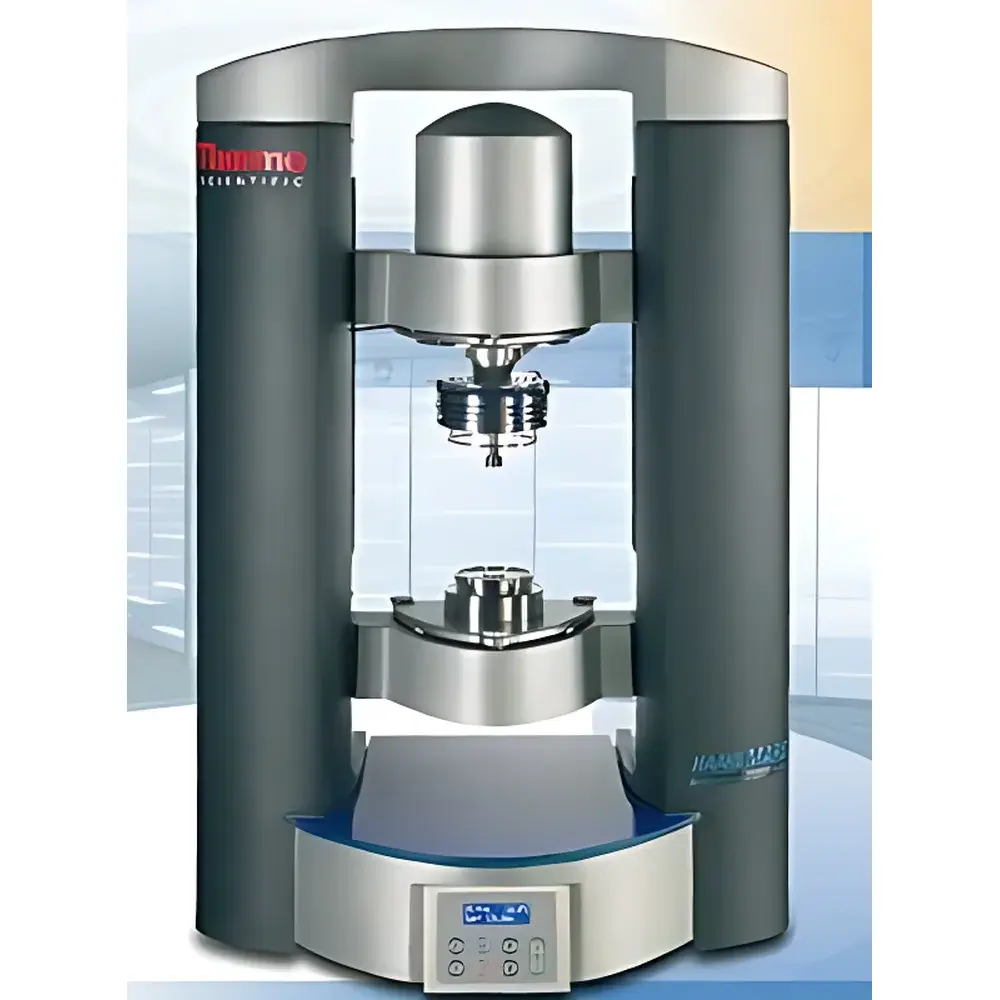
Thermo Fisher HAAKE MARS 40/60 Modular Rotational Rheometer
| Brand | Thermo Fisher |
|---|---|
| Origin | USA |
| Manufacturer Type | Authorized Distributor |
| Origin Category | Imported |
| Model | MARS 40/60 |
| Instrument Type | Rotational Rheometer |
| Motor Bearing | Air Bearing |
| Minimum Rotational Speed | 10⁻⁸ rpm |
| Frequency Range | 10⁻⁶–100 Hz |
| Maximum Rotational Speed | 4500 rpm |
| Maximum Torque | 200 mNm |
| Torque Resolution | 0.1 nNm |
Overview
The Thermo Fisher HAAKE MARS 40/60 Modular Rotational Rheometer is an advanced, high-precision instrument engineered for fundamental and applied rheological characterization of complex fluids and soft solids. Based on Couette and cone-plate geometries, it employs controlled-stress and controlled-strain rotational measurement principles to quantify viscoelastic properties—including storage modulus (G′), loss modulus (G″), complex viscosity (η*), yield stress, thixotropy, and time-dependent deformation—across an exceptionally broad dynamic range. Its fourth-generation low-inertia air-bearing motor system enables nanonewton-meter torque resolution (0.1 nNm) and ultra-low angular velocity control down to 10⁻⁸ rpm—critical for probing weak gel structures, aging phenomena, and linear viscoelastic regions (LVER) in dilute polymer solutions or biological hydrogels. The dual-column mechanical architecture ensures exceptional torsional rigidity and thermal stability, minimizing frame compliance and enabling high-fidelity data acquisition under oscillatory, creep-recovery, and multi-step shear protocols.
Key Features
- Ultra-high sensitivity air-bearing drive system with 0.1 nNm torque resolution, supporting both steady-shear and dynamic oscillatory measurements with sub-microradian angular precision.
- Extended frequency range of 10⁻⁶–100 Hz, facilitating time–temperature superposition (TTS) analysis and full master curve construction per ISO 6721-10 and ASTM D4440.
- Wide rotational speed range from 10⁻⁸ rpm to 4500 rpm, accommodating both ultra-slow structural relaxation studies and high-shear processing simulations (e.g., extrusion, coating).
- Modular platform architecture with standardized mechanical and electrical interfaces, allowing seamless integration of optional modules including RheoScope (in situ optical microscopy), Rheonaut (FTIR-coupled rheology), SER (melt extensional rheology), and Peltier-based environmental chambers (−40°C to +200°C).
- “Quick-Connect Assistant” hardware recognition system that auto-detects transducer type, geometry dimensions, and temperature module configuration—eliminating manual calibration inputs and ensuring traceable alignment and gap setting per ISO 3219 and ASTM D2196.
Sample Compatibility & Compliance
The MARS 40/60 supports a comprehensive suite of standard and custom geometries—including parallel-plate (8–50 mm), cone-and-plate (1°–4°), concentric cylinder (Couette), and vane fixtures—to accommodate diverse sample classes: thermoplastic melts, crosslinking resins, emulsions, suspensions, gels, pastes, and biopolymer solutions. All measurement protocols comply with international standards for rheological testing, including ISO 6721 (plastics), ISO 16520 (paints and varnishes), USP (rheology of pharmaceutical gels), and ASTM D4440 (dynamic mechanical analysis of elastomers). The system’s mechanical design and firmware support GLP/GMP-compliant operation, with audit-trail-enabled user access controls, electronic signatures, and data integrity safeguards aligned with FDA 21 CFR Part 11 requirements.
Software & Data Management
HAAKE RheoWin software provides a unified interface for method development, real-time data visualization, automated sequence execution, and advanced post-processing—including Cox-Merz equivalence validation, Winter-Chambon gel point detection, and LAOS (Large Amplitude Oscillatory Shear) Fourier transform analysis. Raw data files are stored in vendor-neutral HDF5 format with embedded metadata (geometry ID, temperature, ambient conditions, operator ID), ensuring long-term archival integrity and interoperability with third-party analysis tools (e.g., MATLAB, Python SciPy). Software validation packages and IQ/OQ documentation are available to support regulated laboratory environments.
Applications
- Polymers & Plastics: Melt elasticity assessment, branching quantification via extensional viscosity, and processing window definition for injection molding and blow film extrusion.
- Pharmaceuticals & Biologics: Gelation kinetics of injectable depots, syringeability profiling of high-concentration mAb formulations, and stability screening of protein-based suspensions.
- Food & Cosmetics: Yield stress mapping of yogurt gels, thixotropic recovery in toothpastes, and emulsion breakdown under repeated shear cycles.
- Coatings & Inks: Set-to-touch time prediction, leveling behavior simulation, and pigment dispersion stability evaluation under low-shear storage conditions.
- Construction Materials: Rheological specification of self-compacting concrete admixtures and early-age cement paste structure evolution.
FAQ
What distinguishes the MARS 40/60 from previous generations of HAAKE rheometers?
The MARS 40/60 introduces a redesigned dual-column frame, fourth-generation air-bearing motor with improved torque resolution, and hardware-level geometry recognition—enabling faster setup, enhanced reproducibility, and broader low-frequency capability.
Can the MARS 40/60 perform extensional rheology without adding external modules?
No. Extensional measurements require the optional SER (Sentmanat Extensional Rheometer) module or the FiSER accessory, both of which integrate mechanically and electronically with the base platform.
Is the instrument compliant with 21 CFR Part 11 for use in pharmaceutical QC labs?
Yes—when configured with RheoWin 5.x and validated software options, the system supports electronic records, role-based access, audit trails, and digital signatures required for regulated submissions.
Does the system support temperature-controlled measurements below 0°C?
Yes, using the Peltier-cooled environmental chamber (–40°C to +200°C) or liquid nitrogen cryostat option, both fully integrated with active gap control and thermal equilibration monitoring.
How is geometry calibration performed to ensure measurement accuracy?
Calibration is executed automatically during startup via the Quick-Connect Assistant; physical gap verification is supported by laser displacement sensors and motorized gap adjustment with ±0.1 µm repeatability.



