
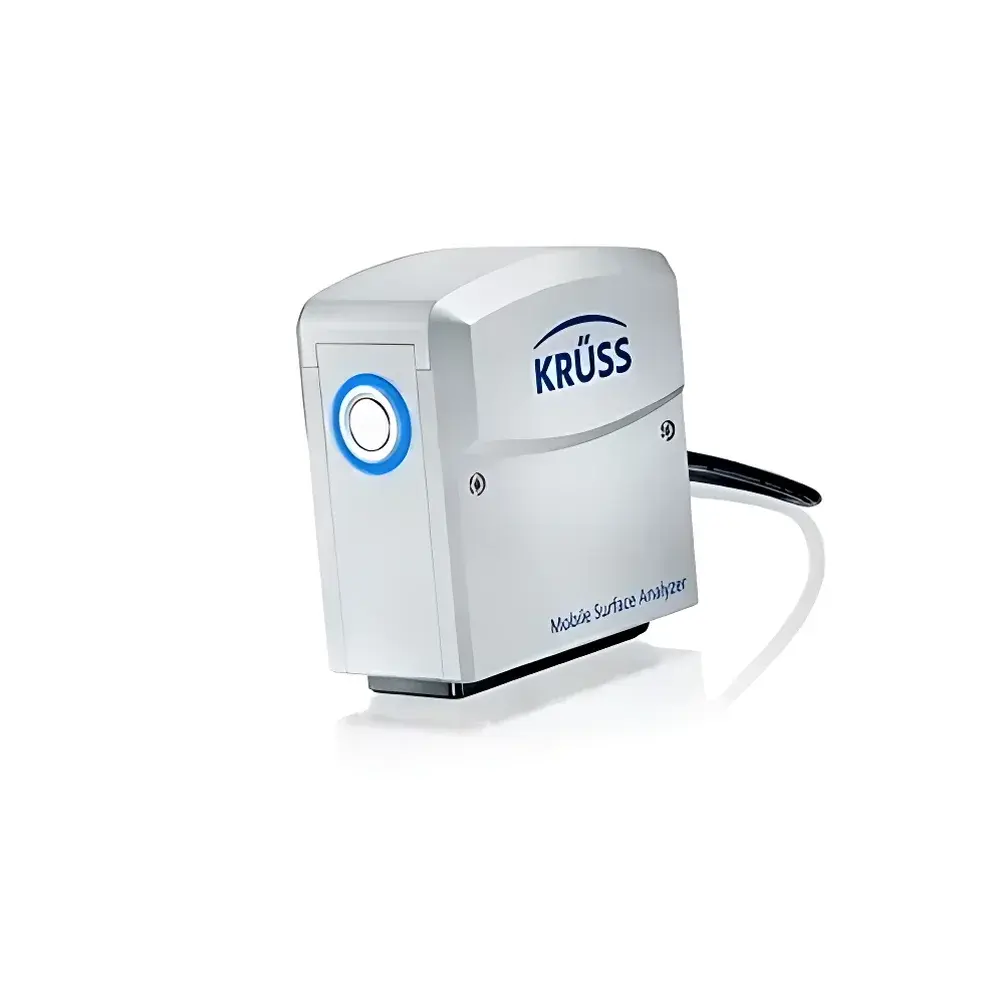
Krüss MSA Flexible Liquid Portable Droplet Shape Analyzer
| Origin | Germany |
|---|---|
| Manufacturer Type | Authorized Distributor |
| Import Status | Imported |
| Model | MSA Flexible Liquid |
| Pricing | Available Upon Request |
Overview
The Krüss MSA Flexible Liquid is a portable, benchtop-compatible droplet shape analyzer engineered for in-situ and laboratory-based contact angle and surface free energy (SFE) characterization of solid surfaces. It operates on the principle of axisymmetric drop shape analysis (ADSA), leveraging high-resolution imaging and precise digital image processing to extract contact angles from sessile droplets under static or quasi-static conditions. Unlike fixed-stage goniometers, the MSA Flexible Liquid features a compact, modular architecture—measuring just 180 × 120 × 140 mm—with integrated high-speed CMOS camera (≥1.3 MP, adjustable frame rate), collimated LED illumination, and motorized syringe pump for reproducible liquid dispensing. Its portability enables direct measurement on large, immobile industrial components—including automotive body panels, aerospace composite parts, coated glass façades, and rolled polymer films—without sample sectioning or relocation. The system supports both single-liquid static contact angle measurement and multi-liquid SFE calculation using the Owens–Wendt–Rabel–Kaelble (OWRK) method, delivering quantitative insight into surface polarity, dispersion forces, and interfacial thermodynamics.
Key Features
- True field-deployable design: self-contained unit with internal power supply option and USB-C connectivity for laptop operation
- Automated dispensing via disposable, pre-calibrated plastic syringes (100 µL–1 mL volume range), eliminating cross-contamination and solvent-induced clogging
- Real-time image acquisition at up to 60 fps with auto-focus and dynamic exposure control for optimal droplet edge contrast
- Motorized Z-axis stage (±5 mm travel, 1 µm resolution) for fine-tuning needle-to-surface distance and minimizing gravitational distortion
- Integrated ADVANCE software v5.0+ with embedded ASTM D7334–22 and ISO 19403–2:2017 compliant analysis algorithms
- One-button workflow: automatic droplet deposition → image capture → baseline detection → contour fitting → contact angle quantification → SFE derivation (if ≥2 test liquids used)
Sample Compatibility & Compliance
The MSA Flexible Liquid accommodates substrates of arbitrary geometry, curvature, and size—flat, curved, textured, or porous—provided the local surface area exceeds 5 mm² and surface roughness remains below Ra < 5 µm. Compatible materials include metals (aluminum, stainless steel), polymers (PP, PET, PU), ceramics, glass, wood veneers, paperboard, and plasma-treated textiles. It supports all Newtonian and weakly non-Newtonian test liquids (water, diiodomethane, ethylene glycol, formamide, hexadecane) with surface tensions ranging from 20–72 mN/m. The system meets essential regulatory documentation requirements for GLP and GMP environments: full audit trail logging (user ID, timestamp, parameter set, raw image, processed result), electronic signature support per FDA 21 CFR Part 11, and traceable calibration via certified reference standards (e.g., Krüss PTFE and silicon wafer calibration kits).
Software & Data Management
ADVANCE software provides a unified interface for instrument control, image analysis, and report generation. It includes six built-in evaluation models (Young–Laplace fitting, circle/ellipse tangent, conic section, polynomial, spline, and dynamic baseline correction), each selectable based on droplet symmetry and substrate heterogeneity. Batch processing allows sequential analysis of multiple images with identical parameters. Export formats include CSV (contact angle, SFE components, hysteresis), PDF (annotated reports with metadata), and TIFF (lossless raw image). All data files are timestamped, digitally signed, and stored in a hierarchical folder structure compliant with ISO/IEC 17025 documentation standards. Optional cloud synchronization (via Krüss CloudLink) enables secure remote access and collaborative review across global R&D teams.
Applications
- Quality assurance of surface activation processes: quantifying efficacy of plasma, corona, flame, or chemical etching treatments on polyolefin films or injection-molded parts
- Formulation development for coatings, inks, adhesives, and sealants—correlating contact angle hysteresis with spreading coefficient and adhesion work
- In-line verification of hydrophobic/hydrophilic coating uniformity on architectural glass or medical device housings
- Failure analysis of delamination or poor printability linked to insufficient surface energy (42 mJ/m² for UV-curable inks)
- Research into biofunctionalized surfaces, where polar component (γp) values predict protein adsorption kinetics and cell attachment density
FAQ
Can the MSA Flexible Liquid measure advancing and receding contact angles?
Yes—by integrating optional automated liquid addition/removal cycles via external peristaltic pump control (hardware upgrade required), the system supports dynamic contact angle measurements per ASTM D7490–21.
Is surface free energy calculation limited to the OWRK method?
No—ADVANCE software also implements the Wu harmonic mean and van Oss–Chaudhury–Good (vOCG) models, selectable based on material class and available test liquid database.
How is calibration verified between measurements?
Each session begins with an automated optical alignment check; users may perform daily verification using Krüss-certified reference surfaces with traceable contact angle values (±0.5° uncertainty).
Does the system support ISO 15989-compliant surface tension measurement of pure liquids?
No—the MSA Flexible Liquid is optimized for solid surface characterization; for liquid surface tension determination, Krüss recommends the tensiometer series (e.g., K100 or DCAT25).
What is the minimum measurable contact angle on highly hydrophilic surfaces?
The system reliably resolves angles down to 5° with sub-degree repeatability (RSD < 0.8%) when using high-contrast illumination and optimized droplet volume (1–2 µL).



