
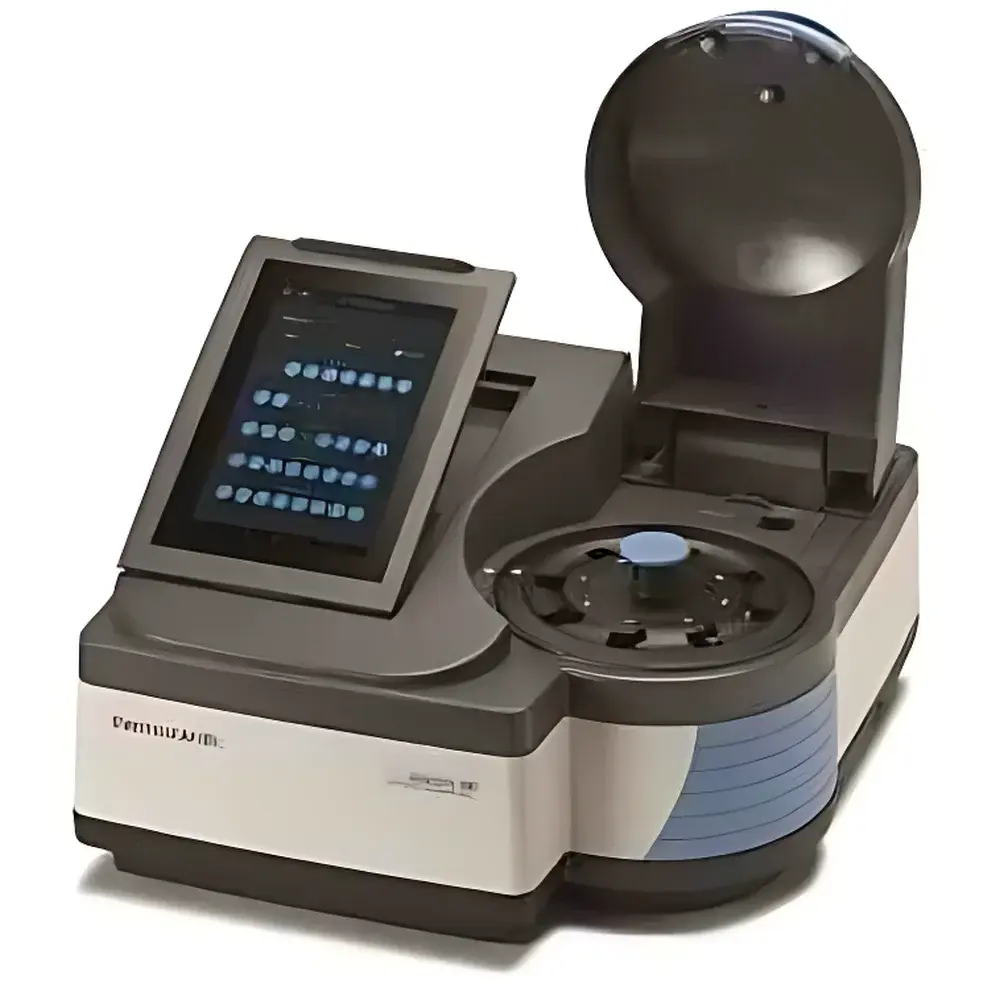
Thermo Fisher GENESYS 150 UV-Visible Spectrophotometer
| Brand | Thermo Fisher |
|---|---|
| Origin | USA |
| Distributor Type | Authorized Distributor |
| Origin Category | Imported |
| Model | GENESYS 150 |
| Instrument Architecture | Pseudo-Double-Beam |
| Detector Type | Photodiode Array (PDA) |
| Wavelength Range | 190–1100 nm |
| Automation Level | Automatic Wavelength Scanning |
| Spectral Bandwidth | 2 nm |
| Wavelength Accuracy | ±0.5 nm |
| Stray Light | <1.0%T at 198 nm (KCl), <0.05%T at 220 nm (NaI), <0.03%T at 340 nm (NaNO₂) |
Overview
The Thermo Fisher GENESYS 150 UV-Visible Spectrophotometer is a high-performance, pseudo-double-beam spectrophotometer engineered for routine and regulated quantitative analysis in pharmaceutical, academic, environmental, and industrial quality control laboratories. It operates on the principle of absorption spectroscopy—measuring the attenuation of ultraviolet and visible light as it passes through a sample—to determine analyte concentration, purity, or spectral characteristics with high reproducibility. Its optical design integrates a xenon flash lamp source, eliminating warm-up delay and enabling rapid, stable measurements across the full 190–1100 nm range. The instrument’s 2 nm spectral bandwidth ensures sufficient resolution for most standard assays—including nucleic acid quantification, protein A280 determination, enzyme kinetics, and colorimetric endpoint assays—while maintaining signal-to-noise integrity under daily operational loads.
Key Features
- 7-inch high-resolution, tilt-adjustable touchscreen interface for glare-free operation and intuitive local method execution—no external PC required for basic workflows.
- Xenon flash lamp technology delivers instantaneous illumination without stabilization delay, supporting high-throughput batch analysis and reducing per-sample measurement time by up to 40% versus continuous-source instruments.
- Pseudo-double-beam architecture with real-time reference beam correction minimizes drift from lamp intensity fluctuations or ambient temperature variation, enhancing baseline stability over extended acquisition periods.
- Front-access large sample compartment accommodates standard 10 mm cuvettes, multi-cell holders, micro-volume adapters, and optional accessories—streamlining workflow and minimizing operator handling errors.
- Native Wi-Fi connectivity enables secure transfer of methods, spectra, and reports to networked storage or printers; supports TLS 1.2 encrypted communication for IT-compliant lab environments.
- Modular accessory compatibility includes automated sample changers (e.g., 6-position or 12-position autosamplers), Peltier temperature-controlled cells, intelligent pipetting modules for reagent addition, and fiber-optic probes for remote or in-situ measurements.
Sample Compatibility & Compliance
The GENESYS 150 supports liquid, solution-phase samples in quartz, glass, or plastic cuvettes (1–50 mm pathlength), as well as solid thin films via reflectance attachments. It complies with core analytical standards including ASTM E275 (spectrophotometer performance verification), ISO 6059 (water quality analysis), and USP (UV-Vis absorbance testing). When operated with VISIONlite software under validated configurations, the system supports audit trail generation, electronic signatures, and data integrity controls aligned with FDA 21 CFR Part 11 requirements—making it suitable for GLP and GMP-regulated environments where traceability and procedural rigor are mandatory.
Software & Data Management
Local touchscreen operation provides immediate access to preloaded methods (e.g., DNA/RNA quantitation, Bradford assay, kinetic monitoring) and customizable calibration curves. For advanced applications, the optional VISIONlite software suite runs on Microsoft Windows® platforms and offers comprehensive data processing—including derivative spectroscopy, multi-component analysis, spectral subtraction, and time-resolved kinetics export. All data files adhere to ASTM E1381/E1489 standards for spectral data interchange (SDI), ensuring interoperability with LIMS and ELN systems. Built-in password-protected user roles, method locking, and automatic timestamped audit logs satisfy laboratory data governance policies.
Applications
- Pharmaceutical QA/QC: Assay validation, dissolution testing, excipient interference screening, and raw material identification per ICH Q2(R2) guidelines.
- Life sciences: Nucleic acid purity assessment (A260/A280, A260/A230 ratios), protein concentration determination, and enzyme activity profiling using chromogenic substrates.
- Environmental monitoring: Nitrate, phosphate, and heavy metal ion quantification in wastewater and drinking water per EPA Method 353.2 and ISO 15681-1.
- Chemical manufacturing: Reaction progress tracking, catalyst efficiency evaluation, and batch-to-batch consistency verification in fine chemical synthesis.
- Academic research: Teaching labs benefit from its robustness and guided workflows; research labs leverage its PDA detector for full-spectrum capture during transient phenomena such as photochemical reactions.
FAQ
Does the GENESYS 150 require lamp warm-up before measurement?
No—the xenon flash lamp produces consistent intensity pulses without thermal stabilization delay, enabling immediate measurement after power-on.
Can the instrument be integrated into an existing LIMS environment?
Yes—VISIONlite supports ODBC-compliant database export and ASTM SDI file output; custom API integration is available via Thermo Fisher’s Professional Services group.
What is the maximum scan speed for full-spectrum acquisition?
At 1 nm data interval and 2 nm bandwidth, full 190–1100 nm scans complete in ≤1.5 seconds with photodiode array readout.
Is the system compliant with FDA 21 CFR Part 11 when used with VISIONlite?
Yes—when deployed with enabled audit trail, electronic signature, and role-based access controls, it meets Part 11 technical and procedural requirements for electronic records and signatures.
How often does the instrument require wavelength calibration verification?
Thermo Fisher recommends annual verification using NIST-traceable holmium oxide or didymium filters; internal self-check routines run at startup and can be scheduled weekly via VISIONlite.





