
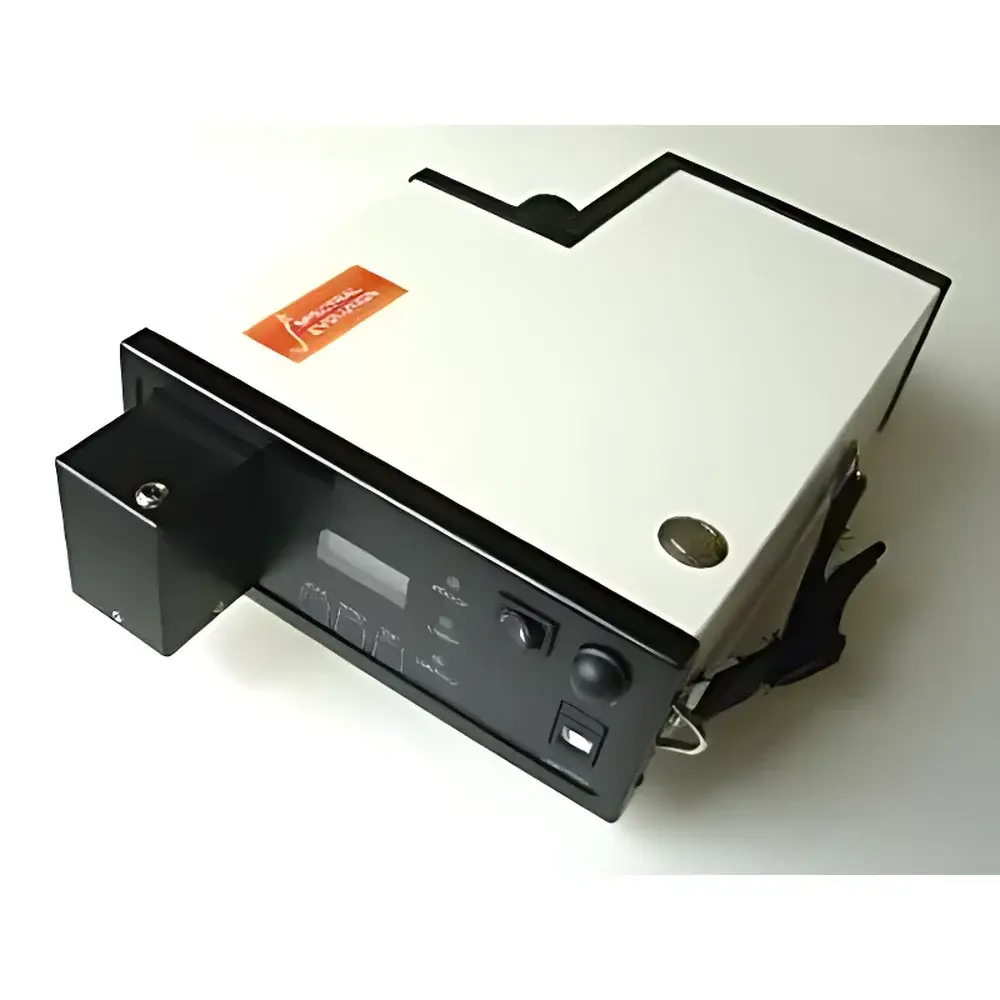
Spectral Evolution PSR-3500 Portable Field Spectroradiometer
| Brand | Spectral Evolution |
|---|---|
| Origin | USA |
| Model | PSR-3500 |
| Spectral Range | 350–2500 nm |
| Spectral Resolution | 3.5 nm (350–1000 nm), 10 nm @ 1500 nm, 7 nm @ 2100 nm |
| Field of View (TFOV) | 4° (interchangeable optics: 4°/8°/14° lenses, fiber optic, integrating sphere) |
| Detector Configuration | Si CCD (350–1000 nm), cooled InGaAs (970–2500 nm) |
| Integration Time | Adjustable from 1 ms to 60 s |
| Scan Speed | Full-spectrum acquisition in ≤100 ms (up to 10 Hz) |
| Wavelength Accuracy | ±0.5 × spectral bandwidth |
| Wavelength Repeatability | ±0.1 nm |
| Calibration Traceability | NIST-traceable |
| Interface | USB 2.0 and Bluetooth 4.0 |
| Onboard Storage | 500 spectra |
| Power | Dual removable Li-ion batteries (7.4 V, ≥2 h operation) |
| Weight | 3.3 kg (7.3 lbs) |
| Dimensions | 21.6 × 29.2 × 8.3 cm (8.5″ × 11.5″ × 3.25″) |
| Mounting | Dual ¼-20 tripod threads |
| Operating Environment | Ground-based field use only |
Overview
The Spectral Evolution PSR-3500 Portable Field Spectroradiometer is a high-performance, NIST-traceably calibrated instrument engineered for quantitative spectral measurements in terrestrial remote sensing applications. It operates on a fixed-grating, full-array detector architecture—eliminating moving optical components—and employs a dual-detector design: a silicon CCD array (350–1000 nm) and a thermoelectrically cooled InGaAs array (970–2500 nm). This configuration enables simultaneous, high-fidelity acquisition across the ultraviolet, visible, near-infrared, and shortwave infrared (UV-VIS-NIR-SWIR) spectrum (350–2500 nm) without mechanical scanning or slit-based dispersion. The PSR-3500 utilizes a filter-based spectral separation method combined with interferometric calibration stability, ensuring long-term radiometric consistency under variable ambient conditions. Its primary measurement modes include spectral radiance, reflectance (via reference panel), transmittance, and irradiance—each traceable to SI units through factory-applied, wavelength-specific responsivity functions. Designed explicitly for ground-based deployment, the system meets the operational demands of field spectroscopy where portability, thermal stability, and measurement repeatability are critical.
Key Features
- Fixed holographic grating and full-line array detectors ensure optical robustness, eliminating calibration drift associated with scanning mechanisms, rotating filters, or motorized gratings.
- NIST-traceable factory calibration with documented uncertainty budgets (±5% @ 400 nm, ±4% @ 700 nm, ±7% @ 2200 nm) supports compliance with ISO/IEC 17025 and ASTM E275, E131, and E1477 standards.
- Integrated drift-lock auto-calibration and mechanical shutter enable real-time dark-current correction and radiometric stabilization during extended field campaigns.
- Interchangeable fore-optics—including 4°, 8°, and 14° field-of-view lenses, bare fiber inputs, cosine correctors, and optional integrating spheres—support flexible sampling geometries for leaf-level, canopy, soil, mineral, and water surface measurements.
- Onboard data acquisition via intuitive keypad interface and internal flash memory (500 spectra capacity) allows autonomous operation without tethered computing.
- Bluetooth 4.0 and USB 2.0 connectivity enable seamless integration with Windows-based PCs, rugged handhelds (e.g., Getac PS236 with GPS, digital camera, and DARWin CE Mobile software), and custom LabVIEW control environments.
- Thermally stable aluminum housing (with passive thermal management) maintains spectral fidelity across −10 °C to +50 °C operating temperatures; ergonomic nylon carry strap and tripod compatibility enhance field usability.
Sample Compatibility & Compliance
The PSR-3500 is optimized for non-contact, non-destructive spectral characterization of natural and engineered surfaces under ambient illumination or controlled light sources. It supports reflectance measurements using standardized Spectralon® or ceramic reference panels (certified per ASTM E259), irradiance quantification via cosine-corrected input, and transmittance analysis of thin films or liquids using fiber-coupled configurations. All hardware and firmware comply with FCC Part 15 Class B and CE electromagnetic compatibility directives. Data integrity workflows align with GLP and GMP principles: DARWin SP software provides audit-trail-enabled metadata logging (GPS coordinates, time stamp, integration time, detector temperature, calibration ID), satisfying requirements for FDA 21 CFR Part 11–compliant environments when paired with validated user protocols.
Software & Data Management
DARWin SP (Spectral Evolution’s proprietary acquisition and processing suite) delivers real-time spectral visualization, automated exposure control, batch normalization, and export to industry-standard formats (ASCII, CSV, ENVI BIL, HDF5). It supports spectral index calculation (e.g., NDVI, PRI, NDWI), atmospheric correction preprocessing (using MODTRAN-compatible parameters), and spectral library matching (via built-in USGS, ECOSTRESS, and ASTER libraries). For integration into enterprise lab informatics systems, the PSR-3500 offers LabVIEW drivers and a documented SDK for Python/C++ API development. Field-deployed data captured on the Getac PS236 PDA includes synchronized geotagged imagery, GPS-derived elevation, and magnetic heading—enabling spatially referenced spectral datasets suitable for GIS interpolation and time-series analysis.
Applications
- Earth observation calibration/validation: vicarious calibration of airborne/satellite sensors (e.g., Landsat OLI, Sentinel-2 MSI, PRISMA).
- Agricultural phenotyping: chlorophyll content estimation, water stress detection, nitrogen status mapping, and yield prediction modeling.
- Geological and mining surveys: mineral identification (e.g., clays, carbonates, iron oxides) via diagnostic absorption features in SWIR.
- Environmental monitoring: wetland vegetation classification, snow albedo assessment, coastal water quality (CDOM, chlorophyll-a, suspended sediments).
- Photovoltaic materials testing: spectral response characterization of solar cells and anti-reflective coatings across AM1.5G-relevant bands.
- Food and pharmaceutical QC: non-invasive compositional analysis of grains, tablets, and powders based on NIR-SWIR spectral fingerprints.
FAQ
Is the PSR-3500 suitable for laboratory use?
Yes—it is routinely deployed in controlled environments for material reflectance standardization, but its design prioritizes field ruggedness, thermal inertia, and battery autonomy over benchtop precision optics.
Does it support real-time GPS-tagged spectral mapping?
Yes, when paired with the optional Getac PS236 PDA or external GNSS receiver, DARWin SP logs synchronized position, altitude, heading, and timestamp with each spectrum.
Can I perform absolute irradiance measurements?
Yes—the system includes a removable cosine corrector accessory and factory-calibrated irradiance responsivity curves traceable to NIST SRM 2201.
What maintenance is required for long-term calibration stability?
Annual verification against a NIST-traceable lamp source is recommended; no routine optical alignment or detector recalibration is needed due to the fixed-optics architecture.
Is spectral data compatible with ENVI, ArcGIS, or Python-based analysis pipelines?
Yes—all exported files include embedded wavelength vectors and metadata headers compliant with GDAL, SciPy, and rasterio conventions.
Related Products





