
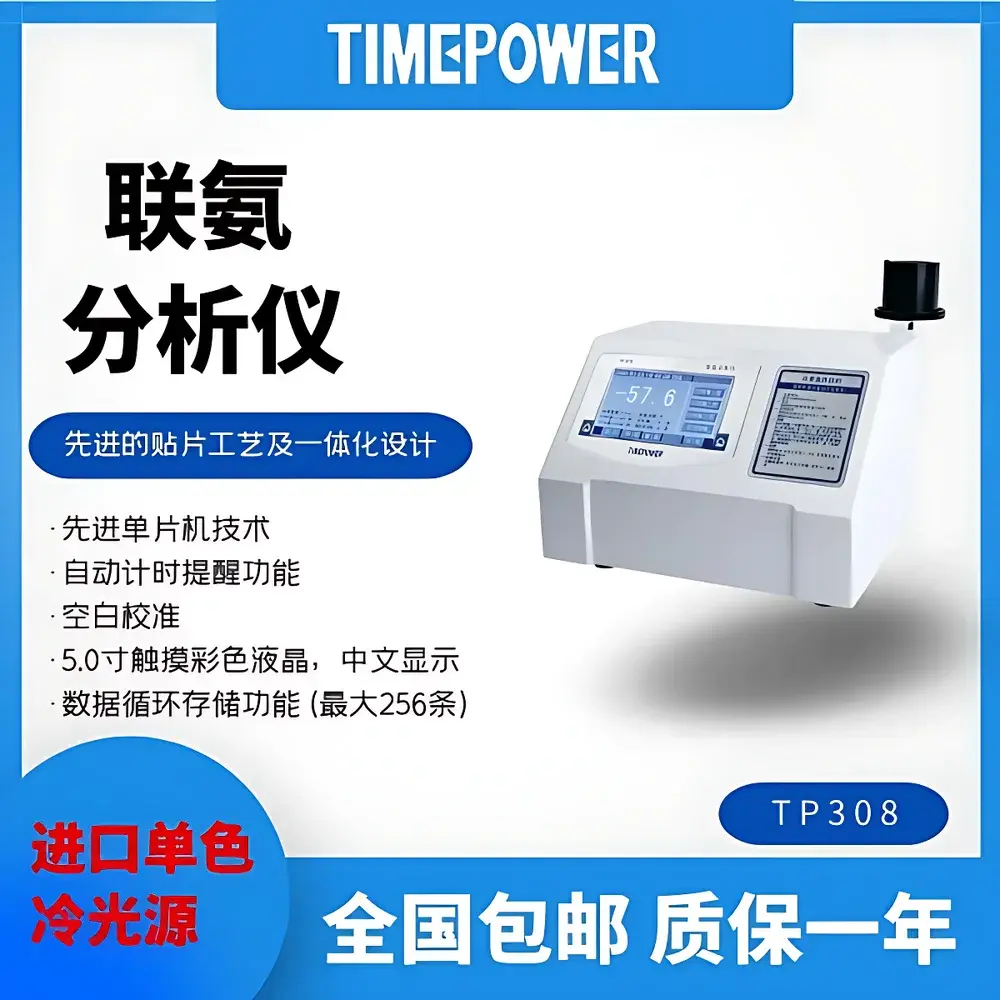
Hydrazine Analyzer TP308 by TimePower
| Brand | TimePower |
|---|---|
| Origin | Beijing, China |
| Manufacturer Type | Direct Manufacturer |
| Product Category | Domestic |
| Model | TP308 |
| Instrument Type | Benchtop Laboratory Analyzer |
| Measurement Principle | Colorimetric Method (p-Dimethylaminobenzaldehyde Reaction) |
| Measurement Range | 0.02–60 mg/L |
| Accuracy | ≤ ±5% of reading |
| Detection Limit | 0.01 mg/L |
| Analysis Time | 10–15 minutes per sample |
| Batch Capacity | 10 samples per run |
| Display | 5.0-inch color TFT touchscreen with Chinese UI |
| Optical Source | Imported monochromatic cold-light LED |
| Data Storage | Up to 256 records with auto-overflow overwrite |
| Calibration | Blank calibration supported |
| Compliance | Designed for ISO/IEC 17025-aligned laboratory environments and compatible with GLP documentation workflows |
Overview
The TimePower TP308 Hydrazine Analyzer is a dedicated benchtop spectrophotometric instrument engineered for the precise quantification of hydrazine (N₂H₄) in ultrapure water matrices. It operates on the internationally recognized p-dimethylaminobenzaldehyde (p-DMAB) colorimetric reaction, wherein hydrazine reacts under acidic conditions to form a yellow azine derivative with strong absorbance at 455 nm. This method is widely adopted in power generation, pharmaceutical manufacturing, semiconductor fabrication, and fine chemical synthesis—industries where trace hydrazine control is critical for corrosion inhibition, boiler feedwater conditioning, and process purity assurance. Unlike electrochemical sensors prone to interference from dissolved oxygen or redox-active species, the TP308 leverages optical specificity and thermal stability to deliver high reproducibility across low-concentration ranges (0.02–60 mg/L), making it suitable for routine QC testing in ISO 17025-accredited laboratories.
Key Features
- 5.0-inch high-resolution color TFT touchscreen interface with intuitive Chinese-language navigation—designed for rapid operator training and minimal error risk.
- Monochromatic cold-light LED source ensures spectral stability, eliminates lamp warm-up delays, and extends operational lifetime beyond 10,000 hours.
- Integrated microcontroller architecture based on industrial-grade single-chip technology enables low-power operation (<5 W), noise-immune signal processing, and robust electromagnetic compatibility (EMC).
- Automated timing sequence with audible/visual alerts guides users through reagent addition, incubation, and measurement phases—reducing procedural variability and supporting SOP compliance.
- Onboard blank calibration routine corrects for cuvette-specific absorbance offsets and electronic baseline drift, enhancing long-term measurement fidelity without external reference standards.
- Embedded data logger stores up to 256 test records—including date/time stamp, sample ID, measured concentration, and calibration status—with automatic FIFO overwrite upon memory saturation.
Sample Compatibility & Compliance
The TP308 accepts standard 10-mm pathlength quartz or high-transmittance optical plastic cuvettes (1.0 mL volume). It is validated for use with deionized water, condensate, boiler feedwater, and process streams containing <10 ppm total dissolved solids (TDS). Interference studies confirm minimal cross-sensitivity to common anions (Cl⁻, SO₄²⁻, NO₃⁻) and cations (Ca²⁺, Mg²⁺, Fe²⁺) at typical power plant concentrations. The analyzer meets mechanical and electrical safety requirements per GB 4793.1–2019 (equivalent to IEC 61010-1) and supports audit-ready documentation for GLP and GMP environments. While not FDA 21 CFR Part 11–certified out-of-the-box, its timestamped, non-editable data logs and calibration history enable manual traceability compliant with Annex 11 principles.
Software & Data Management
Data export is supported via USB 2.0 port in CSV format for downstream analysis in Excel, LIMS, or statistical software (e.g., JMP, Minitab). No proprietary software installation is required. All stored measurements include metadata: operator ID (manually entered), sample ID, calibration ID, ambient temperature (measured internally), and pass/fail flag against user-defined action limits. Audit trail functionality is implemented at firmware level—each calibration event, parameter change, or data deletion generates an immutable log entry with timestamp and context. This architecture aligns with ALCOA+ (Attributable, Legible, Contemporaneous, Original, Accurate, Complete, Consistent, Enduring, Available) data integrity expectations.
Applications
- Monitoring hydrazine residual in high-pressure boiler feedwater and turbine condensate systems to ensure effective oxygen scavenging while avoiding excess dosing that may promote copper alloy corrosion.
- Verifying hydrazine removal efficiency in polishing mixed-bed ion exchange resins prior to ultrapure water distribution in semiconductor fabs (ASTM D5127–22 compliant sampling protocols recommended).
- Batch release testing of purified water (PW) and water for injection (WFI) in pharmaceutical facilities per USP conductivity and TOC correlation guidelines.
- Supporting environmental compliance reporting for wastewater discharge permits where hydrazine is listed as a regulated substance (e.g., EPA Method 351.2 adaptation).
- Method validation and stability-indicating assays in R&D labs developing hydrazine-based catalysts or pharmaceutical intermediates.
FAQ
What is the recommended sample pretreatment for turbid or colored water matrices?
Pre-filtration through a 0.45 µm membrane filter is advised; if significant organic coloration persists, a matched blank using acidified reagent-only solution should be employed to offset background absorbance.
Can the TP308 be integrated into a SCADA or DCS system?
No native analog/digital I/O or Modbus support is provided; however, exported CSV files can be ingested via middleware or custom Python scripts into enterprise monitoring platforms.
Is p-DMAB reagent supplied with the instrument?
Reagents are sold separately as certified kits (Cat. No. TP-REAG-HYD-01), each containing stabilized p-DMAB powder, sulfuric acid solution, and calibrated standards traceable to NIST SRM 3182.
How often must the optical path be cleaned?
Visual inspection before each batch is recommended; cleaning with lens-grade tissue and isopropanol is sufficient—no alignment or recalibration is required after routine maintenance.
Does the analyzer comply with ASTM D129 or ISO 7150-1?
The TP308 implements the core chemistry of ISO 7150-1:1984 (Water quality — Determination of hydrazine — Spectrophotometric method), though formal method validation per that standard requires lab-specific verification per ISO/IEC 17025 Clause 7.2.2.







