
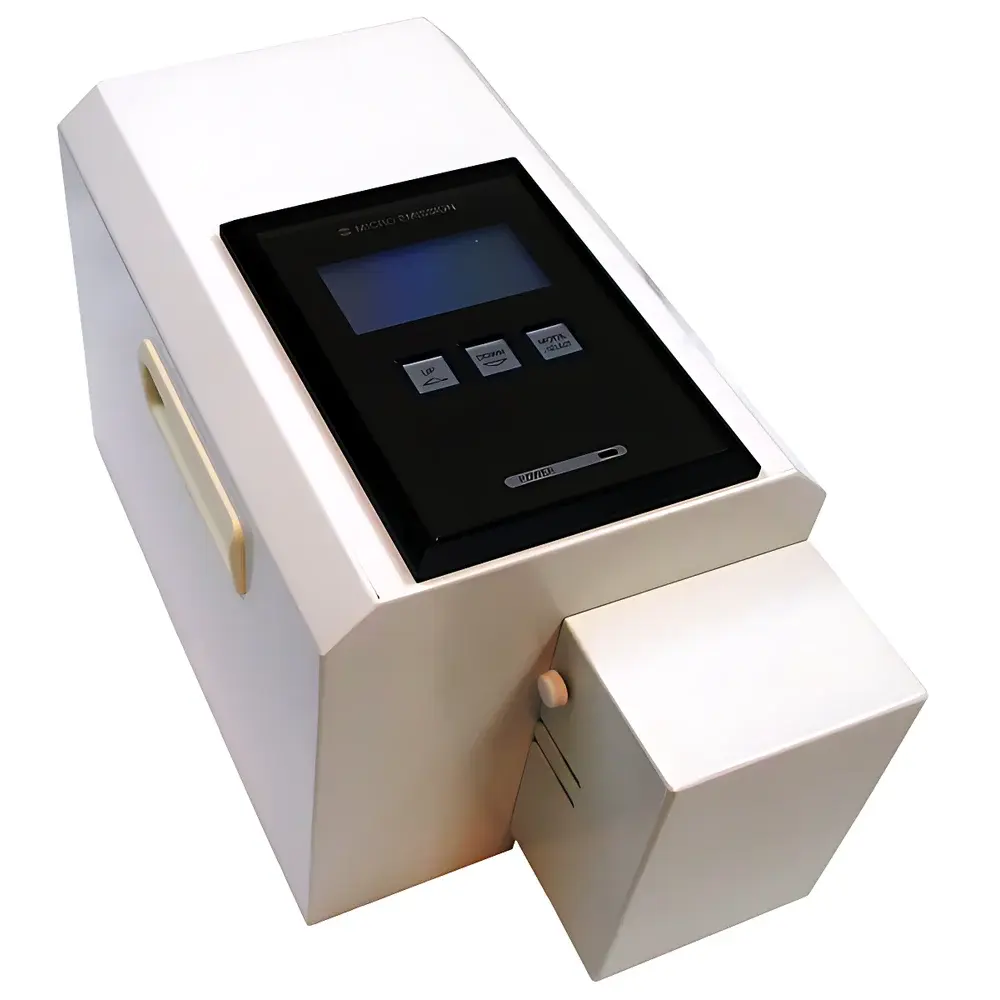
Micro Emission MH-6000A Portable Liquid Electrode Capillary Plasma Optical Emission Spectrometer (LECP-OES)
| Brand | Micro Emission |
|---|---|
| Origin | Japan |
| Model | MH-6000A |
| Instrument Type | Full-Spectrum Direct-Reading OES |
| Wavelength Range | 200–860 nm |
| Weight | 4.4 kg |
| Dimensions (L×W×H) | 31 × 16 × 20 cm |
| Power Consumption | 100 W |
| Gas Requirement | None |
| Cooling | Air-Cooled, No Water Circulation |
| Sample Introduction | Peristaltic Pump |
| Detector Configuration | Dual-Detector Array |
| Sample Form | Aqueous Liquids (with Optional Sapphire Flow Cell) |
Overview
The Micro Emission MH-6000A is a portable, full-spectrum direct-reading optical emission spectrometer based on Liquid Electrode Capillary Plasma (LECP) technology—a compact, low-power alternative to conventional inductively coupled plasma optical emission spectrometry (ICP-OES). Unlike traditional ICP-OES systems requiring high-power RF generators (>7 kW), argon gas supply, water-cooled torches, and dedicated exhaust hoods, the MH-6000A generates a stable, low-temperature plasma directly within a capillary using a liquid electrode configuration. This eliminates dependency on external gas sources and complex thermal management while maintaining multi-element detection capability across 40+ elements—including Na, K, Ca, Mg, Fe, Mn, Zn, Cu, Pb, Cd, As, Cr, Ni, Al, Si, and P—in aqueous matrices. The instrument operates on standard 100–240 V AC power with peak consumption of only 100 W, enabling true field-deployable elemental analysis without infrastructure compromises.
Key Features
- True portability: 4.4 kg total mass with integrated battery option (optional), housed in a ruggedized transport case compliant with IP54 environmental rating.
- Gas-free operation: No requirement for high-purity argon or nitrogen; plasma sustained solely via electrochemical excitation in aqueous sample stream.
- Dual-detector optical architecture: Simultaneous coverage from 200 nm to 860 nm ensures broad elemental coverage—including UV-sensitive elements (e.g., As, P, S) and visible-region transitions (e.g., Ca II 393.37 nm, Mg II 279.55 nm).
- Peristaltic pump-based liquid handling: Compatible with standard 0.8 mm ID PTFE tubing; flow rate programmable between 0.5–3.0 mL/min for optimized nebulization efficiency and matrix tolerance.
- Optional sapphire flow cell: Chemically inert and thermally stable, suitable for alkaline samples (pH > 12) and silicon-rich matrices where quartz would degrade.
- Self-contained thermal design: Passive air cooling with intelligent thermal regulation maintains detector stability over ambient temperatures from 5 °C to 40 °C.
- No routine maintenance: Solid-state plasma source, sealed optical path, and absence of consumable torches or injector tubes reduce operational overhead significantly.
Sample Compatibility & Compliance
The MH-6000A is validated for direct analysis of clarified aqueous solutions—such as drinking water, wastewater filtrates, soil extracts (EPA Method 3050B/3051A digests), food digestates (AOAC 999.10), and industrial process liquors—without dilution or internal standard addition in most cases. It complies with key regulatory frameworks for field-deployable instrumentation: data integrity supports ALCOA+ principles (Attributable, Legible, Contemporaneous, Original, Accurate, Complete, Consistent, Enduring, Available); audit trail functionality meets FDA 21 CFR Part 11 requirements when used with optional secure software license; and analytical performance aligns with ISO 17025 clause 5.9 (method validation) under user-established conditions. While not certified to ASTM D511 or ISO 11885 out-of-the-box, method transfer protocols are provided for alignment with these standards.
Software & Data Management
Control and data acquisition are managed via SpectraLink™ v3.2 software (Windows 10/11 compatible), offering both standalone instrument interface and networked deployment. Key capabilities include: real-time spectral visualization with dynamic background correction; multivariate calibration using partial least squares (PLS) regression; automatic inter-element interference correction for overlapping lines (e.g., Fe 238.204 nm / Cr 238.203 nm); customizable report templates compliant with GLP/GMP documentation requirements; encrypted local database storage with timestamped audit logs; and export to CSV, PDF, or LIMS-ready XML formats. Remote firmware updates and diagnostic telemetry are supported via HTTPS-secured cloud portal (opt-in configuration).
Applications
The MH-6000A serves as a primary screening tool in environmental monitoring (field-based compliance testing for WHO/EPA drinking water guidelines), agricultural extension services (soil nutrient profiling and irrigation water quality), food safety inspection (heavy metal screening in produce wash water and dairy effluents), mining site characterization (leachate and tailings pond analysis), and civil infrastructure QA/QC (concrete admixture verification, corrosion inhibitor monitoring in cooling towers). Its rapid turnaround (<90 seconds per sample) and robustness against vibration, dust, and variable ambient lighting make it particularly suited for mobile laboratories, emergency response units, and decentralized testing hubs operating beyond centralized lab reach.
FAQ
Does the MH-6000A require carrier gas or compressed air?
No. The LECP plasma is generated exclusively through electrochemical excitation of the liquid sample itself—no external gas supply is needed.
Can it analyze solid samples directly?
No. Samples must be in solution form. Solid matrices require digestion per established protocols (e.g., EPA 3050B, ISO 11466) prior to analysis.
What is the typical detection limit range?
Method-dependent, but routinely achieves single-digit ppm for most transition metals and alkaline earth elements in clean aqueous matrices; sub-ppm performance possible with preconcentration or extended integration time.
Is calibration traceable to NIST standards?
Yes. Certified reference materials (CRMs) including NIST SRM 1643e (Trace Elements in Natural Water) and custom multi-element calibrants are supported through built-in CRM library mapping.
How is instrument performance verified in the field?
Built-in wavelength calibration using Hg/Ne spectral lines and intensity stability check via internal reference channel ensure ongoing spectral fidelity without external tools.






