
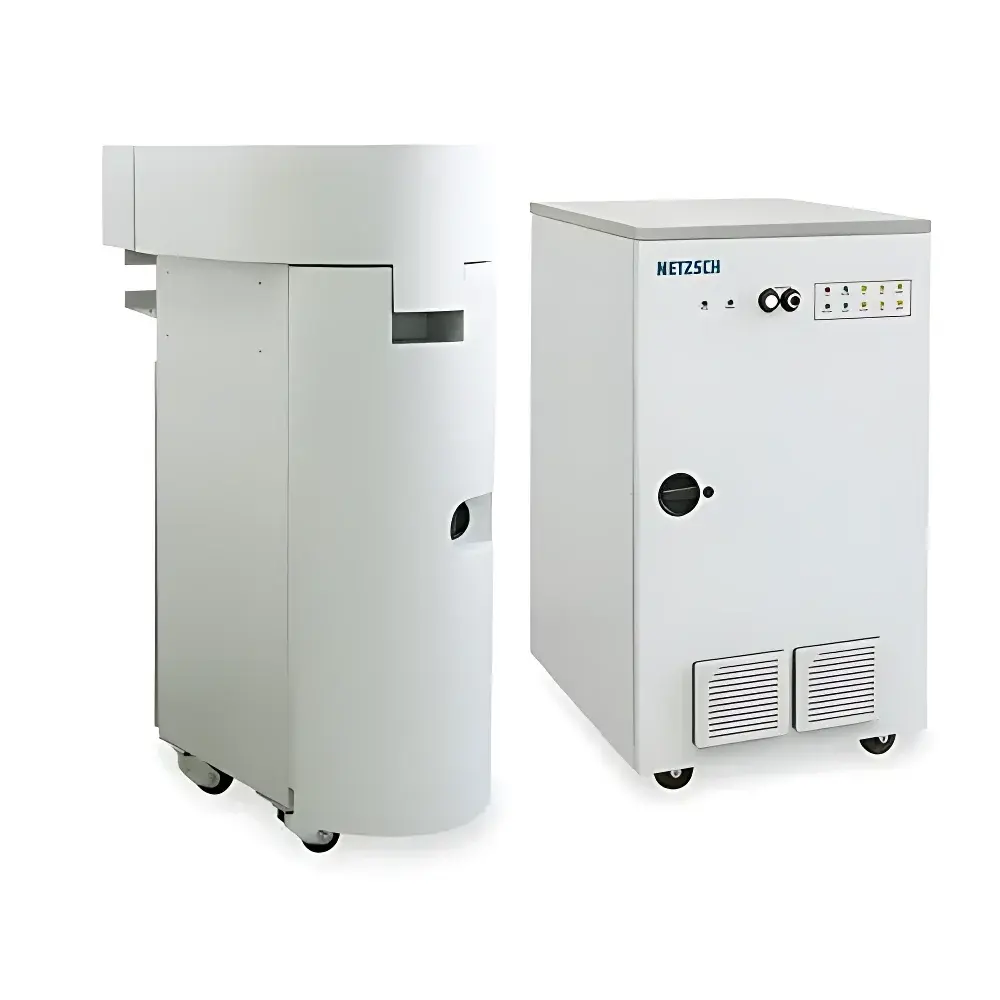
Netzsch APTAC 264 Automatic Pressure-Tracking Adiabatic Calorimeter
| Brand | Netzsch |
|---|---|
| Origin | Germany |
| Model | APTAC 264 |
| Category | Adiabatic Reaction Calorimetry System |
| Operating Principle | Heat Flow Compensation with Real-Time Pressure-Tracking Adiabatic Control |
| Temperature Range | Up to 500 °C (dependent on cell configuration) |
| Pressure Range | Up to 200 bar (standard cell), optional high-pressure variants available |
| Sample Volume | 0.5–20 mL (adjustable via interchangeable reaction cells) |
| Data Acquisition Rate | ≥10 Hz for temperature and pressure |
| Compliance | ASTM E1981, DIERS Guidelines, ISO/IEC 17025-aligned operation protocols |
| Software | Proteus® Thermal Analysis Suite with DIERS-compliant vent sizing module |
| Regulatory Support | FDA 21 CFR Part 11 audit trail, GLP/GMP documentation templates |
Overview
The Netzsch APTAC 264 Automatic Pressure-Tracking Adiabatic Calorimeter is a high-fidelity thermal safety instrument engineered for the quantitative assessment of runaway reaction hazards under realistic process conditions. Unlike conventional adiabatic calorimeters relying on fixed-volume containment or static pressure assumptions, the APTAC 264 implements dynamic pressure-tracking control—continuously adjusting the heating jacket power in real time to maintain near-zero heat loss while simultaneously compensating for vapor-phase expansion and gas evolution. This dual-parameter feedback loop enables true adiabaticity across evolving phase compositions, particularly critical during decomposition, polymerization, or gas-generating reactions. Designed for laboratory-scale hazard evaluation and kinetic parameter extraction, the system bridges the gap between small-scale screening (e.g., ARC, DSC) and pilot-plant validation—providing thermokinetic data directly applicable to process safety studies, emergency relief system design, and thermal stability qualification per OSHA 1910.119 and CCPS guidelines.
Key Features
- Real-time pressure-tracking adiabatic control algorithm, maintaining <±0.05 °C/min thermal drift under dynamic gas evolution
- Modular reaction chamber architecture supporting sealed, vented, and flow-through configurations—including DIERS-compliant rupture disk testing setups
- Integrated high-speed pressure transducer (0–200 bar, ±0.1% FS) and calibrated K-type thermocouple (−20 to 500 °C, ±0.5 °C accuracy) with synchronized 10 Hz data logging
- Automated vent-sizing calculation module compliant with DIERS methodology for two-phase flow scenarios (vapor-liquid mixtures)
- Robust stainless-steel construction with Hastelloy C-276 wetted parts for corrosion resistance against aggressive reagents (e.g., nitric acid, chlorinated solvents, alkyl lithiums)
- Self-calibrating thermal inertia compensation to correct for sample mass variation and cell geometry effects
Sample Compatibility & Compliance
The APTAC 264 accommodates heterogeneous systems including solids, liquids, slurries, emulsions, and gas-liquid mixtures without pre-screening limitations. It supports batch, semi-batch, and controlled-addition reaction protocols—enabling simulation of charging errors, cooling failures, or agitation loss. The system meets functional requirements outlined in ASTM E1981 (“Standard Guide for Evaluating Chemical Reaction Hazards”), adheres to CCPS “Guidelines for Safe Handling of Reactive Chemicals”, and supports documentation frameworks aligned with ISO/IEC 17025 for accredited testing laboratories. All raw data files include embedded metadata (operator ID, timestamp, calibration certificate IDs, environmental conditions) to satisfy GLP and GMP audit requirements.
Software & Data Management
Controlled via Netzsch Proteus® Thermal Analysis Software, the APTAC 264 provides integrated workflow management from experiment setup to kinetic modeling. The software includes built-in modules for Arrhenius parameter estimation, adiabatic time-to-maximum-rate (TMRad) projection, and vent area calculation per DIERS Method 2. All user actions—including method edits, calibration updates, and report generation—are logged with immutable timestamps and operator authentication. Audit trails comply with FDA 21 CFR Part 11 requirements, including electronic signatures, role-based access control, and secure database encryption. Export formats include CSV, XML, and PDF/A-2 for long-term archival and regulatory submission.
Applications
- Kinetic parameter derivation (Ea, lnA, reaction order) for thermal hazard modeling using advanced non-isothermal methods
- Emergency relief system design verification—including two-phase flow vent sizing, burst disk selection, and flare capacity assessment
- Process upset scenario simulation: thermal runaway initiation, self-heating onset, and decomposition propagation analysis
- Stability profiling of APIs, intermediates, and energetic materials under storage and processing conditions
- Validation of computational fluid dynamics (CFD) and process safety software inputs (e.g., TSS, CHEMCAD, Dymola)
- Regulatory dossier preparation for REACH, ICH Q5C, and EPA TSCA submissions requiring experimental thermal stability evidence
FAQ
What distinguishes APTAC 264 from conventional ARC instruments?
It employs active pressure-tracking adiabatic control rather than passive insulation or fixed-volume containment—delivering superior fidelity for reactions involving significant gas evolution or phase change.
Can the APTAC 264 be used for low-temperature exotherms below 0 °C?
Yes, with optional cryogenic jacketing and low-temperature thermocouples; standard operation begins at −20 °C.
Is vent gas composition analysis supported?
The system integrates seamlessly with FTIR or GC-MS via its standardized vent port interface, enabling real-time off-gas speciation when coupled with external analyzers.
How does the instrument handle highly viscous or solid-forming samples?
Interchangeable reaction cells—including paddle-stirred and magnetic stir-bar variants—accommodate rheologically complex systems without compromising thermal uniformity.
Does Netzsch provide application support for kinetic modeling and DIERS reporting?
Yes: application engineers offer protocol development, data interpretation workshops, and template-based report generation aligned with CCPS and NFPA 498 standards.



