
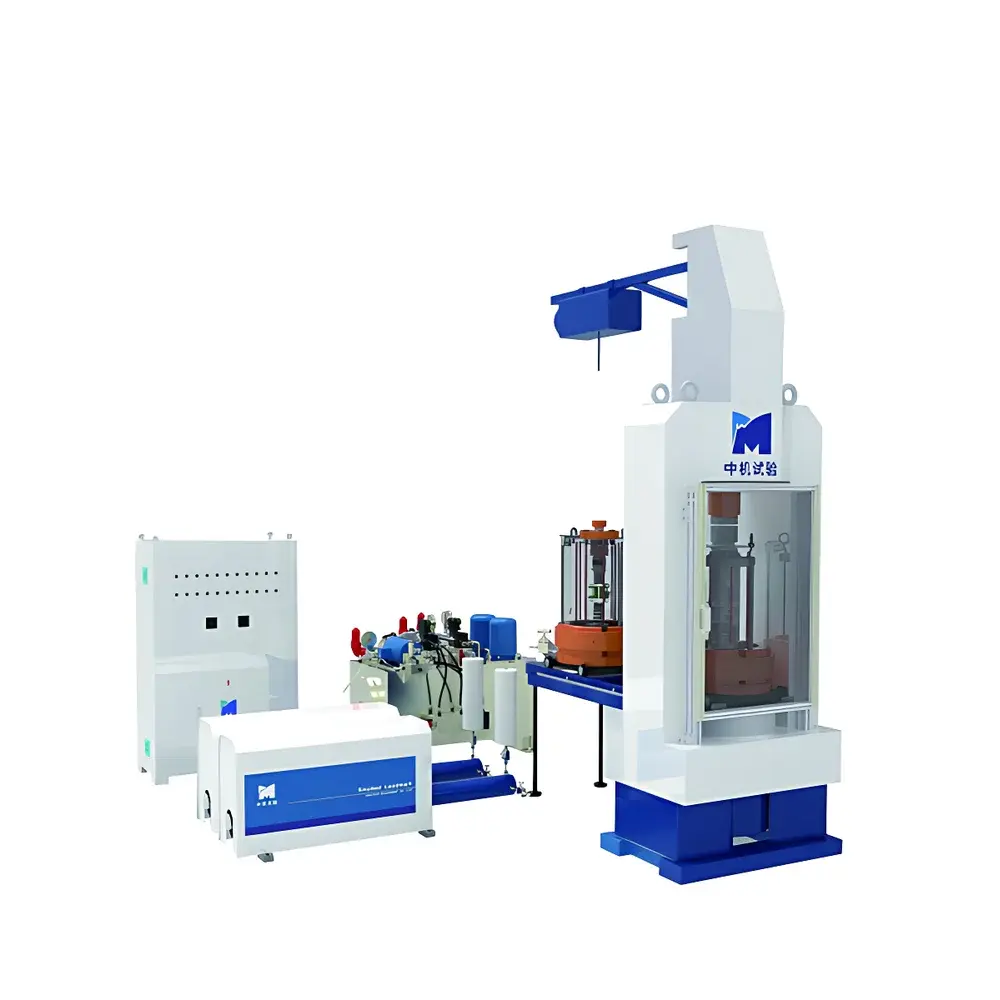
SINOTEST ZYSS Series Rock Triaxial (Confining Pressure) Testing Machine
| Brand | SINOTEST |
|---|---|
| Origin | Jilin, China |
| Manufacturer Type | Direct Manufacturer |
| Country of Origin | China |
| Model | ZYSS Series |
| Instrument Type | Electro-Hydraulic Servo-Controlled |
| Maximum Test Load | 2000 kN |
| Maximum Piston Stroke | 100 mm |
| Overall Dimensions (L×W) | 2300 × 950 mm |
| Machine Weight | 500–1200 kg |
Overview
The SINOTEST ZYSS Series Rock Triaxial (Confining Pressure) Testing Machine is an electro-hydraulic servo-controlled physical property testing system engineered for high-fidelity mechanical characterization of intact rock, rock joints, and cemented geomaterials under simulated in-situ stress conditions. It implements the classical triaxial compression principle—applying independent axial deviatoric load and isotropic or anisotropic confining pressure—to replicate geostatic stress states encountered at depth in mining, tunneling, geothermal energy development, and reservoir engineering applications. Unlike purely mechanical test frames, the ZYSS series integrates closed-loop hydraulic pressure control for confining fluid (typically silicone oil or mineral oil), coupled with high-precision load cells and displacement transducers compliant with ISO 16474-1 and ASTM D7012 requirements for rock strength testing. Its architecture supports static loading protocols—including monotonic compression, stepwise loading, and sustained-load creep tests—as well as quasi-static cyclic loading for deformation modulus and post-peak softening behavior analysis.
Key Features
- Electro-hydraulic servo-controlled axial actuation delivering up to 2000 kN maximum deviatoric force with ≤±0.5% full-scale load accuracy per ASTM E4 calibration guidelines.
- Independent confining pressure system capable of generating uniform lateral stress up to 100 MPa (configurable), regulated via digital pressure controller with real-time feedback and ramp/hold profiles.
- Integrated high-resolution axial displacement measurement (LVDT-based) with 10 µm resolution over 100 mm stroke range, enabling precise strain determination for Young’s modulus and Poisson’s ratio calculation.
- Modular specimen chamber design accommodating standard rock core diameters (Ø50 mm, Ø70 mm, Ø100 mm) and custom-height specimens; optional high-temperature furnace integration (up to 200 °C) for thermo-mechanical coupling studies.
- Rigid C-frame structural design with reinforced steel columns and preloaded crossheads, minimizing frame compliance to ensure measurement integrity per ISO 7500-1 Class 1 requirements.
- Onboard safety interlocks including overpressure cutoff, thermal shutdown, emergency stop circuitry, and hydraulic leak detection—fully documented for GLP-compliant laboratory operation.
Sample Compatibility & Compliance
The ZYSS platform is validated for testing cylindrical rock specimens conforming to international core geometry standards (ASTM D4543, ISRM Suggested Methods). It supports both dry and saturated conditions, with optional pore pressure control modules (Bishop’s effective stress implementation) for consolidation and undrained triaxial testing. All mechanical and control subsystems comply with CE Machinery Directive 2006/42/EC, electromagnetic compatibility per EN 61326-1, and electrical safety per EN 61000-6-2. Data acquisition and reporting align with ISO/IEC 17025:2017 clause 7.7 (measurement traceability) and support audit-ready documentation for regulatory submissions under mining permit frameworks or geological survey protocols.
Software & Data Management
Control and data acquisition are managed via SINOTEST’s proprietary TRIAX-OS v3.2 software suite, running on Windows 10 IoT Enterprise. The interface provides synchronized multi-channel logging (axial load, confining pressure, axial displacement, radial strain via extensometers, temperature, pore pressure), with sampling rates up to 100 Hz. Raw datasets are stored in HDF5 format with embedded metadata (operator ID, calibration certificate IDs, environmental logs). Software features include automated test sequence scripting, real-time stress–strain curve overlay, failure envelope generation (Mohr–Coulomb, Hoek–Brown), and export to ASTM E2928-compliant PDF reports. Full 21 CFR Part 11 compliance is available via optional validation package—including electronic signatures, audit trail with immutable timestamps, and role-based access control.
Applications
- Geomechanical parameter derivation: uniaxial compressive strength (UCS), elastic modulus, cohesion, internal friction angle, tensile strength (via Brazilian test mode).
- Critical assessment of rock mass behavior under deep-buried tunneling conditions, including time-dependent creep response and stress relaxation kinetics.
- Validation of numerical models (e.g., FLAC2D/FLAC3D, Phase2) used in slope stability analysis and cavern design.
- Performance evaluation of grouted rock bolts, shotcrete interfaces, and engineered backfill materials under combined confining and deviatoric stresses.
- Research into thermally induced microcracking and strength degradation in enhanced geothermal systems (EGS) and nuclear waste repository host rocks.
FAQ
What confining pressure ranges does the ZYSS system support?
Standard configuration delivers 0–100 MPa confining pressure; extended-range options up to 140 MPa are available upon request with upgraded pressure vessel certification.
Can the system perform true triaxial (σ₁ ≠ σ₂ ≠ σ₃) testing?
The base ZYSS series is designed for conventional triaxial (σ₂ = σ₃) testing; true triaxial capability requires the optional ZYSS-TT add-on module with independent lateral actuation.
Is third-party calibration documentation included?
Yes—each unit ships with NIST-traceable calibration certificates for load cell, pressure transducer, and displacement sensor, valid for 12 months from commissioning.
What specimen preparation standards does the machine reference?
Testing procedures follow ASTM D7012, ISRM Suggested Methods for Rock Characterization, and GB/T 50266–2013, with built-in test templates aligned to these protocols.
Does SINOTEST provide application support for academic research projects?
Yes—dedicated technical support includes method development consultation, raw data interpretation workshops, and co-authored publication assistance for peer-reviewed geomechanics journals.
Related Products



