
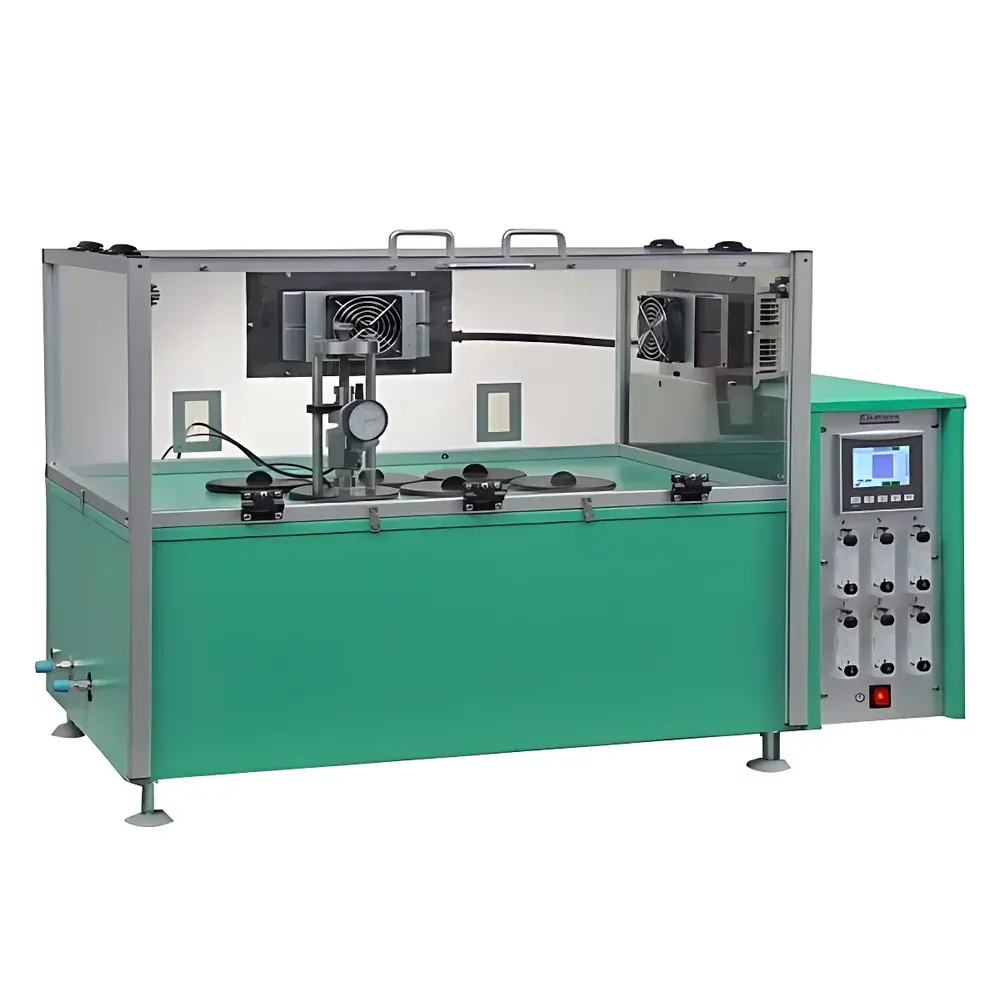
Elastocon ER-2000 Stress Relaxation Tester
| Brand | Elastocon |
|---|---|
| Origin | Sweden |
| Model | ER-2000 |
| Compression Load Capacity | 500 / 1,000 / 2,000 N (standard: 1,000 N) |
| Tensile Load Capacity | 100 N |
| Accuracy | ±0.1% of full scale |
| Compression Resolution | 0.05 / 0.1 / 0.2 N (selectable) |
| Tensile Resolution | 0.01 N |
| Dimensions (Ø × H) | 120 × 450 mm |
| Weight | 4.5 kg |
| Construction Material | Stainless steel |
| Temperature Sensor | Pt100, 1/3 DIN Class |
| Max Operating Temperature | 200 °C (HT version: 300 °C) |
| Compliance | ISO 3384, ISO 6914, ASTM D6147 |
Overview
The Elastocon ER-2000 Stress Relaxation Tester is a precision-engineered instrument designed for the quantitative evaluation of viscoelastic stress decay in elastomeric and thermoplastic materials under constant strain conditions. Based on the fundamental principle of stress relaxation—where a material held at fixed deformation exhibits time-dependent reduction in internal stress—the ER-2000 delivers high-reproducibility force-time profiles essential for characterizing network stability, crosslink density, and thermal aging behavior. Its modular architecture enables seamless integration with environmental chambers (e.g., aging ovens), allowing controlled-stress relaxation measurements across defined temperature ranges—from ambient up to 200 °C (300 °C with HT option). This capability supports standardized testing protocols required in R&D, quality control, and regulatory documentation for rubber compounds, silicone elastomers, polyurethanes, and thermoplastic vulcanizates.
Key Features
- High-resolution load measurement system with selectable compression resolution (0.05 / 0.1 / 0.2 N) and fine tensile resolution (0.01 N), ensuring sensitivity for low-force elastomer characterization.
- Stainless-steel structural frame and load train engineered for dimensional stability, minimal thermal drift, and long-term mechanical integrity in laboratory and production environments.
- Pt100 temperature sensor (1/3 DIN accuracy class) integrated into the test zone for traceable, real-time thermal monitoring—critical for correlating relaxation kinetics with Arrhenius-based aging models.
- Modular design compatible with standard ISO/ASTM-compliant aging chambers; facilitates synchronized thermal conditioning and mechanical relaxation without sample transfer.
- Compact footprint (Ø120 × H450 mm) and lightweight construction (4.5 kg) enable flexible benchtop deployment, including use within temperature-controlled enclosures or glove boxes.
- Standardized force transducer calibration traceable to national metrology institutes, supporting GLP-compliant data generation and audit readiness.
Sample Compatibility & Compliance
The ER-2000 accommodates cylindrical, dumbbell, and strip-shaped specimens per ISO 3384 (rubber—determination of stress relaxation in compression), ISO 6914 (rubber—determination of stress relaxation in tension), and ASTM D6147 (standard test method for stress relaxation of vulcanized rubber). Specimen geometry is defined by applicable standards, with typical compression tests using O-rings or disk samples (e.g., Ø12.7 mm × 6.35 mm), and tensile tests employing Type C dumbbells per ASTM D412. The instrument’s compliance with these international methods ensures data comparability across global supply chains and regulatory submissions. All test procedures align with ISO/IEC 17025 requirements for testing laboratories, and raw force–time datasets support retrospective analysis under FDA 21 CFR Part 11 when paired with compliant software platforms.
Software & Data Management
While the ER-2000 operates as a standalone hardware platform, it outputs analog or digital signals (e.g., 0–10 V, RS-232, or optional USB interface) compatible with third-party data acquisition systems such as LabVIEW, MATLAB, or Elastocon’s proprietary ElastoSoft suite. Time-stamped force and temperature data are recorded at user-defined intervals (down to 100 ms), enabling derivation of relaxation modulus E(t), characteristic relaxation time τ, and activation energy via multi-temperature master curve construction. Export formats include CSV and ASCII for integration into LIMS, statistical process control (SPC) dashboards, or computational material modeling workflows. Audit trails, electronic signatures, and metadata tagging (operator ID, test ID, chamber serial number) are supported when deployed within validated software environments meeting GMP/GLP documentation requirements.
Applications
- Quantification of crosslink stability in sulfur- and peroxide-cured rubber compounds during accelerated aging studies.
- Comparative assessment of plasticizer migration effects on stress retention in PVC and TPE formulations.
- Validation of heat-resistant elastomer performance for automotive sealing systems (e.g., engine gaskets, turbocharger hoses).
- Supporting ISO 22313-compliant fatigue life prediction through correlation between initial relaxation rate and cyclic durability.
- Material screening for medical-grade silicones where prolonged stress maintenance under compression (e.g., implantable device seals) is critical to biocompatibility assurance.
- Development of predictive models linking relaxation spectra to Shore A hardness, compression set, and rebound resilience.
FAQ
What standards does the ER-2000 directly support?
ISO 3384 (compression), ISO 6914 (tension), and ASTM D6147—fully implemented via prescribed fixture geometries, loading rates, and data reporting conventions.
Can the ER-2000 operate inside an environmental chamber?
Yes—its compact dimensions, stainless-steel construction, and external signal interface allow direct mounting or placement inside standard aging ovens up to 200 °C (300 °C with HT variant).
Is temperature control built into the instrument?
No—the ER-2000 includes a high-accuracy Pt100 sensor for monitoring but relies on external thermal chambers for active temperature regulation.
How is calibration maintained over time?
Load cells are factory-calibrated with NIST-traceable reference masses; users perform periodic verification using certified dead-weight kits per ISO 7500-1.
Does the system meet FDA 21 CFR Part 11 requirements?
The hardware itself is Part 11–neutral; compliance is achieved through validated third-party DAQ software with electronic signatures, audit trails, and role-based access control.






