
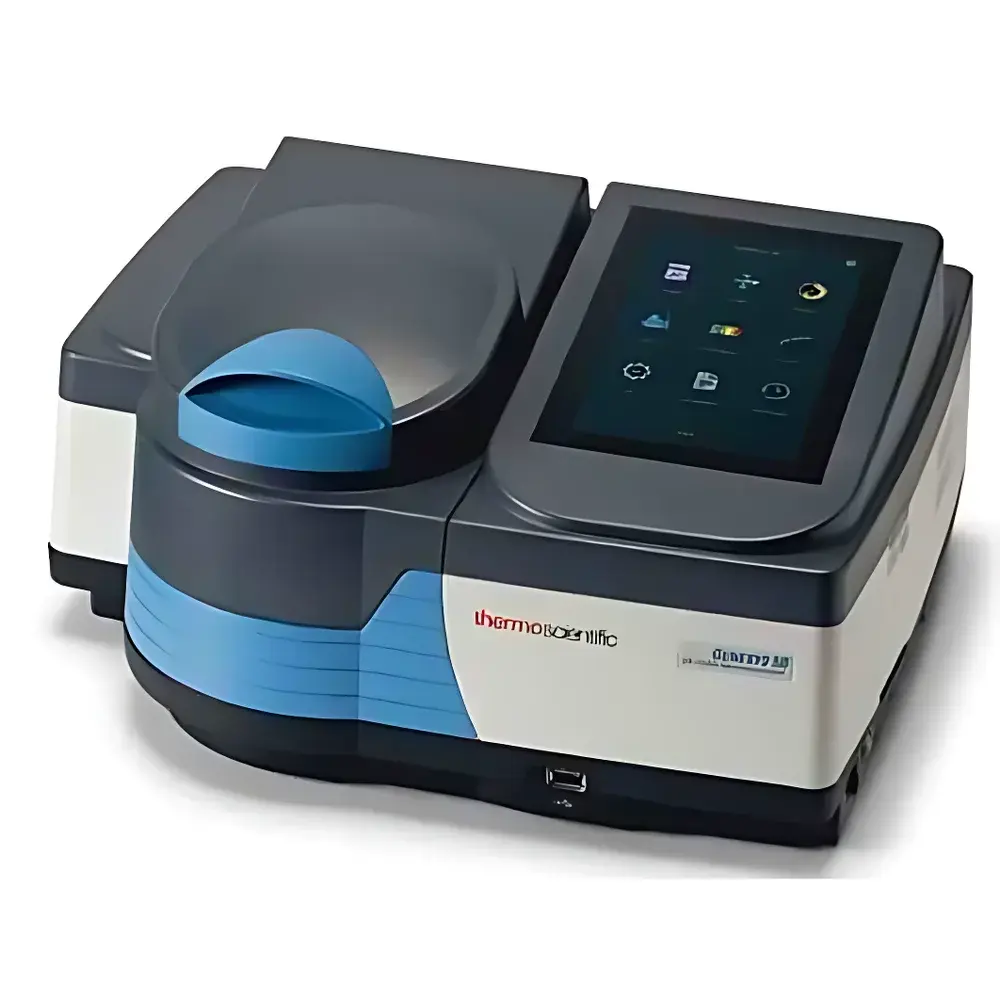
Thermo Fisher GENESYS 40 UV-Vis Spectrophotometer
| Brand | Thermo Fisher |
|---|---|
| Origin | USA |
| Manufacturer Status | Authorized Distributor |
| Origin Category | Imported |
| Model | GENESYS 40 |
| Instrument Architecture | Pseudo-Double-Beam |
| Detector Type | Photodiode Array (PDA) |
| Wavelength Range | 325–1100 nm |
| Automation Level | Automatic Wavelength Scanning |
| Spectral Bandwidth | 5 nm |
| Wavelength Accuracy | ±0.5 nm |
| Stray Light | <0.05% T at 340 nm and 400 nm |
Overview
The Thermo Fisher GENESYS 40 UV-Vis Spectrophotometer is a benchtop, pseudo-double-beam spectrophotometer engineered for precision, robustness, and intuitive operation in teaching laboratories, quality control environments, and routine analytical workflows. It employs a fixed-grating monochromator coupled with a photodiode array (PDA) detector to deliver rapid, stable absorbance and transmittance measurements across the ultraviolet–visible spectrum (325–1100 nm). Unlike single-beam instruments requiring frequent reference corrections, the pseudo-double-beam optical design continuously monitors source intensity drift by splitting light into sample and reference paths—enabling real-time baseline compensation without mechanical chopper movement. This architecture ensures high reproducibility in kinetic assays, concentration determinations, and spectral scanning under variable ambient conditions. Designed to meet ISO/IEC 17025-aligned laboratory practices, the GENESYS 40 supports traceable calibration via NIST-traceable standards and complies with fundamental performance criteria outlined in ASTM E275 and USP for spectrophotometric instrumentation.
Key Features
- 7-inch high-resolution capacitive touchscreen interface with gesture support for direct method navigation, spectrum visualization, and real-time data annotation
- Large, accessible sample compartment with removable, autoclavable polypropylene liner—designed for rapid decontamination and compatibility with cuvettes (10 mm, 20 mm, 50 mm pathlength), test tubes (12–16 mm diameter), and microvolume adapters
- Integrated Wi-Fi 802.11 b/g/n module enabling secure local network connectivity for method and result synchronization with shared network drives or LIMS endpoints
- Onboard data storage supporting ≥1,000 spectra, ≥500 quantitative methods, and audit-ready timestamped logs—including operator ID, date/time stamp, and instrument serial number
- Automatic wavelength calibration using internal holmium oxide and didymium filters; user-accessible validation protocols per ISO 17025 Section 5.9
- Energy-efficient solid-state tungsten-halogen and deuterium lamp system with intelligent power management—lamp life extended up to 2,000 hours via adaptive on/off cycling
Sample Compatibility & Compliance
The GENESYS 40 accommodates standard quartz, glass, and plastic cuvettes (including matched pairs for ratio-based quantitation), as well as disposable microcuvettes and flow cells (with optional accessories). Its 5 nm spectral bandwidth meets resolution requirements for most pharmacopeial assays (e.g., USP , EP 2.2.25), while stray light performance (<0.05% T at 340 nm and 400 nm) ensures reliable quantitation of highly absorbing samples—critical for nucleic acid purity assessment (A260/A280) and protein extinction coefficient determination. The instrument conforms to IEC 61010-1 safety standards and electromagnetic compatibility (EMC) requirements per EN 61326-1. For regulated environments, firmware version 2.3+ supports 21 CFR Part 11-compliant electronic signatures and audit trails when used with VISIONlite software and validated Windows® systems.
Software & Data Management
Local operation is fully self-contained; no PC is required for basic absorbance, %T, concentration, and kinetics measurements. For advanced data handling, optional VISIONlite software (v3.5+) provides full remote control, multi-curve overlay, derivative spectroscopy, and customizable report generation—including PDF export with embedded metadata (instrument ID, calibration status, operator name). All data files are saved in vendor-neutral CSV and XML formats compatible with third-party statistical packages (e.g., JMP, OriginLab) and LIMS integration via HL7 or ASTM E1384 interfaces. Audit trail records capture every parameter change, measurement execution, and calibration event—retained for ≥12 months and exportable for GLP/GMP inspection readiness.
Applications
- Quantitative analysis of pharmaceutical actives (e.g., paracetamol, ibuprofen) per USP monographs
- Enzyme kinetics (e.g., NADH/NADPH oxidation at 340 nm) and ligand-binding studies
- Water quality testing (nitrate, phosphate, COD) using EPA-approved colorimetric methods
- Food and beverage QA—color index (L*a*b*), anthocyanin content, and preservative quantitation
- Academic instruction in Beer–Lambert law verification, spectral deconvolution, and method validation principles
FAQ
Is the GENESYS 40 compliant with 21 CFR Part 11 for electronic records and signatures?
Yes—when operated with validated VISIONlite software v3.5+ on a GxP-configured Windows platform, it supports role-based access control, electronic signatures, and immutable audit trails.
Can the instrument perform spectral scanning without a connected computer?
Yes—the built-in touchscreen enables full spectral acquisition, peak identification, and derivative analysis independently of external hardware.
What is the recommended recalibration frequency for routine QC use?
Thermo Fisher recommends wavelength and photometric calibration verification every 6 months or after 200 operational hours, whichever occurs first—using certified reference materials traceable to NIST SRM 2034 and SRM 930e.
Does the GENESYS 40 support microvolume measurements?
Microvolume capability is available via optional accessories including the GENESYS Microcell adapter (pathlengths: 0.5–2 mm), compatible with 1–2 µL sample volumes and integrated baseline correction algorithms.
How is data security managed during Wi-Fi transmission?
All wireless communications use WPA2-Enterprise encryption with TLS 1.2 handshake; no unencrypted HTTP or FTP transfers are permitted in factory-default configuration.





