
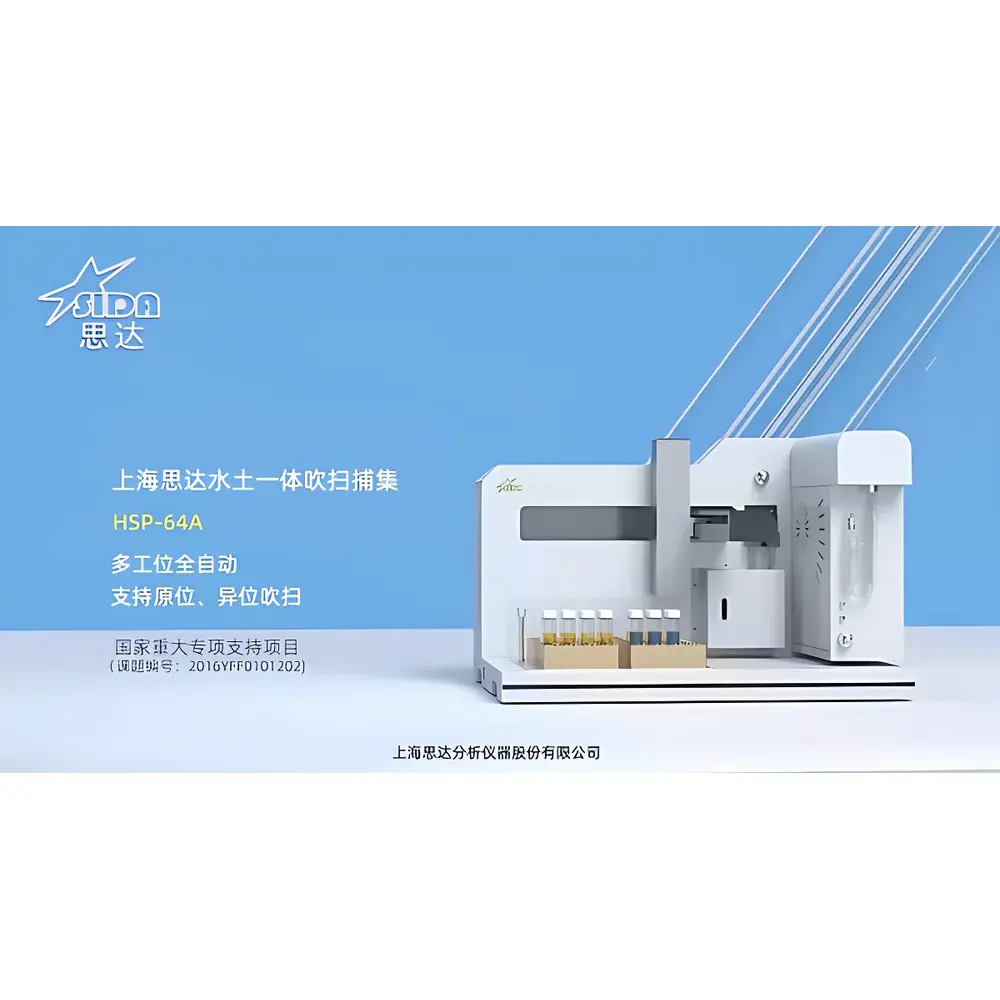
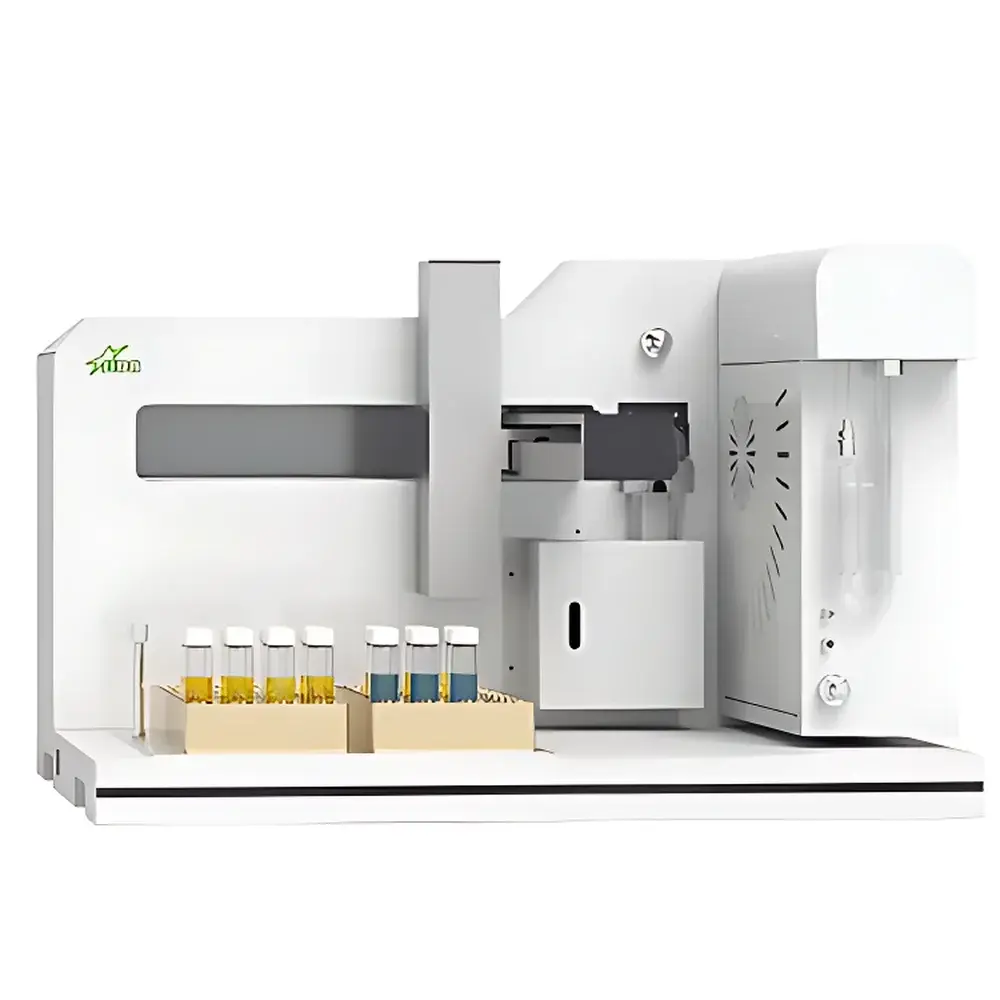
Shida HSP-64A Automated Purge and Trap Concentrator
| Brand | Shida |
|---|---|
| Origin | Shanghai, China |
| Manufacturer Type | Original Equipment Manufacturer (OEM) |
| Product Category | Domestic |
| Model | HSP-64A |
| Instrument Type | Water & Soil Integrated Purge and Trap System |
| Sample Tray Capacity | 64 positions |
Overview
The Shida HSP-64A Automated Purge and Trap Concentrator is a fully integrated, laboratory-grade sample preparation system engineered for the quantitative enrichment and transfer of volatile organic compounds (VOCs) from aqueous and solid matrices prior to gas chromatographic analysis. Based on the fundamental principle of dynamic headspace extraction—where inert gas purges VOCs from a heated, agitated sample into a cryogenically or resistively cooled trap—the HSP-64A delivers high recovery efficiency, low carryover, and robust reproducibility across environmental compliance workflows. Designed specifically for regulatory-driven laboratories performing EPA Method 502.2, 524.4, 8260D, and equivalent Chinese national standards (e.g., HJ 605–2011, HJ 639–2012, HJ 686–2014, HJ 713–2014, HJ 735–2015, HJ 806–2016, HJ 893–2017, and GB/T 5750.8–2023), the system supports both liquid-phase direct injection and solid-phase slurry preparation (e.g., soil/sediment + distilled water), eliminating manual derivatization or solvent extraction steps.
Key Features
- 64-position automated sample carousel with barcode-ready vial support for unattended overnight operation.
- Integrated purge, trap, desorption, and system cleaning—all controlled via unified software interface with audit-trail logging compliant with GLP/GMP data integrity requirements.
- Direct-resistive heating of the trap enables rapid thermal ramping (≥1000 °C/min) and precise temperature control during desorption, minimizing analyte degradation and ensuring sharp peak morphology in GC/MS.
- Self-purging bubble suppression design in the purge tube prevents liquid entrainment and protects downstream valves, traps, and transfer lines from contamination.
- Independent purge gas and backflush gas pathways isolate trap eluate from the purge stream, effectively eliminating cross-contamination between samples.
- Integrated vortex-type water removal module reduces water vapor load entering the GC inlet—critical for maintaining column integrity and detector sensitivity in electron ionization (EI) and selected ion monitoring (SIM) modes.
- All fluidic paths—including sample loop, transfer lines, six-port switching valves, and trap housing—are constructed from PEEK and silanized stainless steel, thermally insulated and actively heated (up to 220 °C) to eliminate cold spots and minimize adsorptive losses of polar VOCs.
- Optional internal standard spiking module enables automated, gravimetrically accurate addition at programmable intervals—supporting response factor normalization per ASTM D5845 and ISO 15681-2 protocols.
- Dedicated cleaning solution auto-dilution and delivery system ensures consistent, residue-free decontamination of purge tubes and traps between runs.
- Hardware synchronization output (TTL pulse) triggers GC oven start, valve actuation, and data acquisition simultaneously—ensuring temporal alignment critical for retention time locking and method transferability.
Sample Compatibility & Compliance
The HSP-64A accommodates a broad range of environmental sample types: raw drinking water, wastewater effluents, groundwater extracts, homogenized soils, sediments, sludges, and solid waste leachates. Solid samples are processed by automatic addition of distilled water (programmable volume) followed by mechanical agitation prior to purge initiation. The system meets full functional equivalence with U.S. EPA Methods 502.2 (VOCs in drinking water), 524.4 (VOCs in groundwater), and 8260D (VOCs in solid waste), as well as all referenced Chinese Ministry of Ecology and Environment (MEE) standards. Its architecture supports 21 CFR Part 11-compliant electronic signatures and audit trails when paired with validated LIMS or chromatography data systems (CDS). All thermal zones and timing parameters are user-configurable and logged with timestamped metadata for full traceability during regulatory audits.
Software & Data Management
The HSP-64A operates under Shida’s proprietary PurgeControl™ software—built on a Windows-based platform with intuitive graphical workflow builder, real-time status dashboard, and event-driven alarm management. Method files include complete thermal profiles, gas flow schedules, valve sequencing logic, and cleaning cycle definitions. All run logs are stored in encrypted SQLite databases with immutable timestamps and operator ID tagging. Raw instrument commands and sensor feedback (temperature, pressure, valve position) are recorded at 100 Hz resolution for forensic troubleshooting. Export options include CSV, XML, and vendor-neutral .cdx formats compatible with Thermo Fisher Chromeleon, Agilent OpenLab CDS, and Waters Empower platforms.
Applications
- Quantitative determination of BTEX (benzene, toluene, ethylbenzene, xylenes), chlorinated solvents (e.g., PCE, TCE), trihalomethanes (THMs), and fuel hydrocarbons (C2–C9) in drinking water per GB/T 5750.8–2023 and HJ 639–2012.
- Analysis of volatile petroleum hydrocarbons (VPH) in contaminated soil and sediment using HJ 735–2015 and HJ 605–2011.
- Screening of acrylonitrile and acrolein in surface water and industrial discharges per HJ 806–2016.
- Compliance testing of halogenated VOCs in landfill leachate and municipal solid waste per HJ 713–2014.
- Method validation studies requiring low-level detection (sub-ng/L), high precision (RSD < 5% at 10× MDL), and inter-laboratory reproducibility.
FAQ
Does the HSP-64A support integration with third-party GC and GC-MS systems?
Yes—it features universal analog/digital I/O ports and TTL-compatible trigger signals compatible with all major GC platforms including Agilent, Thermo Fisher, Shimadzu, and PerkinElmer.
Is the system compliant with FDA 21 CFR Part 11 requirements?
When deployed with validated PurgeControl™ software and an approved CDS, it supports electronic signatures, audit trails, and role-based access control required for regulated environments.
Can solid samples be introduced without pre-extraction?
Yes—soil, sediment, or sludge samples are automatically mixed with distilled water in the vial prior to purge, enabling direct slurry-phase VOC release per HJ 605–2011 and HJ 735–2015.
What materials are used in the sample pathway to ensure inertness?
All wetted surfaces consist of PEEK tubing and silanized stainless steel components, with active heating up to 220 °C to prevent adsorption of polar or reactive VOCs.
How is carryover minimized between samples?
Through independent backflush gas routing, high-efficiency water removal, automated trap bake-out cycles, and programmable multi-stage cleaning with fresh solvent delivery.



