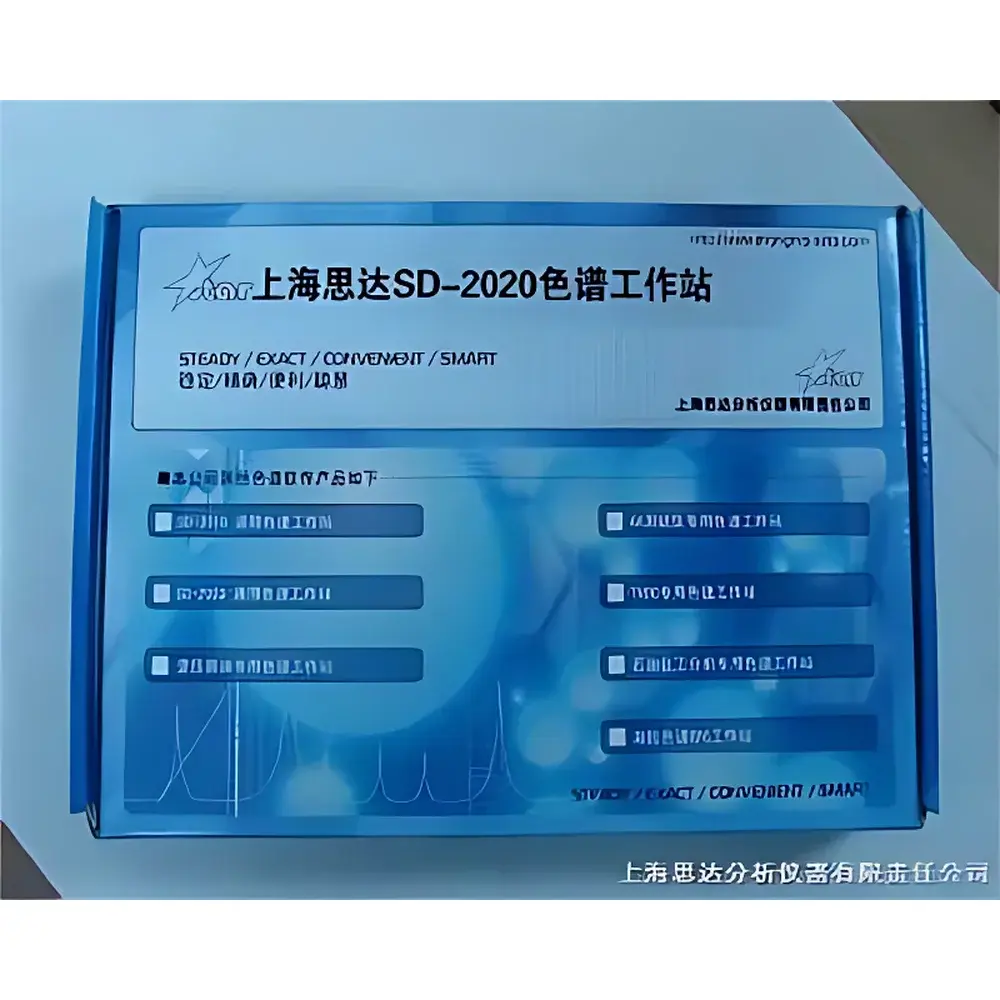
Shida SD2020 Chromatography Data System (CDS) Workstation
| Brand | Shida |
|---|---|
| Origin | Shanghai, China |
| Manufacturer Type | Original Equipment Manufacturer (OEM) |
| Country of Origin | China |
| Model | SD2020 |
| Software Type | Chromatography Data Acquisition and Analysis Software |
| Hardware Interface | Dual-channel, external 24-bit USB-powered data acquisition unit with RS-232 compatibility |
| Sampling Rates | 10 / 20 / 50 Hz |
| Input Voltage Range | ±2.5 V |
| Minimum Detectable Signal | 0.05 ± 0.02 µV |
| Integration Sensitivity | 1 µV·s |
| Dynamic Range | 10⁷ |
| Linearity | < ±0.1% |
| Electrical Isolation | Optocoupled interface |
| Connectivity | Auto-detect serial port, plug-and-play Ethernet-style connector with channel status LED |
Overview
The Shida SD2020 Chromatography Data System (CDS) Workstation is a dedicated, 32-bit Windows-native software platform engineered for robust acquisition, real-time processing, and regulatory-compliant reporting of chromatographic data. Designed specifically for gas chromatography (GC) and liquid chromatography (LC) instrumentation, the system implements a multithreaded architecture to ensure deterministic timing in data acquisition while maintaining full responsiveness during concurrent analytical tasks—such as report generation, method editing, or background file export. Its core algorithm engine delivers high reproducibility in peak detection, baseline estimation, and quantitative calculation under variable signal-to-noise conditions. The workstation operates as a complete turnkey solution when paired with the included dual-channel, 24-bit external data acquisition hardware—featuring optically isolated RS-232 communication, auto-triggered sampling initiation, and USB-supplied power to eliminate ground-loop interference. This architecture meets fundamental requirements for laboratory environments where electromagnetic compatibility (EMC), signal fidelity, and operational continuity are critical.
Key Features
- Real-time multithreaded data acquisition supporting simultaneous analysis, reporting, and system monitoring without resource contention
- Compliance-ready data handling: native support for AIA/ANDI (.cdf) file format per ASTM E1947 and NIST SRD 186 specifications
- Quantitative methodology suite including area/height-based integration, normalization (single/multi-point), internal/external standardization, and retention index calculation
- Advanced peak manipulation tools: manual baseline drawing, peak merging/splitting, tailing correction (fronting/dragging), vertical/horizontal slicing, and retention time alignment across multiple runs
- Dual-channel synchronized acquisition with independent gain and offset calibration per channel
- Hardware-level noise suppression via 24-bit resolution, optocoupled input isolation, and regulated USB power delivery
- Plug-and-play installation with auto-serial-port detection and visual channel-status indicators
Sample Compatibility & Compliance
The SD2020 CDS is compatible with a broad range of analog-output chromatographs—including legacy and modern GC/FID, GC/TCD, HPLC/UV-VIS, and HPLC/RI systems—provided they deliver ±2.5 V unipolar or bipolar analog signals. It supports method transfer between major OEM platforms (e.g., Agilent ChemStation, Waters Empower) through standardized AIA file interchange. While the software itself does not enforce 21 CFR Part 11 controls in its base configuration, the architecture permits audit-trail extension via third-party validation packages. All quantitative calculations adhere to ISO/IEC 17025 principles for measurement uncertainty estimation, and peak integration logic follows USP and EP 2.2.46 guidelines for chromatographic system suitability testing. GLP-compliant metadata capture—including operator ID, instrument ID, method version, and raw data checksum—is fully configurable.
Software & Data Management
Data files are stored in a structured local directory hierarchy with timestamped subfolders, supporting both .cdf (AIA) and proprietary .sd2 binary formats. Batch processing enables automated reintegration of archived runs using updated methods or calibration curves. Report templates are customizable in RTF or HTML and support bilingual (English/Chinese) output with embedded chromatograms, tables, and statistical summaries (RSD, resolution, tailing factor). The system logs all user actions—including method edits, integration parameter changes, and result approvals—in a tamper-evident activity log. Raw data integrity is preserved via SHA-256 hashing at acquisition time, and backup routines integrate with network-attached storage (NAS) or enterprise LIMS via configurable UNC paths.
Applications
The SD2020 CDS serves routine QC laboratories performing pharmaceutical assay validation (ICH Q2), environmental pollutant screening (EPA Method 8081/8270), food safety testing (AOAC 995.12), and petrochemical hydrocarbon profiling (ASTM D5503). Its high linearity (50% w/w) within a single run. The dual-channel capability supports parallel column configurations, valve-switching sequences, or simultaneous detector monitoring (e.g., FID + ECD), making it suitable for method development labs requiring flexible signal routing and comparative response evaluation.
FAQ
Does the SD2020 support 64-bit Windows operating systems?
No—the software is compiled exclusively for 32-bit Windows environments (Windows XP through Windows 10 32-bit); virtual machine emulation is required for 64-bit host compatibility.
Can raw data be exported to LIMS without proprietary software?
Yes—AIA-compliant .cdf files are natively readable by most LIMS platforms; ASCII export (CSV/TXT) is also available for peak tables and calibration data.
Is hardware calibration traceable to national standards?
The acquisition unit includes factory calibration certificates referencing NIM (National Institute of Metrology, China) standards; end-user verification protocols align with JJG 705–2014 (Chinese metrological verification regulation for chromatographic data systems).
What level of electronic signature support is provided?
Basic user authentication is implemented; full 21 CFR Part 11 compliance requires integration with validated identity management middleware and digital certificate infrastructure.
How is firmware updated on the external data acquisition module?
Firmware upgrades are delivered via signed HEX files and applied using the included utility; updates preserve all user-configured channel parameters and calibration coefficients.
Related Products