
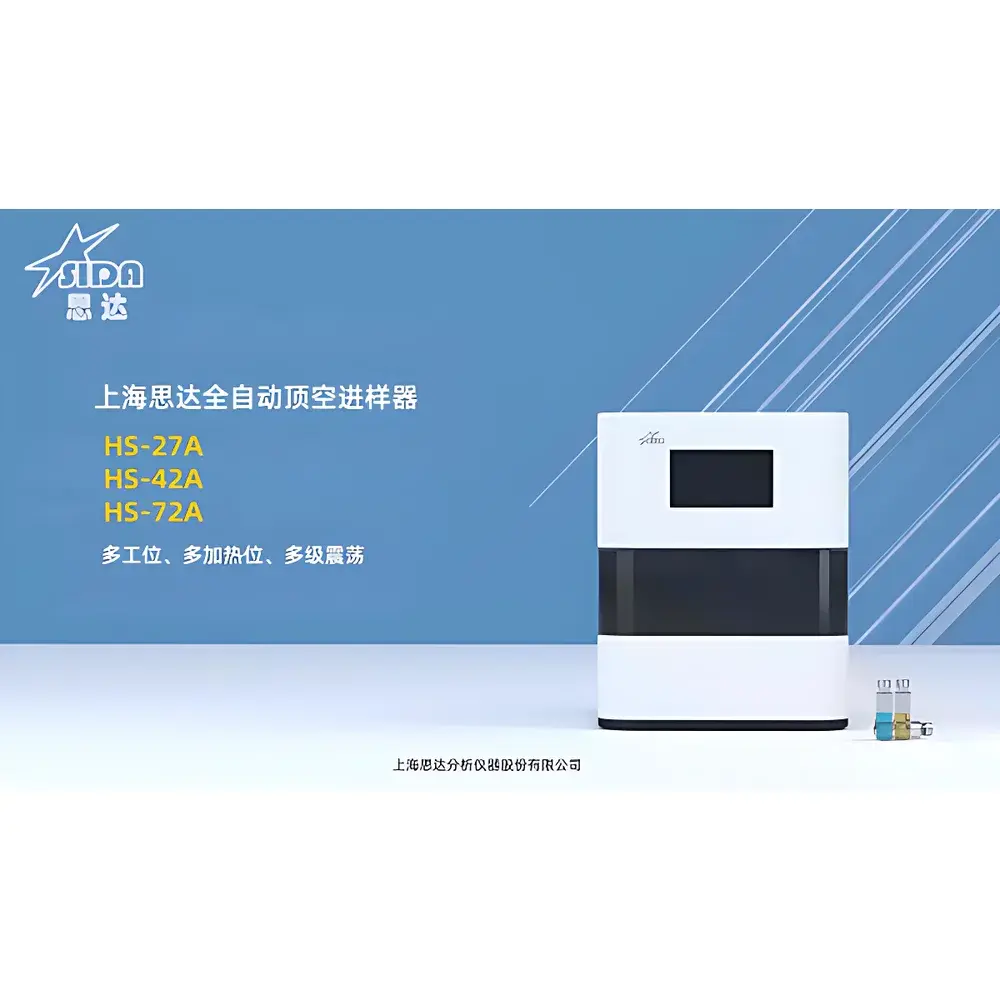
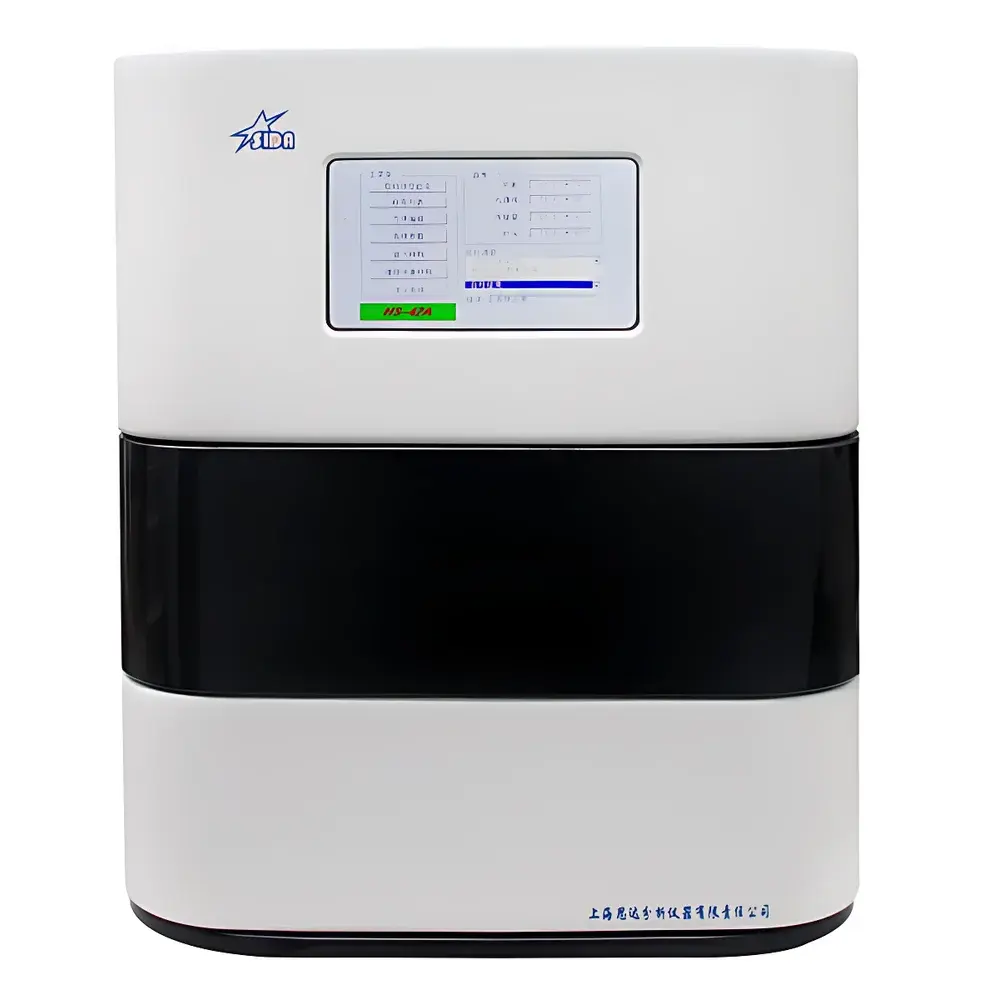
Sida HS-42A Automated Static Headspace Sampler
| Brand | Sida |
|---|---|
| Origin | Shanghai, China |
| Manufacturer Type | OEM Manufacturer |
| Regional Classification | Domestic (China) |
| Model | HS-42A |
| Instrument Type | Static Headspace Sampler |
| Automation Level | Fully Automatic |
| Sample Vial Capacity | 42 positions |
| Compatible Vial Sizes | 10 mL and 20 mL |
Overview
The Sida HS-42A Automated Static Headspace Sampler is an engineered solution for precise, reproducible, and high-throughput volatile organic compound (VOC) analysis in conjunction with gas chromatography (GC) or GC–mass spectrometry (GC–MS) systems. Based on the static headspace principle—where analytes partition between a sealed sample matrix and its equilibrated vapor phase—the HS-42A enables quantitative determination of volatile species without liquid-phase injection, thereby minimizing column contamination, inlet degradation, and carryover. Designed for laboratories requiring regulatory-compliant, unattended operation across environmental, pharmaceutical, food safety, forensic toxicology, and materials testing applications, the instrument delivers robust thermal control, inert flow path architecture, and deterministic sequence execution—key prerequisites for GLP/GMP-aligned workflows and method validation under ISO/IEC 17025.
Key Features
- Fully automated 42-position carousel accommodates standard 10 mL and 20 mL crimp-top or screw-cap headspace vials; start and end positions are user-definable to support partial batch runs and priority sample insertion.
- Integrated vial agitation mechanism enhances phase equilibrium kinetics—reducing equilibration time by up to 40% while improving sensitivity and inter-run precision for low-concentration VOCs.
- Six independently controlled heating zones allow overlapping thermal conditioning of multiple vials, enabling continuous sample processing and optimized cycle time per analysis.
- Real-time vial presence detection prevents sequence interruption due to missing or misloaded vials, ensuring data integrity and audit-trail continuity.
- Valve-and-loop sampling architecture ensures fixed, repeatable injection volumes (typically 0.5–2.0 mL, configurable via method); combined with PID-controlled oven and loop temperature zones (up to 220 °C), this design guarantees minimal condensation, maximum transfer efficiency, and long-term calibration stability.
- Entire sample pathway—including transfer lines, valves, and quantitative loop—is actively heated and chemically passivated (e.g., Siltek® or Sulfinert®-treated surfaces) to prevent adsorption, degradation, or memory effects—critical for trace-level aldehydes, ketones, halocarbons, and polar VOCs.
Sample Compatibility & Compliance
The HS-42A supports aqueous, semi-solid (e.g., soil, sediment, sludge), solid (e.g., polymers, medical devices, packaging), and biological matrices (e.g., blood, tissue homogenates). Its operational parameters align with internationally recognized standard methods, including but not limited to: ASTM D6866 (bio-based content), USP (residual solvents), EP 2.4.24 (VOCs in pharmaceutical excipients), and numerous Chinese EPA standards such as HJ 620–2011, HJ 642–2013, HJ 810–2016, and HJ 1289–2023. The system’s hardware architecture and firmware support 21 CFR Part 11-compliant electronic records when integrated with validated LIMS or chromatography data systems (CDS), including full audit trail logging for temperature setpoints, vial status, injection timing, and error events.
Software & Data Management
The HS-42A operates in dual-control mode: locally via a 7-inch capacitive touchscreen with intuitive icon-driven navigation, or remotely through PC-based control software compatible with Windows 10/11. Method development includes granular configuration of equilibration time (0–999 min), oven temperature (30–220 °C), agitator speed (0–1000 rpm), pressurization time, loop fill/purge cycles, and GC trigger logic. All methods and sequences are stored with metadata (user ID, timestamp, version), exportable in CSV or XML format. Software enforces role-based access control (RBAC), supports electronic signatures, and generates PDF-formatted run reports containing real-time temperature profiles, vial status logs, and fault diagnostics—facilitating internal QA review and external regulatory submissions.
Applications
- Environmental monitoring: quantification of BTEX, chlorinated solvents, and emerging contaminants (e.g., 1,4-dioxane, MTBE) in water, soil, and landfill leachate per HJ 741–2015 and HJ 760–2015.
- Pharmaceutical quality control: residual ethylene oxide (EO) in sterilized devices per GB/T 16886.7–2015 and USP .
- Forensic toxicology: blood alcohol concentration (BAC) measurement per GA/T 842–2019 using n-propanol internal standard calibration.
- Packaging safety: VOC migration screening from food-contact materials per SN/T 4148–2015.
- Industrial hygiene: workplace air monitoring of acetone, MEK, and acetonitrile in workplace wipe samples or sorbent tubes re-analyzed via thermal desorption–GC–MS coupling.
FAQ
What sample vial formats does the HS-42A support?
The instrument accepts industry-standard 10 mL and 20 mL headspace vials with crimp-seal or screw-cap closures. Vial dimensions comply with ASTM D7277 and ISO 11923 specifications.
Does the HS-42A support method validation per ICH Q2(R2)?
Yes—its thermal stability, injection precision (<2% RSD over 24 h), and system suitability test (SST) functionality (e.g., replicate injections, blank tracking, carryover assessment) meet key ICH Q2(R2) criteria for accuracy, repeatability, and robustness.
Can the HS-42A be integrated with third-party GC or GC–MS systems?
It features universal TTL and RS-232/485 interfaces, plus optional Ethernet (TCP/IP) connectivity, enabling seamless synchronization with Agilent, Thermo Fisher, Shimadzu, and PerkinElmer platforms via standard GC start/stop triggers and status feedback.
Is remote monitoring and troubleshooting supported?
Yes—via secure HTTPS-enabled web interface (optional firmware upgrade), allowing real-time status viewing, log download, and diagnostic parameter adjustment from off-site locations without compromising network security.
What maintenance intervals are recommended for long-term reliability?
Quarterly valve cleaning and annual loop calibration are advised; consumables (septa, O-rings, transfer lines) are field-replaceable with documented SOPs included in the technical manual.
Related Products



