
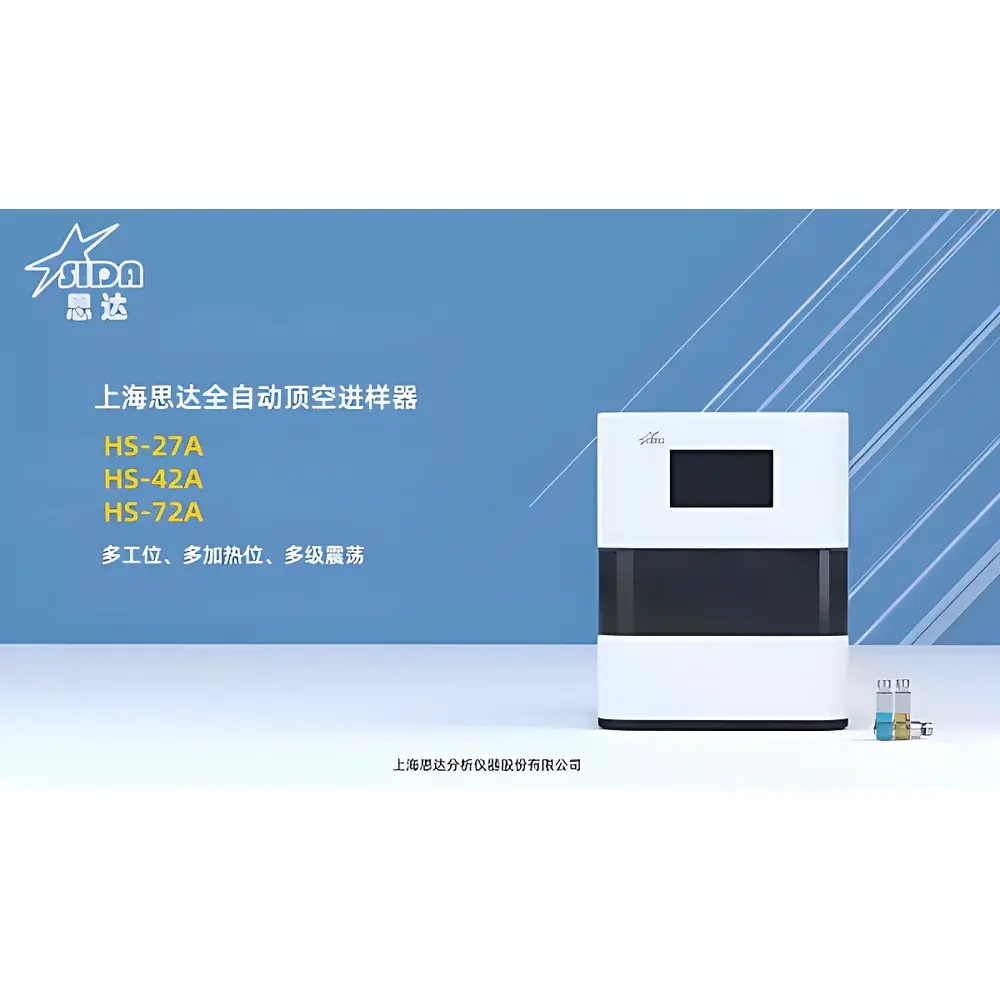
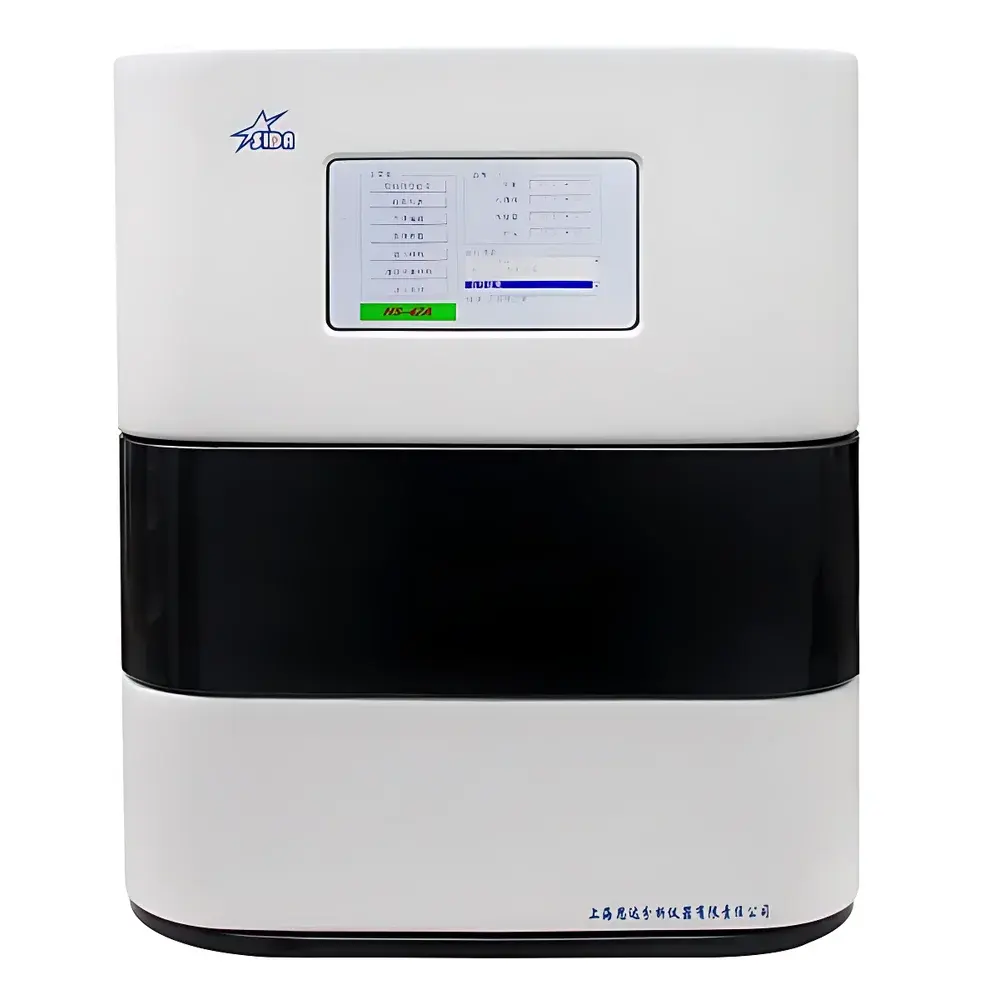
Sida HS-27A Fully Automated Static Headspace Sampler
| Brand | Sida |
|---|---|
| Origin | Shanghai, China |
| Manufacturer Type | OEM Manufacturer |
| Regional Origin | Domestic (China) |
| Model | HS-27A |
| Instrument Type | Static Headspace Sampler |
| Automation Level | Fully Automatic |
| Sample Vial Capacity | 27 positions |
| Compatible Vial Sizes | 10 mL and 20 mL |
Overview
The Sida HS-27A Fully Automated Static Headspace Sampler is an engineered solution for precise, reproducible, and high-throughput volatile organic compound (VOC) analysis in compliance with international chromatographic workflows. It operates on the principle of static headspace equilibrium—where a sealed sample vial is heated to thermally partition analytes between the liquid/solid matrix and the gas phase above it. After equilibration, a fixed-volume gas-phase aliquot is transferred via a pressurized valve-and-loop system into a coupled gas chromatograph (GC) or GC–MS. This methodology eliminates solvent use, minimizes matrix interference, and significantly reduces column and inlet contamination—making it ideal for environmental, clinical, pharmaceutical, food safety, and forensic laboratories requiring robust, low-maintenance sample introduction.
Key Features
- Fully automated 27-position carousel accommodates standard 10 mL and 20 mL crimp-top headspace vials—enabling unattended batch processing for up to 27 samples per sequence.
- User-definable start/end vial positions allow flexible run customization for partial batches or priority-sample insertion without interrupting the instrument queue.
- Integrated vial agitation (orbital shaking) accelerates headspace equilibration kinetics, improving method sensitivity, peak shape, and inter-run reproducibility—particularly for viscous or heterogeneous matrices.
- Six independently controlled heating zones support overlapping thermal conditioning: while one vial equilibrates, others may be preheated or cooled, optimizing total cycle time without compromising temperature stability.
- Real-time vial presence detection prevents sequence errors caused by missing or misloaded vials—ensuring data integrity and eliminating manual verification steps.
- Valve-and-fixed-loop injection architecture delivers consistent, metered sample volumes (typically 0.5–2.0 mL, configurable per method), minimizing carryover and enhancing quantitative precision.
- Entire sample pathway—including transfer lines, loop, and injection valve—is actively temperature-controlled and chemically passivated (e.g., Siltek® or Sulfinert®-treated surfaces) to prevent adsorption, condensation, or catalytic degradation of reactive VOCs.
Sample Compatibility & Compliance
The HS-27A supports diverse sample types including aqueous solutions, soils, sediments, solid waste, blood, packaging materials, medical device extracts, and polymer leachates. Its design aligns with critical regulatory frameworks governing analytical validity: methods implemented on this platform are compatible with EPA Method 502.2, ASTM D6866, ISO 11843-2, and pharmacopeial standards including USP (Residual Solvents) and EP 2.4.24. The instrument’s hardware architecture and operational logic support GLP/GMP environments—facilitating audit-ready documentation when paired with compliant chromatography data systems (CDS). Temperature calibration traceability follows ISO/IEC 17025 requirements, and thermal uniformity across all vial positions is validated per ICH Q2(R2) guidelines for analytical method validation.
Software & Data Management
Control is available via dual interfaces: a responsive 7-inch capacitive touchscreen with intuitive icon-driven navigation, or remote operation through PC-based software compatible with Windows 10/11. Method development includes granular control over equilibration time (0–999 min), oven and vial block temperatures (30–200 °C, ±0.1 °C), shake speed (0–500 rpm), pressurization time, loop fill volume, and injection dwell. All parameters are stored as encrypted .mth files with full version history. Sequence templates support conditional logic (e.g., pause after specific injections), auto-recovery from power loss, and real-time status overlays showing current vial ID, temperature profiles, and GC trigger signals. Audit trails log user actions, parameter changes, and system events in accordance with FDA 21 CFR Part 11 requirements when integrated with validated CDS platforms.
Applications
The HS-27A serves as a primary sample introduction tool in accredited laboratories performing analyses referenced in over 20 Chinese national and industry standards—including HJ 620–2011 (volatile halogenated hydrocarbons in water), HJ 642–2013 (VOCs in soil/sediment), HJ 810–2016 (VOCs in water by GC–MS), GA/T 842–2019 (blood ethanol quantification), GB/T 16886.7–2015 (ethylene oxide residue in medical devices), and HJ 1289–2023 (ketones and ethers in soil). It is routinely deployed for residual solvent testing in APIs, flavor profiling in beverages, VOC screening in indoor air monitoring, forensic toxicology, and leachable studies in pharmaceutical packaging—where regulatory defensibility, inter-laboratory comparability, and long-term operational reliability are non-negotiable.
FAQ
What sample vial formats does the HS-27A support?
It accepts standard 10 mL and 20 mL crimp-top headspace vials with magnetic or screw caps—compatible with most commercially available autosampler vials.
Is the HS-27A compatible with third-party GC and GC–MS systems?
Yes—it features universal TTL and RS-232/485 interfaces for seamless synchronization with Agilent, Thermo Fisher, Shimadzu, PerkinElmer, and other major GC platforms.
Does the system support method validation under GLP or GMP conditions?
Its hardware design, temperature traceability, electronic logging capabilities, and integration readiness with 21 CFR Part 11-compliant CDS enable full validation per ICH, USP, and ISO guidelines.
How is carryover minimized during high-concentration sample analysis?
The system employs inertized flow paths, programmable bake-out cycles, and optional split venting to purge residual analytes between injections—validated to achieve <0.05% carryover for chloroform and benzene at 100 ppm levels.
Can the HS-27A be integrated into a laboratory information management system (LIMS)?
Yes—via ASCII file export, OPC UA protocol support, or custom API integration, enabling bidirectional sample tracking and result reporting within enterprise LIMS environments.
Related Products





