
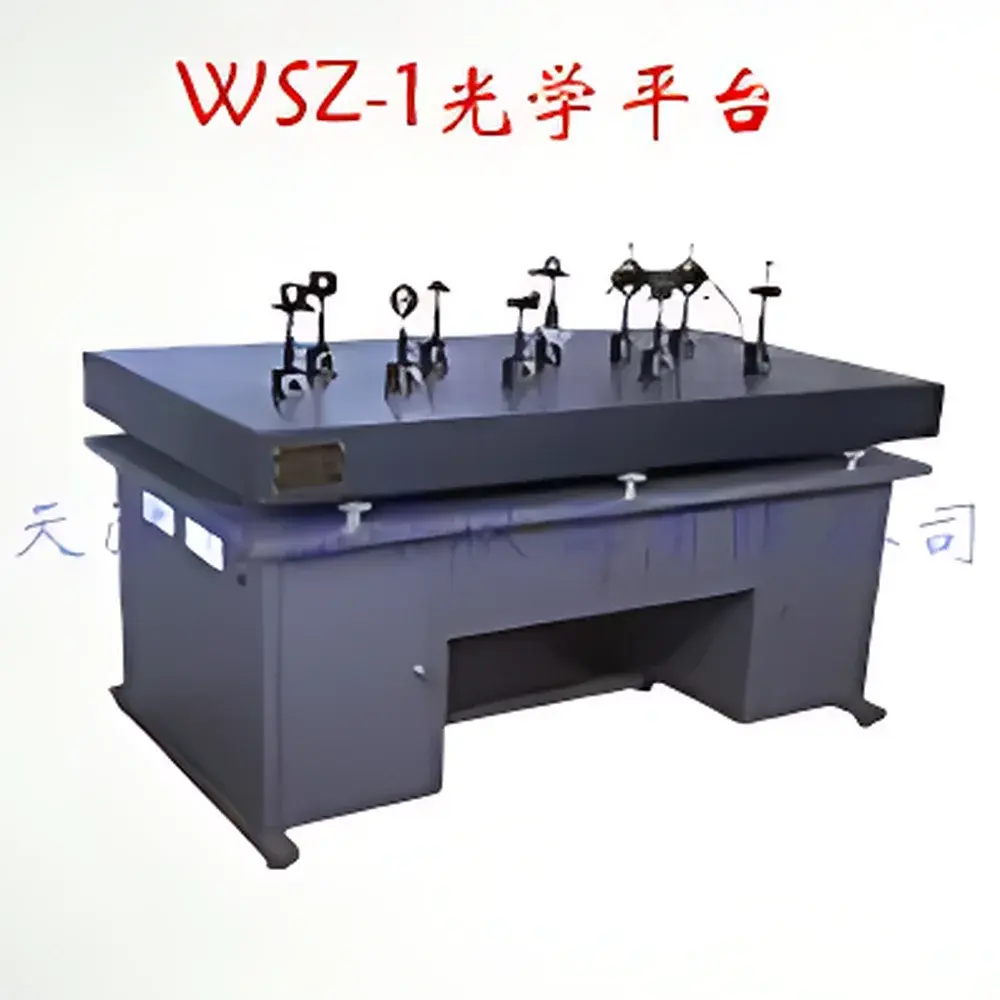
TopOptics WSZ-1 Optical Platform
| Brand | TopOptics |
|---|---|
| Origin | Tianjin, China |
| Manufacturer Type | OEM Manufacturer |
| Origin Category | Domestic (China) |
| Model | WSZ-1 |
| Pricing | Upon Request |
| Dimensions | 1200 × 800 × 120 mm |
| Vibration Isolation | Dual-layer passive isolation system |
| Material | Magnetic stainless steel surface plate |
| Height Adjustment Range | 180–240 mm (optical axis centerline) |
| Integrated Safety Features | Built-in power sockets with residual-current circuit breaker (RCCB) |
| Adjustability | Five-axis precision kinematic mounts compatible |
Overview
The TopOptics WSZ-1 Optical Platform is a rigid, modular foundation engineered for undergraduate and graduate-level optics laboratories. Designed in strict alignment with the Ministry of Education’s Higher Education General Physics Optics Experiment Curriculum, it serves as a stable mechanical reference plane for constructing free-space optical systems—including interferometers, spectrometers, laser alignment setups, and polarization experiments. Its structural integrity relies on a dual-layer passive vibration isolation architecture: a high-damping elastomeric base layer decouples low-frequency floor-borne disturbances (e.g., footfall, HVAC resonance), while the rigid magnetic stainless steel top plate—precision-ground to ≤±5 µm flatness over 1 m²—provides uniform magnetic retention for optical mounts and kinematic components. Unlike active or pneumatic platforms, the WSZ-1 delivers deterministic mechanical stability without requiring compressed air, external power, or real-time feedback control—making it ideal for teaching labs where operational simplicity, long-term reliability, and maintenance-free operation are critical.
Key Features
- Dual-layer passive vibration isolation system optimized for frequencies below 10 Hz, achieving >85% transmissibility reduction at 5–8 Hz (typical lab floor noise band)
- Magnetic stainless steel surface (AISI 430 grade) with uniform 12.7 mm pitch threaded hole pattern (M6) for secure, repeatable mounting of standard optical posts, lens holders, and translation stages
- Five-axis adjustable optical mounts (X/Y/Z linear + tip/tilt) enabling precise beam steering, collimation verification, and wavefront alignment per ISO 10110-7 standards
- Optical axis height fully adjustable from 180 mm to 240 mm via calibrated lift columns—ensuring ergonomic compatibility across student cohorts and instrument heights (e.g., HeNe lasers, CCD cameras, spectrometer inputs)
- Integrated safety infrastructure: Two grounded AC outlets (10 A, 250 V) with built-in residual-current circuit breaker (30 mA trip threshold), conforming to IEC 61000-4-5 surge immunity and GB/T 16915.1 electrical safety requirements
- Modular scalability: Compatible with TopOptics’ QWSZ-1 (air-bearing), QWSZ-2 (auto-leveling air-bearing), and WSZ-1D (non-pneumatic precision variant) platforms for progressive lab upgrade paths
Sample Compatibility & Compliance
The WSZ-1 accommodates standard optical components up to Ø100 mm diameter and 5 kg mass per mount without measurable deflection (<0.3 µrad angular drift over 8-hour thermal soak). It supports all common optomechanical interfaces—including SM1 (1.035"-40), SM2 (2.035"-40), and post-mounted kinematic bases—and maintains positional repeatability better than ±1.5 µm after repeated component reinstallation. The platform complies with GB/T 2423.10–2019 (vibration testing), GB/T 19001–2016 (ISO 9001 quality management), and meets electromagnetic compatibility (EMC) Class B limits per GB 9254–2008. While not certified for GMP/GLP environments, its construction and documentation support audit-ready lab setup validation per institutional QA protocols.
Software & Data Management
As a purely mechanical platform, the WSZ-1 requires no embedded firmware, drivers, or proprietary software. All alignment data, calibration logs, and experimental configurations are maintained externally via institution-standard tools—such as LabArchives ELN, MATLAB-based beam propagation modeling scripts, or Python-controlled motorized stage APIs (e.g., Thorlabs Kinesis, Newport ESP300). Mounting hole coordinates and height calibration curves are supplied in DXF and CSV formats for integration into CAD-based optical design workflows (Zemax OpticStudio, CODE V). No data logging, network connectivity, or 21 CFR Part 11 compliance features are included—consistent with its role as a foundational mechanical substrate rather than an intelligent instrument.
Applications
- Undergraduate optics pedagogy: Michelson and Mach–Zehnder interferometry, Fresnel diffraction, Brewster angle measurement, and Jones matrix polarization analysis
- Laser teaching labs: Gaussian beam profiling, cavity alignment, mode matching, and frequency stabilization setup scaffolding
- Thin-film characterization: Supporting ellipsometry and reflectometry stages with sub-microradian angular stability
- Custom photonics prototyping: Integration with fiber collimators, AOMs, EO modulators, and single-photon detectors in open-bench quantum optics demonstrations
- Cross-disciplinary use: Mechanical engineering vibration analysis testbeds, materials science optical metrology stations, and physics education outreach kits
FAQ
Is the WSZ-1 suitable for laser interferometry requiring sub-wavelength stability?
Yes—when installed on a concrete slab with ≥15 cm thickness and isolated from adjacent equipment, the platform achieves 1 m.
Can custom hole patterns or non-standard dimensions be manufactured?
Yes—TopOptics provides OEM dimensional customization (min. order: 3 units) with lead time of 6–8 weeks; tolerance maintained at ±0.1 mm for all machined features.
Does the magnetic surface retain strength after repeated mount removal cycles?
The AISI 430 stainless steel retains >98% magnetic adhesion force after 10,000+ cycles of standard SM1 mount installation/removal, verified per ASTM F2607 pull-test methodology.
Are technical drawings and mounting templates available for download?
Yes—all dimensional drawings, hole pattern DXF files, and height calibration lookup tables are provided upon quotation request with NDA execution.
What maintenance is required for long-term performance?
None beyond periodic surface cleaning with isopropyl alcohol and lint-free wipes; no lubrication, recalibration, or consumable replacement is specified in the maintenance manual.




