
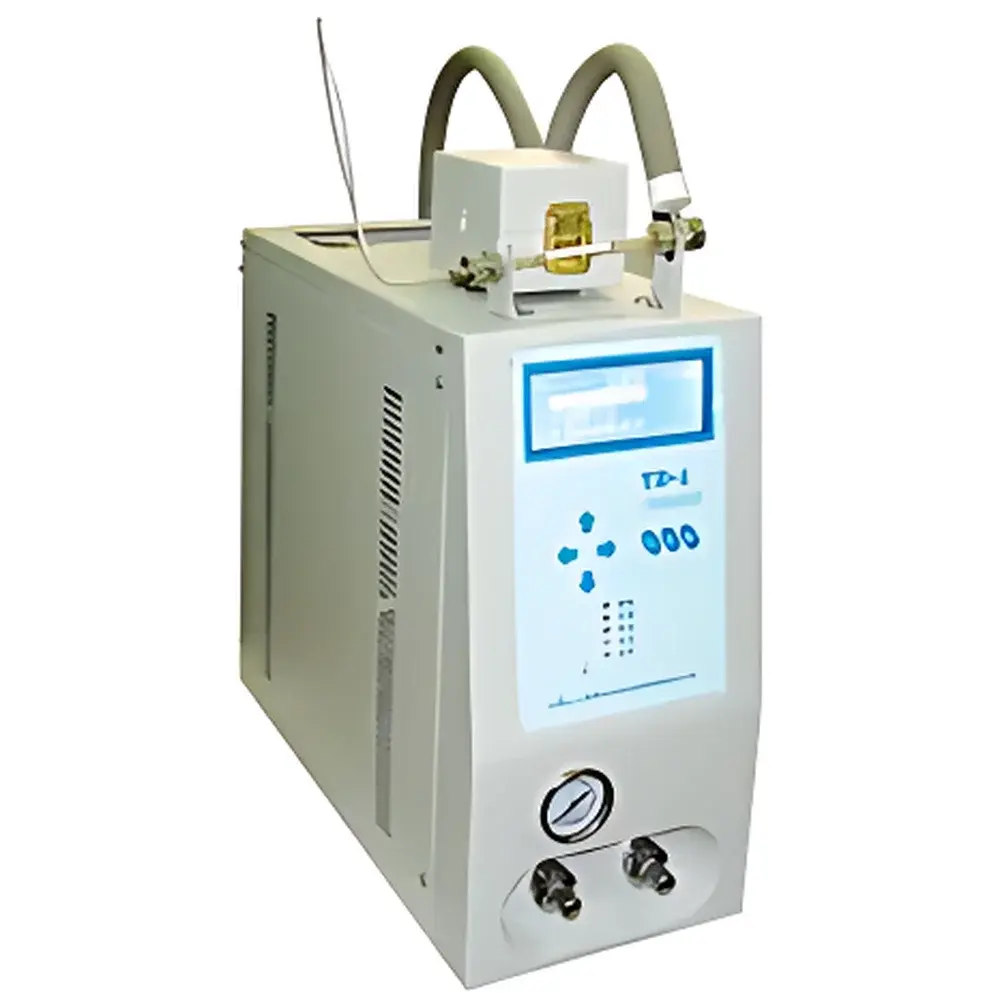
Sida TD-1 Universal Thermal Desorber
| Brand | Sida |
|---|---|
| Origin | Shanghai, China |
| Manufacturer Type | OEM Manufacturer |
| Regional Classification | Domestic (China) |
| Model | TD-1 |
| Price Range | USD 2,800 – 4,200 (FOB Shanghai) |
| Instrument Type | Single-Stage Thermal Desorber |
| Compatibility | GC-Compatible (Universal Interface for Domestic & Imported Gas Chromatographs) |
Overview
The Sida TD-1 Universal Thermal Desorber is a single-stage, benchtop thermal desorption unit engineered for precise, reproducible introduction of volatile and semi-volatile organic compounds (VOCs and SVOCs) from sorbent-packed tubes into gas chromatography (GC) systems. It operates on the principle of controlled resistive heating to thermally desorb analytes adsorbed onto Tenax®, Carbopack™, or other standard sorbent media, followed by rapid transfer—via carrier gas flow—into the GC injector or directly onto a cryo-focused column head. Designed for laboratories requiring robust, cost-effective sample introduction without sacrificing method flexibility, the TD-1 supports both quantitative environmental monitoring (e.g., indoor air, workplace atmospheres per ISO 16017-1 and EPA TO-17) and routine quality control in pharmaceutical, polymer, and materials testing labs. Its architecture prioritizes thermal stability, minimal carryover, and seamless integration with legacy and modern GC platforms—regardless of manufacturer.
Key Features
- Universal GC interface: Compatible with all major domestic and international gas chromatographs via standard split/splitless inlet connections and TTL/relay trigger outputs.
- Dual independent heating zones: Simultaneous operation of the desorption furnace (0–400 °C, ±0.5 °C accuracy) and tube activation furnace (0–400 °C), enabling parallel sample preparation and conditioning.
- Rapid thermal ramping: Programmable heating rates up to 100 °C/min with <1.5 °C temperature gradient across the tube bed—ensuring uniform desorption efficiency.
- Heated transfer line: Stainless-steel output line maintained at 100–300 °C (user-selectable) to prevent analyte condensation and wall adsorption during transfer.
- Cross-contamination mitigation: Integrated tube cleaning mode (high-flow inert gas purge at elevated temperature) between runs; validated residual recovery <0.5% for benzene, toluene, and naphthalene.
- Ergonomic tube handling: Spring-loaded, O-ring-sealed quartz or stainless-steel tube holders with visual alignment guides—enabling tool-free insertion/removal and leak-tight sealing (tested to <1×10⁻⁸ mbar·L/s He).
- Embedded parameter memory: Stores up to four complete method sets—including desorption time (0.1–30 min), injection time (0.01–10 min), and post-desorption purge duration—accessible via intuitive rotary encoder interface.
Sample Compatibility & Compliance
The TD-1 accepts standard 1/4″ OD stainless-steel or quartz thermal desorption tubes (60–150 mm length, 2–4 mm ID), including commercially available formats from Markes International, PerkinElmer, and Thermo Fisher. It supports multi-bed sorbents (e.g., Tenax TA + Carbograph 1TD + Carbopack X) and accommodates both ambient and active sampling configurations. The system meets mechanical and operational requirements outlined in ISO 16017-1:2000 (Indoor, ambient and workplace air — Sampling and analysis of volatile organic compounds using sorbent tubes, thermal desorption and gas chromatography), ASTM D6196-22 (Standard Practice for Selecting Air Monitoring Methods for Formaldehyde and Other Carbonyl Compounds), and EPA Method TO-17. While not a 21 CFR Part 11–compliant instrument out-of-the-box, its TTL-triggered operation enables full audit-trail integration when paired with compliant GC data systems (e.g., Agilent OpenLab CDS, Thermo Chromeleon).
Software & Data Management
The TD-1 operates as a standalone hardware module with no proprietary PC software required. All timing, temperature, and sequence parameters are configured locally via a high-contrast OLED display and tactile encoder. For automated workflow synchronization, it provides three TTL-compatible digital outputs (desorption start, injection start, and cycle complete) and one input (external start trigger), allowing direct coordination with GC acquisition software or LIMS interfaces. When used in regulated environments, method parameters and run logs (date/time stamp, setpoints, operator ID if entered manually) can be exported via optional RS-232 or USB-to-serial adapter for inclusion in electronic batch records. Firmware updates are delivered via microSD card—supporting version-controlled traceability per GLP/GMP documentation standards.
Applications
- Environmental air analysis: Quantification of BTEX, PAHs, aldehydes, and chlorinated solvents in indoor air, ambient monitoring networks, and occupational hygiene surveys.
- Materials emission testing: VOC profiling from carpets, adhesives, automotive interiors, and building products per ISO 16000-9 and ASTM D5116.
- Pharmaceutical packaging: Residual solvent screening in blister foils, bottle caps, and primary containers using USP compliant protocols.
- Forensic and failure analysis: Trace-level detection of accelerants, plasticizers, or degradation products in fire debris or polymer matrix failures.
- Method development labs: Rapid screening of sorbent performance, desorption optimization, and breakthrough volume validation under controlled flow/temperature conditions.
FAQ
Is the TD-1 compatible with cryogenic focusing modules?
Yes—its heated transfer line and TTL trigger outputs support integration with external cryo-traps (e.g., Gerstel CIS, Markes UNITY-xr) when configured for cold trap desorption workflows.
Does it support multi-step desorption (e.g., low-temp bake-out followed by high-temp desorption)?
No—the TD-1 is a single-stage desorber. Multi-step thermal programs require external controller coordination or a two-stage instrument such as the TD-2 or UNITY series.
Can I use it with GC-MS systems?
Yes—provided the GC inlet is configured for direct desorption injection (e.g., splitless mode with retention gap) and the MS source is optimized for transient peak intensity; method validation is recommended per ICH Q2(R2) guidelines.
What maintenance is required for long-term reliability?
Quarterly verification of furnace calibration (NIST-traceable thermometer), annual O-ring replacement in tube holders, and biannual cleaning of the internal gas path with methanol and dry nitrogen.
Is technical documentation available in English with CE/UKCA conformity statements?
Full English user manual, safety compliance summary (IEC 61010-1:2010), and RoHS declaration are supplied. CE marking applies to the power supply unit; full instrument CE certification requires lab-specific risk assessment per Machinery Directive 2006/42/EC.
Related Products



