
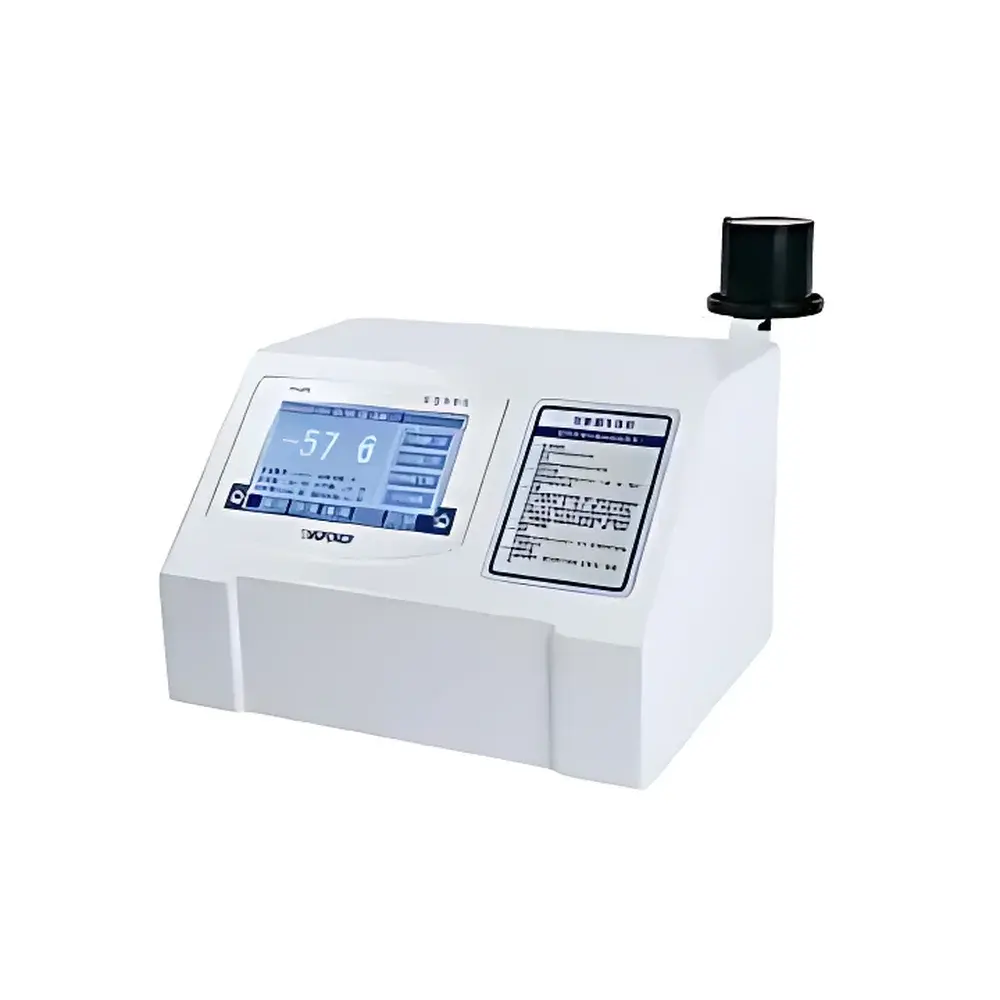
Hydrazine Analyzer TP308 by TimePower
| Brand | TimePower |
|---|---|
| Origin | Beijing, China |
| Manufacturer Type | Manufacturer |
| Origin Category | Domestic |
| Model | TP308 |
| Instrument Type | Benchtop |
| Analyte | Hydrazine (N₂H₄) |
| Detection Principle | Photometric Colorimetry (p-Dimethylaminobenzaldehyde Method) |
| Measurement Range | 0–100 µg/L |
| Detection Limit | 1 µg/L |
| Response Time | ≤1 s |
| Accuracy | ±2% F.S. |
| Repeatability | ≤1% |
| Stability | ±1% F.S. / 4 h |
| Resolution | 0.1 µg/L |
| Operating Temperature | 5–45 °C |
| Relative Humidity | ≤90% RH (non-condensing) |
| Power Supply | AC 85–265 V, 45–65 Hz |
| Power Consumption | ≤30 W |
| Dimensions | 260 × 200 × 180 mm |
| Weight | 3.2 kg |
| Display | 5.0-inch capacitive color touchscreen (Chinese UI) |
| Data Storage | 256 entries (circular buffer) |
| Compliance | GB/T Standard Method (p-Dimethylaminobenzaldehyde Spectrophotometry) |
Overview
The TimePower TP308 Hydrazine Analyzer is a benchtop photometric instrument engineered for precise, trace-level quantification of hydrazine (N₂H₄) in ultrapure water matrices. It operates on the internationally recognized p-dimethylaminobenzaldehyde (p-DMAB) colorimetric reaction: under acidic conditions, hydrazine condenses with p-DMAB to form a stable yellow azo dye with maximum absorbance at 455 nm. This absorbance is linearly proportional to hydrazine concentration within the validated range of 0–100 µg/L. Designed specifically for high-reliability applications in thermal power generation—such as boiler feedwater, condensate, and demineralized water circuits—the TP308 meets the stringent chemical purity requirements defined in ASTM D1066, IAPWS TR-02, and DL/T 934–2021. Its optical architecture integrates a temperature-stabilized, long-life cold LED light source and precision photodiode detection, minimizing thermal drift and ensuring consistent photometric performance across ambient laboratory and plant-floor environments (5–45 °C).
Key Features
- Benchtop form factor with compact footprint (260 × 200 × 180 mm) and lightweight design (3.2 kg) for flexible placement in QC labs or control rooms.
- 5.0-inch capacitive color touchscreen interface with native Chinese language support—intuitive navigation, real-time measurement display, and embedded operational guidance.
- Optimized optical path using imported monochromatic cold LED source: low power consumption (10,000-hour service life—critical for maintaining baseline stability in continuous monitoring scenarios.
- Automated timing sequence with built-in 1-second response trigger and audible/visual alert upon assay completion—reducing operator dependency and improving throughput consistency.
- Dual-point calibration protocol: zero-point blank calibration eliminates electronic and optical zero drift; two-point standard calibration (using certified N₂H₄ reference solutions) corrects for nonlinearity and matrix effects.
- Onboard data management: circular memory buffer stores up to 256 measurement records (timestamp, concentration, operator ID, calibration status); overflow auto-deletion prevents storage corruption.
- Robust mechanical construction utilizing surface-mount technology (SMT) and integrated circuit shielding—resistant to electromagnetic interference common in industrial power plant settings.
Sample Compatibility & Compliance
The TP308 is validated for use with Type I ultrapure water (resistivity ≥18.2 MΩ·cm, TOC <1 µg/L) generated via mixed-bed ion exchange or EDI systems. Sample introduction is manual via calibrated sample cup; no peristaltic pump or fluidic automation is included. All reagents—including p-DMAB reagent solution and acid catalyst—must be prepared using ASTM Type I reagent water and stored in labeled, UV-resistant polyethylene containers. The analyzer conforms to national standard GB/T 5750.11–2023 (Standard Methods for Examination of Drinking Water: Hydrazine) and aligns with ISO 7027–1:2016 principles for turbidity-corrected absorbance measurement. While not FDA 21 CFR Part 11–compliant out-of-the-box, audit trails and calibration logs are timestamped and exportable via USB for GLP/GMP documentation workflows.
Software & Data Management
The embedded firmware supports full traceability: each measurement entry includes date/time stamp, user-defined sample ID, calibration verification flag, and raw absorbance value. Data export is supported via USB flash drive in CSV format—compatible with LIMS integration and statistical process control (SPC) platforms. Firmware updates are delivered via offline USB package to maintain network isolation—a requirement in regulated utility environments. No cloud connectivity or remote access functionality is implemented, preserving data sovereignty and cybersecurity integrity per NIST SP 800-82 guidelines for industrial control systems.
Applications
- Real-time hydrazine residual monitoring in nuclear and fossil-fueled power plant water-steam cycles to verify oxygen scavenging efficacy and prevent corrosion under deposits (CUD).
- Final rinse water testing in semiconductor wafer fabrication cleanrooms where sub-ppb hydrazine carryover may impact gate oxide integrity.
- Pharmaceutical purified water (PW) and water for injection (WFI) system validation per USP and EU GMP Annex 1, supporting risk-based qualification of deaeration and chemical dosing units.
- Process water quality assurance in synthetic fiber (e.g., nylon-6,6) and fine chemical synthesis facilities where hydrazine serves as a reducing agent or catalyst precursor.
FAQ
What is the recommended frequency for blank and calibration verification?
Blank calibration must be performed daily prior to analysis. Full two-point calibration using certified hydrazine standards (e.g., 10 µg/L and 50 µg/L) is required every 14 days—or immediately after reagent lot change, lamp replacement, or instrument relocation.
Can the TP308 measure hydrazine in seawater or wastewater matrices?
No. The method is validated exclusively for ultrapure water with conductivity <0.1 µS/cm. High ionic strength, turbidity, or interfering amines (e.g., monoethanolamine) cause significant positive bias and are outside the scope of this instrument’s design envelope.
Is the p-DMAB reagent supplied with the instrument?
No. Reagents are consumables and must be procured separately. TimePower offers traceable hydrazine standard solutions (NIST-traceable, ±1.5% uncertainty) and pre-formulated p-DMAB kits optimized for TP308’s reaction kinetics and shelf-life requirements.
Does the instrument support external printer or network output?
No. Data output is limited to USB mass storage export. Hardcopy reporting requires manual import into spreadsheet or reporting software.
What maintenance intervals are specified for optical components?
The LED light source requires no scheduled replacement within 5 years of typical usage (≤8 hrs/day). Optical path cleaning with lint-free, ethanol-moistened swabs is recommended quarterly—or whenever absorbance noise exceeds 0.5% RSD over 10 consecutive blanks.







