
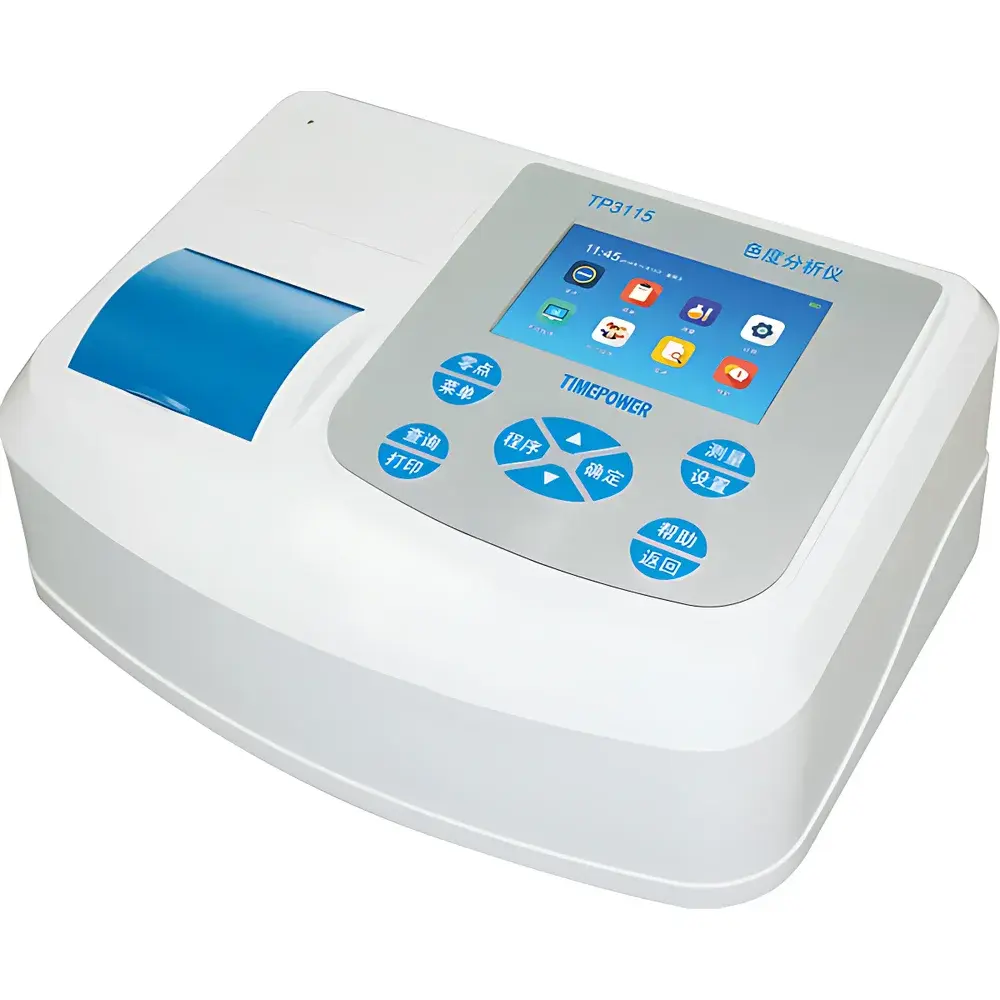
Timepower TP3115 Colorimeter
| Brand | Timepower |
|---|---|
| Origin | Beijing, China |
| Manufacturer Type | Manufacturer |
| Model | TP3115 |
| Measurement Principle | Photometric Colorimetry (based on Lambert-Beer Law) |
| Measurement Range | 2–500 Hazen (Pt-Co) units |
| Accuracy | ≤ ±5% FS |
| Repeatability | ≤ 5% RSD |
| Cell Type | Cuvette-based |
| Display | 5.0-inch color LCD (English/Chinese switchable) |
| Data Storage | 30,000 measurement records + 96 customizable calibration curves |
| Interface | USB 2.0, Ethernet (RJ45) |
| Power Supply | AC 220 V ±10%, 50 Hz |
| Power Consumption | 5 W |
| Operating Temperature | 5–40 °C |
| Relative Humidity | ≤85% RH (non-condensing) |
| Dimensions | 348 × 250 × 145 mm |
| Weight | 2.6 kg |
Overview
The Timepower TP3115 Colorimeter is a benchtop photometric analyzer engineered for precise and reproducible color assessment in water quality laboratories. It operates on the fundamental principle of photometric colorimetry—applying the Lambert-Beer law—to quantify color intensity in aqueous samples as Hazen (Platinum-Cobalt) units. Designed to comply with ISO 7887:1985 “Water quality — Examination and determination of colour”, the instrument delivers traceable, standardized measurements for surface water, groundwater, wastewater, and industrial effluents. Its optical architecture employs a stable, imported cold-light source with spectral consistency across the visible range (400–700 nm), ensuring minimal thermal drift and long-term photometric stability. The system uses fixed-pathlength cuvettes (typically 10 mm or 50 mm, depending on sample turbidity and color intensity), eliminating pathlength variability inherent in visual comparator methods.
Key Features
- 5.0-inch high-resolution color LCD with dual-language interface (English/Chinese), supporting intuitive navigation via tactile keypad.
- Integrated thermal printer for immediate hardcopy output of current results, calibration reports, and historical datasets.
- Dual data connectivity: USB 2.0 port for direct transfer to Windows-based PCs; RJ45 Ethernet interface for networked lab environments and centralized data logging.
- Robust data management architecture: stores up to 30,000 measurement records with timestamps, user IDs, and method identifiers; supports 96 user-defined calibration curves alongside factory-loaded standard curves.
- Cold-light LED source with rated lifetime exceeding 100,000 hours—eliminating lamp replacement cycles and reducing maintenance overhead.
- Low-power design (5 W nominal consumption) suitable for continuous operation in resource-constrained or mobile laboratory settings.
- Comprehensive environmental tolerance: operational within 5–40 °C ambient temperature and ≤85% relative humidity (non-condensing), meeting typical ISO/IEC 17025 laboratory environmental requirements.
Sample Compatibility & Compliance
The TP3115 is validated for use with clarified, low-turbidity aqueous samples per ISO 7887:1985 methodology. Samples requiring pretreatment (e.g., filtration through 0.45 µm membrane filters) must be processed prior to analysis to avoid interference from suspended solids. The instrument conforms to the geometric and photometric specifications outlined in ISO 7887 Annex A for instrumental colorimetry. While not certified to IEC 61000-4 electromagnetic immunity standards out-of-box, its shielded optical chamber and regulated power supply support stable performance in shared analytical lab environments. For GLP/GMP-regulated operations, audit trails (via exported CSV logs) and electronic record integrity can be maintained when paired with compliant LIMS or ELN systems.
Software & Data Management
No proprietary desktop software is bundled; however, raw data export is supported via USB mass-storage mode (CSV format) or TCP/IP socket communication over LAN. Each stored record includes: date/time stamp, operator ID (configurable), sample ID, measured value (Hazen units), curve ID used, and pass/fail flag against configurable limits. Calibration curve parameters (absorbance vs. concentration) are editable via on-device interface or external import. All stored data persist during power loss due to non-volatile flash memory—no battery-backed RAM required. Firmware updates are delivered via USB stick and include version-locked checksum verification.
Applications
- Regulatory compliance monitoring for municipal drinking water treatment plants (per national standards referencing ISO 7887 or equivalent).
- Effluent discharge verification in textile, pharmaceutical, and food processing industries where color is a critical process indicator.
- Research-grade color profiling in environmental chemistry studies assessing natural organic matter (NOM) dynamics in rivers and reservoirs.
- Method validation and inter-laboratory comparison exercises under ISO/IEC 17043 proficiency testing schemes.
- Educational use in university environmental science labs for teaching photometric principles and water quality parameter correlation.
FAQ
Does the TP3115 meet US EPA or ASTM color measurement requirements?
The instrument complies with ISO 7887:1985, which is harmonized with ASTM D1209 (Standard Test Method for Color of Clear Liquids) for Pt-Co scale measurement. It is not EPA-listed but may be used for internal QC where ISO/ASTM alignment is accepted.
Can custom calibration curves be imported from external spectrophotometers?
Yes—user-defined curves may be entered manually or loaded via CSV file containing absorbance/concentration pairs; interpolation is linear or polynomial (2nd order) selectable per curve.
Is the built-in printer compatible with standard lab label stock?
The thermal printer accepts 57 mm wide roll paper only; adhesive labels are not supported due to heat-sensitive media constraints.
What is the recommended calibration frequency for routine regulatory use?
ISO 7887 recommends daily verification using certified color standards (e.g., 10, 50, and 100 Hazen reference solutions); full recalibration every 30 days or after optical component cleaning.
Does the device support 21 CFR Part 11 compliance?
The TP3115 does not provide electronic signatures, role-based access control, or audit trail encryption natively. Full Part 11 compliance requires integration with validated third-party data management software.
Related Products







