
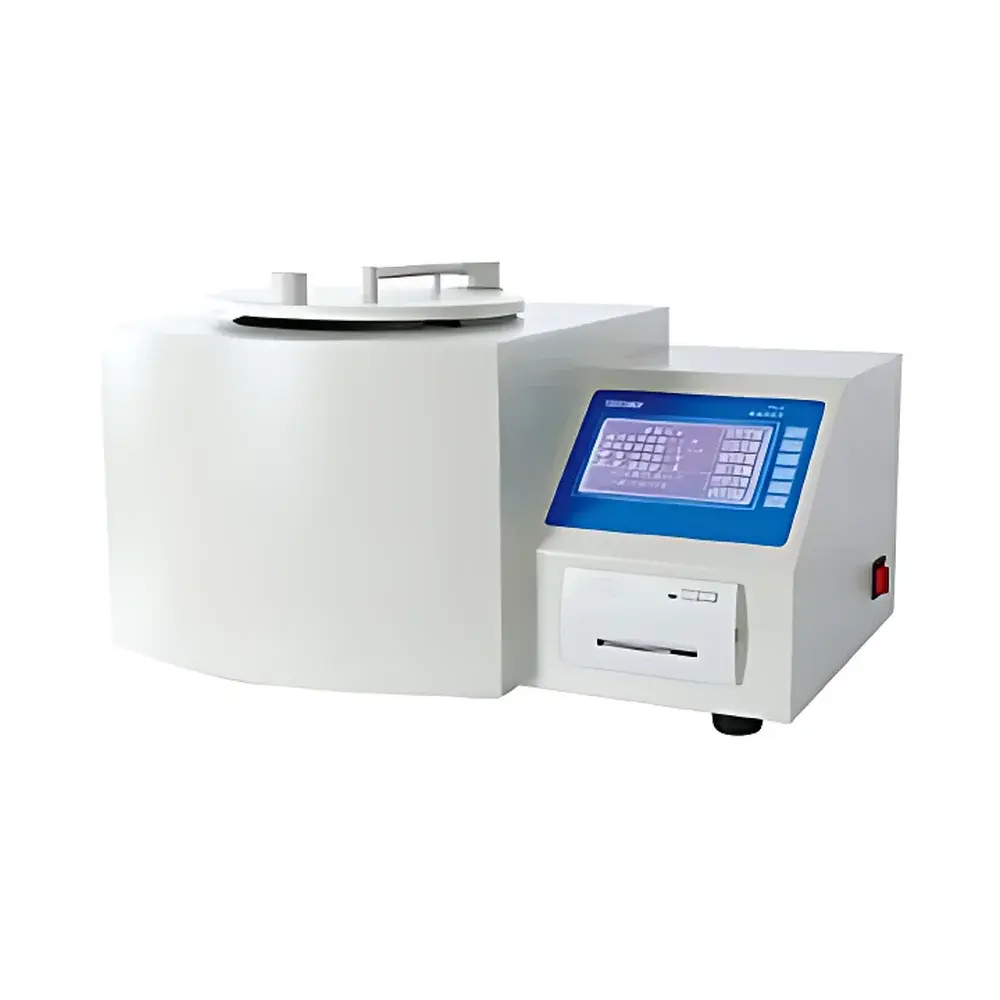
Timepower TP532 Fully Automated Acid Number Analyzer for Petroleum Products
| Brand | Timepower |
|---|---|
| Model | TP532 |
| Measurement Principle | Potentiometric-Optical Endpoint Detection via Colorimetric Titration (KOH-Ethanol Standard Solution) |
| Measurement Range | 0.0001–0.9999 mg KOH/g |
| Resolution | 0.0001 mg KOH/g |
| Accuracy | ±0.01 mg KOH/g (for acid number ≤0.1 mg KOH/g) |
| Repeatability | 0.02 mg KOH/g (0–0.1), 0.05 mg KOH/g (0.1–0.5), 0.07 mg KOH/g (0.5–1.0), 0.1 mg KOH/g (1.0–2.0) |
| Sample Throughput | 6 samples per batch |
| Detection System | Imported low-power laser diode with photodetector array |
| Control Architecture | Dual-CPU microcomputer system |
| Automation Functions | Auto-extraction, auto-titration, auto-cup rotation, endpoint recognition, thermal/impact printing |
| Display | LCD with icon-free tactile keypad |
| Power Supply | AC 220 V ±10%, 50 Hz ±10% |
| Max. Power Consumption | ≤100 W (peak), ≤60 W (operational) |
| Operating Environment | 5–35 °C, ≤80% RH |
| Dimensions (W×D×H) | 480 × 340 × 200 mm |
| Net Weight (main unit) | 12.5 kg |
| Compliance | Designed to support ASTM D664, GB/T 258, ISO 661, and IEC 61000-4 electromagnetic compatibility standards |
| Data Output | Integrated dot-matrix printer with timestamped reports |
Overview
The Timepower TP532 Fully Automated Acid Number Analyzer is an industrial-grade benchtop instrument engineered for precise, reproducible determination of total acid number (TAN) in petroleum-based and bio-derived liquid fuels and lubricants. It implements a standardized colorimetric titration methodology compliant with ASTM D664 (potentiometric—though TP532 employs optical endpoint detection as a validated alternative), GB/T 258 (Chinese national standard for gasoline and kerosene), and ISO 661 (animal and vegetable fats and oils). The system utilizes a two-phase solvent extraction process—employing toluene-isopropanol mixture—to isolate acidic components from the sample matrix, followed by automated titration with potassium hydroxide in ethanol solution. Endpoint detection is achieved via real-time optical monitoring: a collimated laser beam illuminates the reaction vessel; as the indicator (typically p-naphtholbenzein or similar pH-sensitive dye) transitions from yellow to green at the neutralization point, the resulting change in light absorption is captured by a high-stability photodetector array. This hybrid optical-electronic detection scheme eliminates subjectivity inherent in manual visual endpoint judgment while maintaining full traceability to classical wet-chemistry principles.
Key Features
- Dual-CPU embedded control architecture ensures deterministic timing, fault-tolerant operation, and synchronized coordination of all mechanical and electro-optical subsystems.
- Imported low-power laser diode (650 nm nominal wavelength) coupled with calibrated photodiode detection provides long-term signal stability (>10,000 hours MTBF) and immunity to ambient light interference.
- Full automation sequence: solvent addition, sample agitation/extraction, cup indexing, reagent delivery via precision peristaltic pump, real-time absorbance tracking, endpoint confirmation, and report generation—all executed without operator intervention.
- Six-position carousel accommodates simultaneous preparation and analysis of up to six samples, enabling batch processing with independent parameter assignment per vial.
- Dot-matrix impact printer outputs audit-ready reports including sample ID, date/time stamp, acid number result, method identifier, operator code (if configured), and instrument serial number—supporting GLP-compliant documentation.
- Icon-free membrane keypad and monochrome LCD interface reduce training overhead and minimize misoperation risk in high-noise or gloved-hand environments typical of power plant labs or refinery QC zones.
Sample Compatibility & Compliance
The TP532 is validated for use across a broad spectrum of hydrocarbon-based and oxygenated fuels and lubricants, including turbine oils, transformer oils, hydraulic fluids, marine diesel, biodiesel (B100), biodiesel blends (B5–B20), and synthetic ester-based lubricants. Its solvent extraction protocol effectively handles viscous, dark-colored, or particulate-laden samples that challenge potentiometric sensors. Instrument design adheres to IEC 61000-4 series electromagnetic compatibility requirements and meets CE marking essential safety criteria. While not inherently 21 CFR Part 11 compliant, its printed output and deterministic logic path facilitate integration into FDA-regulated environments where electronic records are supplemented by hardcopy archiving per ALCOA+ principles. Routine calibration verification using certified reference materials (e.g., NIST-traceable acid number standards) is recommended prior to each analytical session.
Software & Data Management
The TP532 operates on firmware-level control logic without external PC dependency—eliminating OS-related vulnerabilities and ensuring consistent performance across deployment sites. All method parameters (extraction time, stir speed, titrant flow rate, endpoint threshold sensitivity) are stored in non-volatile memory and can be recalled via numeric menu navigation. Print logs retain the last 100 analyses locally; for extended data retention, users may manually transcribe results into LIMS or Excel-based QA databases. Firmware updates are delivered via USB flash drive and require authorized service technician execution to preserve calibration integrity and regulatory traceability.
Applications
This analyzer serves critical condition-monitoring functions in multiple sectors: In electric power generation, it monitors in-service turbine and insulating oils to detect early-stage oxidation degradation—enabling predictive maintenance and preventing catastrophic bearing failure or transformer insulation breakdown. In petrochemical refining, it verifies acid number compliance of finished diesel and jet fuel against ASTM D975 and D1655 specifications. For biodiesel producers, it supports quality control during transesterification and storage stability assessment per EN 14214. Universities and research institutes utilize the TP532 for method development studies involving novel bio-lubricants or catalytic oxidation kinetics, benefiting from its high resolution (0.0001 mg KOH/g) and low-end sensitivity ideal for near-neutral formulations.
FAQ
What solvent system does the TP532 use for extraction?
It employs a pre-optimized toluene–isopropanol (3:1 v/v) mixture, which provides superior solubilization of organic acids across diverse oil matrices while minimizing water co-extraction.
Can the instrument handle highly viscous samples like used engine oil?
Yes—pre-dilution with extraction solvent and programmable agitation duration ensure complete acid liberation; however, filtration through a 0.45 µm PTFE syringe filter is recommended prior to loading to prevent nozzle clogging.
Is calibration required before each test run?
While full recalibration is not necessary, daily verification using a mid-range certified acid number standard (e.g., 0.25 mg KOH/g) is strongly advised to confirm system accuracy and photodetector linearity.
Does the TP532 support remote diagnostics or network connectivity?
No—it is a standalone, closed-architecture instrument designed for operational robustness in industrial settings; no Ethernet, Wi-Fi, or Bluetooth interfaces are included.
How often should the peristaltic pump tubing be replaced?
Under normal usage (≤10 samples/day), replace the acid number pump tubing every 6 months or after 500 cycles—whichever occurs first—to maintain volumetric delivery accuracy and avoid reagent carryover.







