
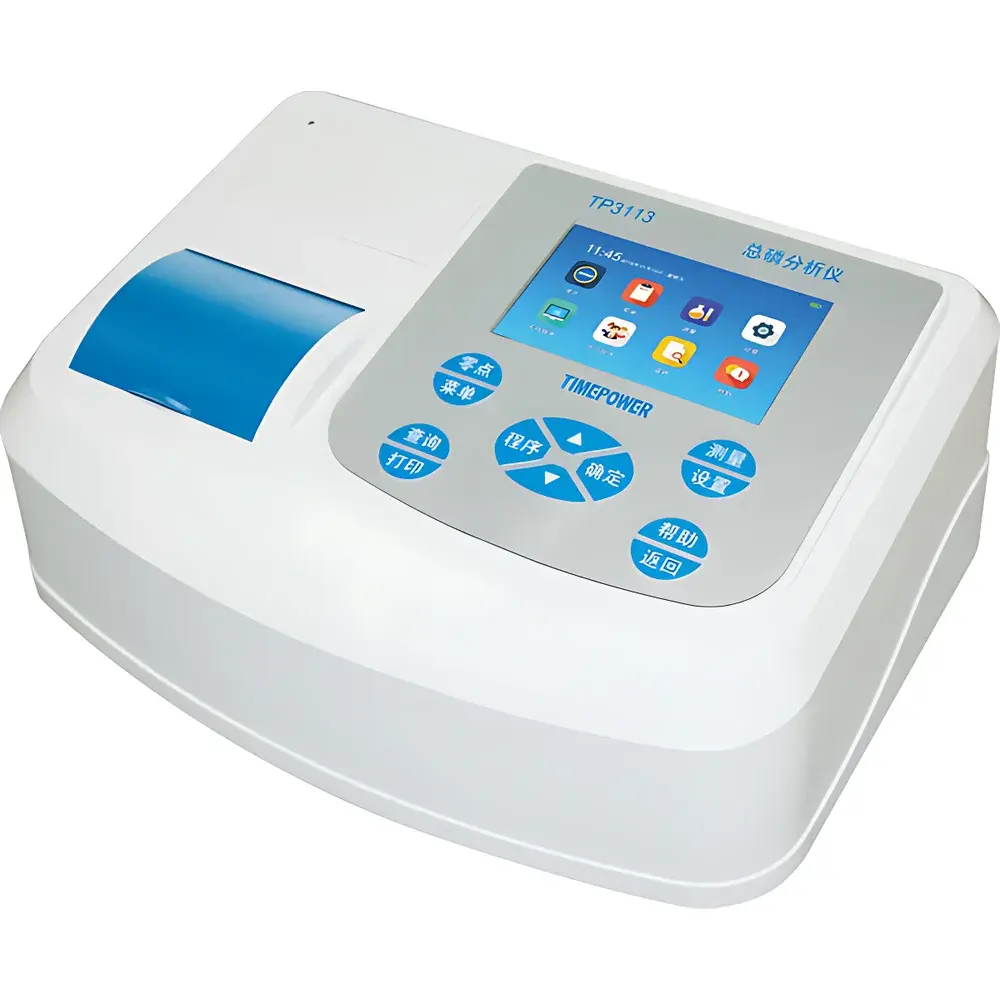
Timepower TP3113 Total Phosphorus Analyzer
| Brand | Timepower |
|---|---|
| Origin | Beijing, China |
| Manufacturer Type | Direct Manufacturer |
| Country of Origin | Domestic (China) |
| Model | TP3113 |
| Pricing | Upon Request |
| Measurement Principle | Photometric Colorimetry (based on Lambert-Beer Law) |
| Optical Source | Imported Monochromatic Cold Light Source |
| Display | LCD with Chinese Interface |
| Measurement Range | 0.02–10 mg/L (dual-range: 0–2 mg/L and 2–10 mg/L) |
| Accuracy | ≤ ±5% F.S. |
| Repeatability | ≤ 3% |
| Operating Temperature | 5–45 °C |
| Relative Humidity | ≤ 85% RH (non-condensing) |
| Dimensions | 266 × 200 × 130 mm |
| Weight | 1 kg |
| Digestion Temperature | 120 ± 1.0 °C |
| Digestion Time | 30 min |
| Power Supply | AC 220 ± 22 V, 50 ± 0.5 Hz |
| Microcontroller | Low-power 16-bit MCU |
| Housing | Molded ABS with Corrosion Resistance |
| Data Storage | Permanent Onboard Memory |
| Calibration Options | Factory-preloaded + User-definable Calibration Curves |
| Included Accessories | 1 set of reagents, 10 digestion/cuvette tubes, 1 dedicated digestion unit |
Overview
The Timepower TP3113 Total Phosphorus Analyzer is a benchtop photometric instrument engineered for accurate, reliable quantification of total phosphorus (TP) in environmental water matrices—including surface water, municipal wastewater, and industrial effluents. It operates on the fundamental principle of photometric colorimetry, applying the Lambert-Beer law to correlate absorbance at a defined wavelength with the concentration of molybdenum-blue chromophore formed during acid digestion and subsequent color development. Prior to measurement, samples undergo standardized high-temperature acid digestion (120 °C for 30 min) to convert all organic and inorganic phosphorus species—including orthophosphate, condensed phosphates, and organophosphorus compounds—into orthophosphate, which then reacts with ammonium molybdate and ascorbic acid under acidic conditions to yield a stable blue complex. The analyzer measures absorbance at ~700 nm using an imported monochromatic cold light source, ensuring minimal thermal drift and long-term photometric stability—critical for compliance with routine monitoring requirements under ISO 6878, EPA Method 365.4, and HJ 670–2013 (Chinese Environmental Protection Standard).
Key Features
- Stable optical detection system utilizing an imported monochromatic cold light source—designed for low power consumption, extended service life (>10,000 h), and reduced thermal noise during extended operation.
- Dual-range measurement capability (0–2 mg/L and 2–10 mg/L) enables optimized sensitivity across low-concentration environmental waters and higher-strength industrial discharges without manual dilution or range switching.
- Integrated 16-bit low-power microcontroller architecture ensures deterministic response time, robust signal processing, and immunity to electromagnetic interference common in field laboratories or plant control rooms.
- Corrosion-resistant molded ABS housing provides mechanical durability and chemical resistance against routine exposure to acidic digestants and humid ambient conditions.
- Onboard non-volatile memory retains calibration curves, measurement history, and operator logs—supporting traceability and basic data integrity requirements aligned with GLP-aligned workflows.
Sample Compatibility & Compliance
The TP3113 is validated for use with clarified, filtered, or centrifuged aqueous samples meeting standard pretreatment criteria per ISO 5667-3. It accommodates standard 16-mm round digestion/cuvette tubes (included), compatible with both standalone digestion units and integrated block heaters. While not certified for regulatory submission under 21 CFR Part 11, its design supports audit-ready practices: user-defined calibration curves are timestamped and stored separately from factory defaults; measurement records include date/time stamps and operator identifiers (via manual entry). The instrument conforms to IEC 61010-1 safety standards for electrical laboratory equipment and meets EMC Class B emission limits for laboratory environments.
Software & Data Management
The TP3113 operates via an embedded firmware interface with full Chinese-language menu navigation—optimized for rapid method selection, zeroing, calibration, and sample measurement. All calibration data (including slope, intercept, correlation coefficient R², and date stamp) are viewable and exportable via USB interface (optional cable required). Raw absorbance values and calculated concentrations are stored with metadata (sample ID, operator, date/time, curve ID) in internal memory—retaining ≥500 test records. No proprietary PC software is required; exported CSV files are compatible with LIMS platforms, Excel-based QA/QC review, or statistical process control tools.
Applications
- Routine compliance monitoring of total phosphorus in municipal wastewater treatment plant influent, effluent, and tertiary polishing streams.
- Industrial discharge verification for food processing, fertilizer manufacturing, and metal finishing facilities subject to local TP discharge limits.
- Surface water quality assessment in lakes, reservoirs, and rivers where eutrophication risk evaluation requires consistent TP trending.
- Research and educational laboratories conducting method validation, inter-laboratory comparison studies, or student training in nutrient analysis protocols.
- Field-deployable use in mobile labs when paired with portable digestion units and stabilized power sources (e.g., UPS or DC-AC inverters).
FAQ
What digestion method does the TP3113 require?
It follows the standard molybdenum antimony colorimetric method with high-temperature acid digestion (H2SO4/K2S2O8) at 120 °C for 30 minutes—fully compliant with HJ 670–2013 and equivalent to EPA 365.4.
Can users create custom calibration curves?
Yes—the instrument supports up to five user-defined calibration curves in addition to the factory-default curve, each independently editable and recallable.
Is the instrument suitable for unattended operation?
It is designed for supervised benchtop use; no automatic sample introduction or continuous monitoring capability is provided.
How often should calibration verification be performed?
Daily verification with a mid-range standard is recommended before sample analysis; full multi-point calibration is advised weekly or after maintenance, reagent lot changes, or observed drift.
What maintenance is required for long-term reliability?
Regular cleaning of the optical path (cuvette chamber and light source window) with lint-free tissue and isopropanol; annual verification of digestion temperature accuracy using a calibrated thermometer probe.







