
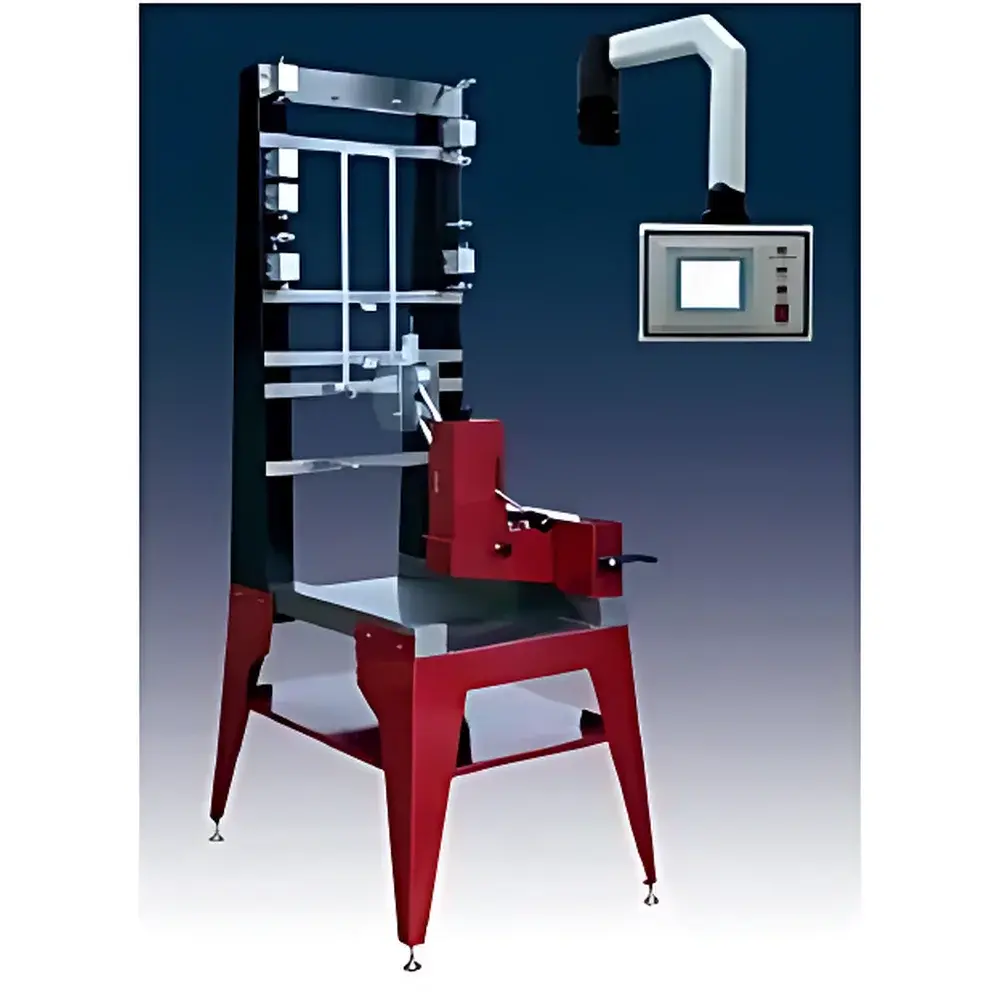
Relia-Burn Multi-Standard Vertical Flame Test Instrument
| Origin | Tianjin, China |
|---|---|
| Manufacturer Type | Authorized Distributor |
| Origin Category | Domestic (PRC) |
| Model | Relia-Burn |
| Price | USD 1,420 (FOB Tianjin) |
| Compliance | ISO 6940/6941/10047/15025, BS 5438/5722/EN 1103/13772, EN 71-2, GB/T 8745/8746/5456, AS 2755.1–3 |
| Flame Source | Adjustable butane/propane burner (0–600 W), electric spark ignition |
| Radiator | 500 W Epiradiator (120 mm Ø quartz disc) |
| Test Chamber Volume | ≥ 4 m³ |
| Positioning Accuracy | ±0.18° (burner angle), stepper motor–driven linear & rotational motion |
| Control System | Siemens HMI + PLC with preloaded test protocols |
| Sample Mounting | 8 standardized needle frames + stainless steel specimen clamps |
| Safety | Floor-standing design, external operation mode, 180° rotatable support arm, 360° rotatable touchscreen |
Overview
The Relia-Burn Multi-Standard Vertical Flame Test Instrument is an engineered platform for quantitative assessment of flame ignition behavior, flame spread rate, and afterflame/afterglow duration in solid materials under controlled vertical orientation. It operates on the principle of standardized radiant and convective heating—combining a calibrated epiradiator (ISO 15025, BS EN 13772) with a precisely positioned, programmable gas burner (ISO 6940, BS 5438, EN 71-2)—to replicate real-world ignition scenarios across textile, apparel, protective clothing, soft furnishings, children’s products, and construction-related substrates. Designed for compliance-driven laboratories, the system enables repeatable execution of over 15 internationally recognized test methods without hardware reconfiguration. Its floor-standing architecture eliminates benchtop dependency, while the ≥4 m³ ventilated test chamber meets ISO 5659-2 and ASTM E1354 requirements for smoke and heat release containment during extended combustion cycles.
Key Features
- Floor-mounted structural frame with integrated vibration-damped base—ensures stability during high-energy burner actuation and eliminates reliance on laboratory workbenches.
- Modular needle-frame system: Includes eight interchangeable ASTM/ISO/BS-compliant specimen holders (e.g., BS 5438 edge-ignition frame, ISO 6941 flame-spread frame, EN 13772 curtain-mounting jig) plus corrosion-resistant stainless-steel clamping fixtures.
- Dual-mode ignition control: Electric spark igniter with <0.5 s response time; programmable switching between butane and propane fuel streams via solenoid-valve manifold—enabling precise stoichiometric calibration per standard (e.g., ASTM D6413 vs. ISO 6940).
- Adjustable thermal radiation source: 500 W epiradiator with 120 mm diameter semi-transparent quartz disc (BS EN 13772 compliant); power regulated from 0–600 W via PID-controlled thyristor module for graded irradiance profiling.
- High-precision mechanical positioning: Stepper motor–driven linear translation (burner advancement/retraction) and angular rotation (±0.18° resolution) ensure sub-millimeter repeatability in flame impingement geometry across test sequences.
- Safety-integrated human-machine interface: Siemens SIMATIC HMI touchscreen (360° rotational mount) running deterministic PLC firmware; all test protocols preloaded per ISO/BS/GB/EN/AS standards with audit-trail logging compliant with GLP and FDA 21 CFR Part 11 Annex 11 requirements.
Sample Compatibility & Compliance
The Relia-Burn accommodates specimens ranging from 50 × 300 mm woven fabrics (GB/T 8746) to 150 × 500 mm curtain panels (BS EN 13772), 120 × 300 mm protective garment swatches (ISO 15025), and 25 × 200 mm toy components (EN 71-2). Specimen mounting conforms to dimensional tolerances specified in ISO 6940:2004 Annex A and ASTM D6413 Section 7.2. The instrument satisfies full technical equivalence to referenced clauses in ISO/IEC 17025:2017 for method validation, including uncertainty budgeting for flame height measurement (integrated digital caliper scale), ignition timing (microswitch-triggered millisecond-resolution chronometry), and radiant flux density (NIST-traceable pyrometer calibration certificate available upon request).
Software & Data Management
Test execution is governed by a deterministic Siemens S7-1200 PLC with dual-channel analog input for real-time thermocouple (burner tip) and photodiode (flame luminosity) monitoring. The HMI interface stores ≥10,000 test records locally with timestamp, operator ID, ambient temperature/humidity metadata, and pass/fail flags derived from configurable thresholds (e.g., afterflame ≤ 2 s per ISO 6940:2004 Clause 8.3). Export formats include CSV (for LIMS integration), PDF test reports with embedded digital signatures, and XML files compatible with ELN platforms. All data modification events are logged with immutable timestamps and user authentication—meeting ALCOA+ principles for regulatory submissions.
Applications
Primary use cases include QC/QA verification of flame-retardant finishing efficacy in workwear textiles (ISO 15025 Class 1–3), regulatory pre-certification of children’s sleepwear (BS 5722:1991, ASTM F1506), fire safety validation of architectural drapery (BS EN 13772 Type B), and material screening for aerospace cabin interiors (SAE AS4373 referencing ISO 6941). Secondary applications encompass R&D-level comparative analysis of char-forming additives, intumescent coating performance under radiant flux gradients, and correlation studies between LOI values (ASTM D2863) and vertical flame propagation metrics.
FAQ
Does the Relia-Burn support automated pass/fail evaluation per ISO 6940:2004?
Yes—the system applies Clause 8.3 decision logic in real time using flame duration, char length, and hole formation parameters; results are displayed and archived with traceable threshold definitions.
Can test protocols be customized beyond preloaded standards?
Yes—engineers may define custom ignition delay windows, radiant flux ramps, or post-ignition observation durations via password-protected engineering mode.
Is third-party calibration documentation provided?
Each unit ships with a factory calibration certificate for burner alignment, flame height scale, and epiradiator output—traceable to NIM (China National Institute of Metrology).
What ventilation requirements apply during operation?
A dedicated exhaust duct (≥300 mm Ø) venting to exterior is mandatory; internal chamber airflow complies with ISO 5659-2 Annex C for reproducible oxygen depletion profiles.
How is operator safety maintained during high-temperature testing?
The system enforces remote operation via HMI only—no manual intervention within 1.5 m of the chamber during active combustion; emergency stop circuit interrupts gas supply and power within 100 ms.



