
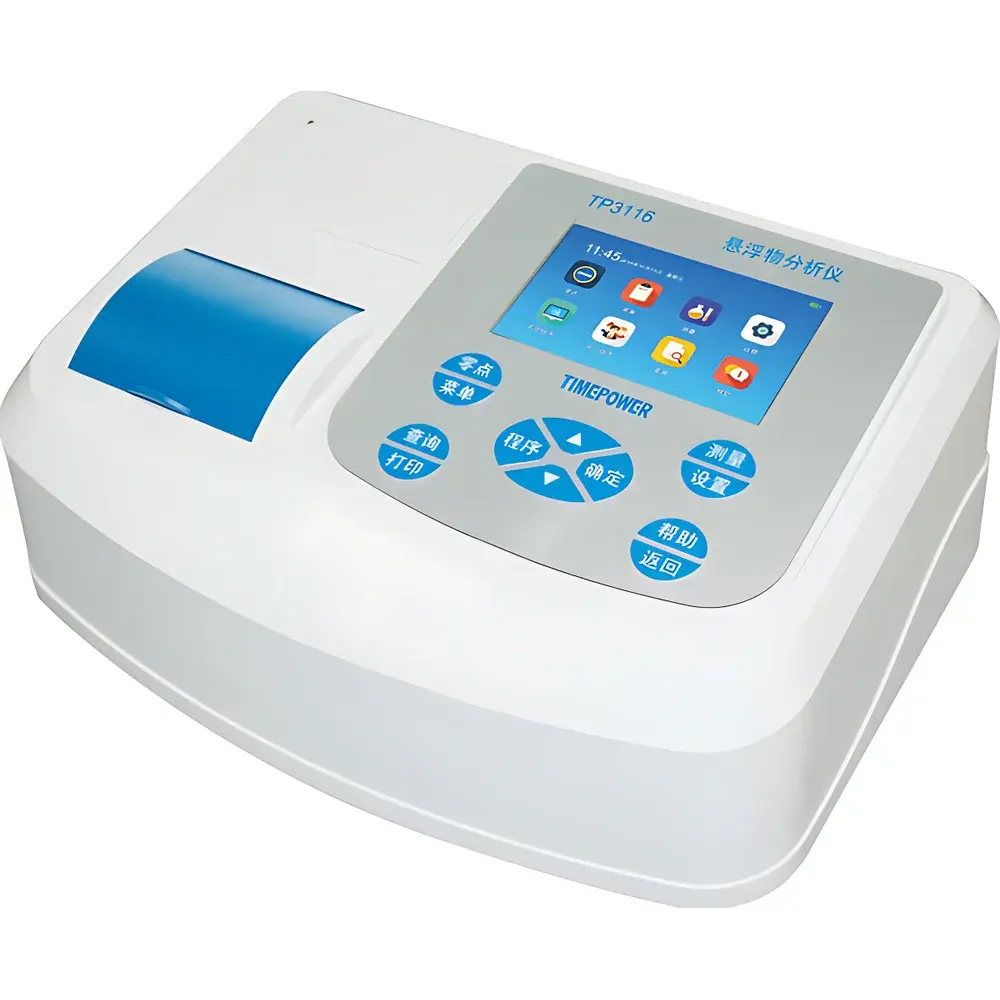
Timepower TP3116 Suspended Solids Analyzer
| Brand | Timepower |
|---|---|
| Origin | Beijing, China |
| Manufacturer Type | Manufacturer |
| Country of Origin | Domestic (China) |
| Model | TP3116 |
| Pricing | Upon Request |
Overview
The Timepower TP3116 Suspended Solids Analyzer is a benchtop photometric instrument engineered for precise, routine quantification of total suspended solids (TSS) in aqueous samples. It operates on the fundamental principle of absorbance photometry—specifically, the Lambert-Beer Law—which establishes a linear relationship between optical absorbance and the concentration of light-scattering particulate matter in a homogeneous suspension, provided path length and particle size distribution remain consistent across measurements. Unlike nephelometric methods that measure scattered light at 90°, the TP3116 employs transmittance-based colorimetry using standardized glass cuvettes (typically 10 mm path length), making it particularly suitable for turbid but non-opaque samples such as municipal wastewater, surface water, industrial effluents, and laboratory-prepared suspensions. Its design prioritizes operational robustness, analytical reproducibility, and compliance-ready data handling—key requirements for environmental laboratories operating under ISO/IEC 17025, EPA Method 160.2, or national standards equivalent to GB/T 11901–1989 (Chinese standard for TSS determination).
Key Features
- 5.0-inch full-color LCD display with dual-language interface (English/Chinese), supporting intuitive menu navigation and real-time parameter visualization.
- High-stability imported cold-light source with spectral output optimized for 420–620 nm range; rated service life exceeds 100,000 hours with minimal intensity drift.
- Integrated thermal printer enabling immediate hardcopy output of current results, calibration logs, and historical datasets—including time stamps and operator IDs.
- Onboard memory stores up to 30,000 measurement records and supports 96 customizable calibration curves, including user-defined polynomial or linear fits derived from reference standards.
- Dual communication interfaces: USB 2.0 for direct PC connectivity and Ethernet port for integration into local area networks—enabling remote configuration, firmware updates, and centralized data export via CSV or XML formats.
- Low-power architecture (≤5 W nominal consumption) with wide-input AC power supply (220 V ±10%, 50 Hz ±0.5 Hz), suitable for continuous operation in field-deployable labs or fixed monitoring stations.
- Modular assay framework allows expansion beyond TSS to over 30 additional water quality parameters—including COD, ammonia nitrogen, nitrate, phosphate, and heavy metal ions—via software-enabled method activation and compatible reagent kits.
Sample Compatibility & Compliance
The TP3116 accepts standard 16 mm diameter glass or quartz cuvettes (10 mm path length) and is validated for use with clarified, filtered, or centrifuged samples meeting ASTM D5907–22 criteria for suspended solids preparation. It complies with core performance specifications outlined in ISO 11923:1997 (Water quality — Determination of suspended solids — Gravimetric method) for comparative validation, and supports audit-ready workflows aligned with GLP and GMP documentation practices. Data integrity safeguards include automatic timestamping, operator login tracking, and write-protected storage—facilitating adherence to FDA 21 CFR Part 11 requirements when deployed with validated LIMS integration.
Software & Data Management
Instrument control and data analysis are managed through embedded firmware with embedded calibration management tools. Raw absorbance values, calculated concentrations, curve-fit residuals, and QC flag indicators (e.g., out-of-range warning, low signal-to-noise alert) are stored with metadata tags. Export protocols support both manual retrieval via USB mass storage mode and automated scheduled uploads to networked servers. Optional PC software provides advanced statistical functions—including batch trending, method comparison reports, and uncertainty budgeting per GUM (Guide to the Expression of Uncertainty in Measurement) principles.
Applications
- Regulatory compliance monitoring of TSS in municipal wastewater treatment plant influent, effluent, and sludge dewatering streams.
- Industrial pretreatment verification for electroplating, food processing, textile dyeing, and pulp & paper facilities discharging to public sewers.
- Environmental impact assessment studies involving sediment transport modeling in rivers, lakes, and estuarine systems.
- Academic research on coagulation-flocculation efficiency, membrane fouling kinetics, and biofilm detachment dynamics.
- Calibration verification and inter-laboratory proficiency testing programs administered by national metrology institutes.
FAQ
What is the measurement range and accuracy specification for TSS quantification?
The TP3116 offers a segmented measurement range of 5–500 mg/L TSS, with an optical resolution of 0.1 mg/L and a maximum permissible error of ±5% of reading (per NIST-traceable validation protocol).
Does the instrument require periodic recalibration, and how is drift compensated?
Yes—optical and electronic baseline stability is maintained through daily zero-point adjustment using deionized water blanks and biweekly verification with certified reference suspensions (e.g., Formazin or polymer latex standards). Internal temperature compensation algorithms mitigate thermal drift within the 5–40 °C operating envelope.
Can the TP3116 be integrated into a laboratory information management system (LIMS)?
Yes—via Ethernet or USB CDC serial emulation, the analyzer supports HL7-compliant message formatting and can transmit structured result packets directly to LIMS platforms without intermediate file conversion.
Is the built-in printer compatible with external label printers for sample tube tagging?
No—the integrated thermal printer is dedicated to report generation only; however, ASCII-formatted data exports can be parsed by third-party labeling software for downstream barcode or QR code printing.
What maintenance procedures are recommended for long-term optical stability?
Quarterly cleaning of the optical window and cuvette holder with lint-free wipes and isopropyl alcohol; annual verification of lamp spectral output profile and detector linearity using factory-provided diagnostic routines.
Related Products







