
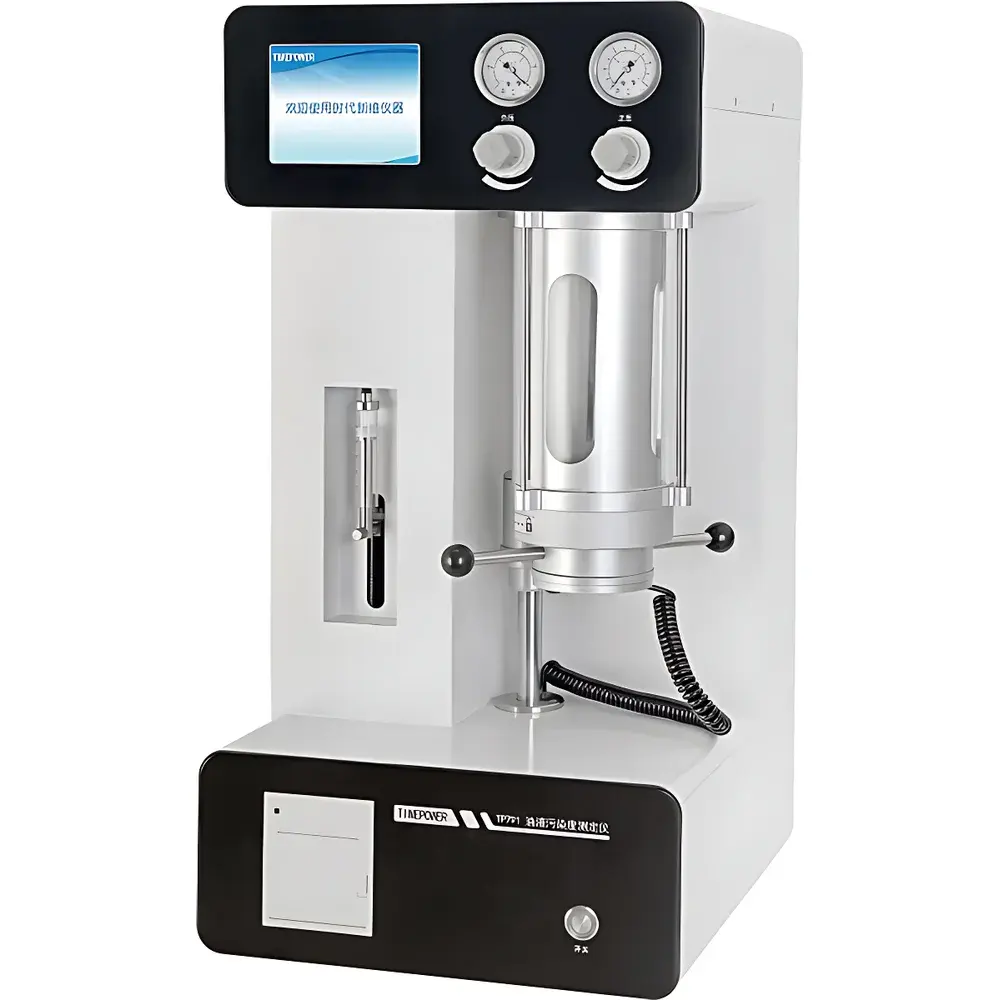
Timepower TP791 Oil Particle Contamination Analyzer
| Brand | Timepower |
|---|---|
| Origin | Beijing, China |
| Manufacturer Type | Direct Manufacturer |
| Model | TP791 |
| Price | Upon Request |
Overview
The Timepower TP791 Oil Particle Contamination Analyzer is a precision laboratory instrument engineered for quantitative assessment of solid particulate contamination in liquid media—primarily hydraulic oils, lubricants, transformer (insulating) oils, turbine oils, gear oils, aviation fuels, and water-glycol hydraulic fluids. It operates on the internationally standardized light extinction (light blockage) principle defined in ISO 11171, ASTM D7647, and GB/T 18854. In this method, particles suspended in a liquid stream pass through a precisely collimated laser beam within a flow cell; each particle obstructs a portion of the incident light proportional to its projected area, generating transient voltage pulses that are digitized and classified by amplitude into discrete size channels. The system delivers calibrated particle counts per unit volume across 16 user-definable size bins, enabling direct assignment of contamination grades per ISO 4406, NAS 1638, GJB 420B, SAE AS4059F, DL/T 432, and other globally recognized standards.
Key Features
- High-stability semiconductor laser source with optimized beam geometry for consistent signal-to-noise ratio and minimal baseline drift.
- 16-channel digital pulse-height analysis architecture supporting customizable size thresholds within the 0.8 μm–600 μm detection range (sensor-dependent).
- Precision syringe pump sampling system with programmable volume selection (0.2–1000 mL) and volumetric accuracy better than ±0.5%.
- Integrated dual-pressure (positive/negative) sample handling module enabling vacuum-assisted degassing and pressure-driven delivery—critical for viscous samples up to 650 cSt.
- Built-in calibration library covering ISO 11171, ISO 4406:2021, NAS 1638 (2022), GJB 420B, SAE AS4059F, DL/T 432, GB/T 14039, and GOST 17216, with support for user-defined reference curves.
- Color capacitive touchscreen interface with full Chinese character input, automated data logging, and embedded thermal printer for immediate hard-copy reporting.
- Onboard grade classification engine that auto-assigns ISO code (e.g., 18/16/13) or NAS class based on selected standard and measured count data.
- RS232 serial interface compliant with standard laboratory data acquisition protocols; compatible with LIMS integration via ASCII-based command sets.
Sample Compatibility & Compliance
The TP791 accommodates a broad spectrum of industrial liquids including mineral- and synthetic-based hydraulic fluids, turbine oils, insulating oils, jet fuels (Jet A-1, JP-8), and polymer solutions. Its positive-pressure chamber (max 0.8 MPa) and vacuum capability (min –0.08 MPa) allow reliable analysis of both low-viscosity solvents and high-viscosity gear oils without dilution or pre-filtration. The instrument meets mechanical and electrical safety requirements per IEC 61010-1 and supports traceable metrological verification. While not inherently 21 CFR Part 11–compliant out-of-the-box, audit-trail functionality—including operator ID tagging, timestamped test records, and immutable result storage—can be enabled via optional firmware upgrade for GLP/GMP environments.
Software & Data Management
Data acquisition and reporting are managed via embedded firmware with non-volatile memory capable of storing >10,000 test records. Each entry includes sample ID, date/time stamp, sampling volume, sensor ID, raw channel counts, calculated contamination grade, and operator annotation. Export options include CSV via RS232 for post-processing in Excel or statistical software (e.g., Minitab, JMP). Optional PC-based analysis suite provides trend charting, batch comparison, historical database queries, and PDF report generation with embedded calibration certificate references. All firmware updates are delivered via secure USB stick; no internet connectivity is required during operation.
Applications
The TP791 serves critical roles in condition-based maintenance programs across aerospace (hydraulic system integrity verification per MIL-STD-3007), power generation (transformer oil cleanliness monitoring per IEEE C57.104), marine propulsion (lubricant wear debris trending), wind turbine gearbox health assessment, and automotive transmission fluid qualification. It is routinely deployed in third-party calibration laboratories accredited to ISO/IEC 17025 for issuing certified particle count reports. Additional use cases include QC release testing of new oil batches, filtration efficiency validation, and research into particle generation mechanisms in tribological systems.
FAQ
What particle size standards does the TP791 support natively?
ISO 4406:2021, NAS 1638 (2022), GJB 420B, SAE AS4059F, DL/T 432, GB/T 14039, and GOST 17216—all preloaded with traceable calibration coefficients.
Can the instrument analyze opaque or highly colored fluids?
Yes, provided optical transmission at the laser wavelength (typically 650 nm) exceeds ~10%; turbid or dyed samples may require dilution or alternative sensor configuration.
Is external calibration certification available?
Yes—Timepower offers optional NIST-traceable calibration verification reports issued by CNAS-accredited metrology institutes upon request.
What maintenance is required for long-term accuracy?
Quarterly verification using ISO MTD reference particles; annual sensor alignment check; routine cleaning of syringe pump and flow cell with petroleum ether or isopropanol.
Does the system comply with FDA or pharmaceutical cleanroom standards?
While not designed for sterile environments, its particle counting methodology aligns with USP for insoluble particle enumeration in injectables when adapted with appropriate sample preparation protocols.




