
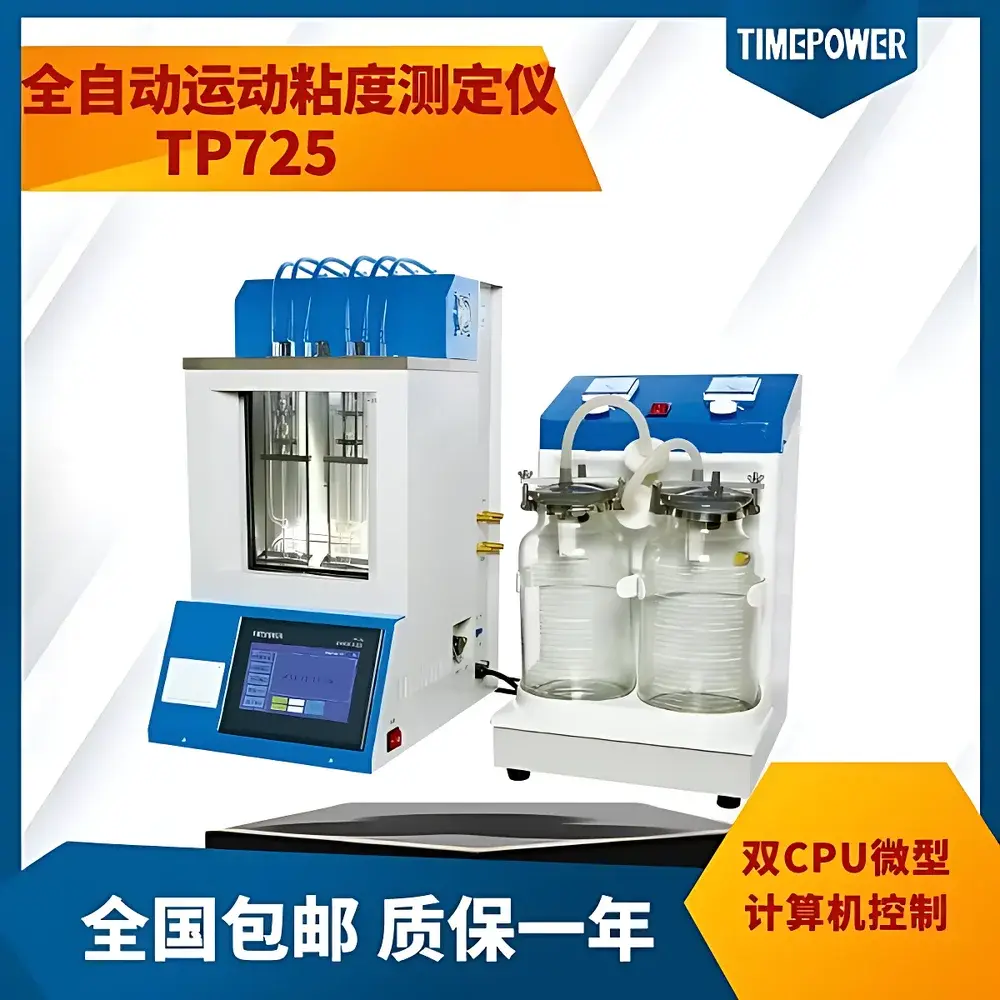
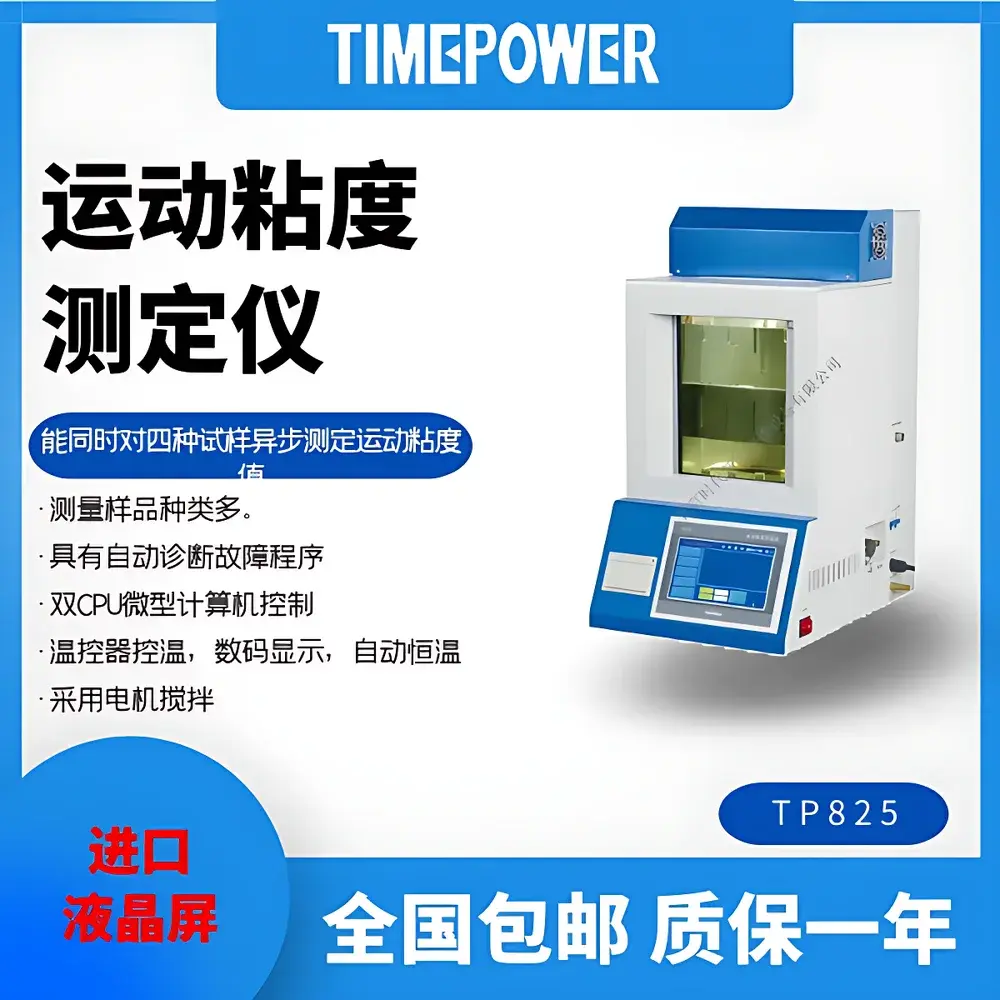
Timepower TP825/TP725 Fully Automated Kinematic Viscosity Tester
| Brand | Timepower |
|---|---|
| Model | TP825 / TP725 |
| Origin | Beijing, China |
| Manufacturer Type | Direct Manufacturer |
| Compliance | ASTM D445, ISO 3104, GB/T 265-1988 |
| Temperature Control Method | PID-controlled Constant-Temperature Bath |
| Capillary Selection | Auto-recognized or user-defined Ubbelohde-type viscometers |
| Data Output | Automatic kinematic viscosity (mm²/s), flow time (s), and calculation per standard algorithms |
| Reporting | CSV and PDF export with audit trail metadata |
| Regulatory Support | GLP-compliant operation log, user access levels, and electronic signature-ready workflow |
Overview
The Timepower TP825 and TP725 Fully Automated Kinematic Viscosity Testers are precision-engineered laboratory instruments designed for the accurate and repeatable determination of kinematic viscosity in petroleum-based liquids—including lubricating oils, transformer oils, diesel fuels, jet fuels, and crude fractions. Operating on the capillary efflux principle defined in ASTM D445 and ISO 3104, these analyzers measure the time required for a fixed volume of liquid to flow under gravity through a calibrated glass capillary tube immersed in a thermally stabilized bath. The instrument calculates kinematic viscosity (ν) using the equation ν = C × t, where C is the capillary constant (mm²/s²) and t is the measured efflux time (s). Both models conform to GB/T 265–1988—the Chinese national standard aligned with international methodology—and integrate high-stability PID temperature regulation to maintain bath uniformity within ±0.01 °C across operating ranges from 20 °C to 100 °C.
Key Features
- PID-driven temperature control system ensures thermal stability ≤ ±0.01 °C over extended test cycles, critical for reproducibility in low-viscosity fuel testing and high-viscosity lubricant evaluation.
- Automated efflux timing with optical flow detection eliminates operator-dependent start/stop errors; dual-sensor alignment verifies meniscus passage at both upper and lower timing marks.
- Capillary recognition module supports rapid configuration of Ubbelohde-type viscometers with pre-loaded calibration constants—no manual entry required for routine QC workflows.
- Integrated calculation engine applies standardized correction factors for kinetic energy, capillary bore deviation, and thermal expansion per ASTM D445 Annex A1 and ISO 3104 Clause 8.
- Modular bath design accommodates up to six capillaries simultaneously; independent thermal zones allow parallel testing of samples at different temperatures without cross-contamination.
- Rugged stainless-steel chassis and corrosion-resistant bath housing ensure long-term reliability in industrial lab environments subject to hydrocarbon exposure and humidity fluctuations.
Sample Compatibility & Compliance
The TP825/TP725 systems accept transparent, homogeneous liquid samples with kinematic viscosity ranging from 1.0 to 25,000 mm²/s (cSt), covering applications from aviation turbine fuel (Jet A-1, ~8 mm²/s) to heavy residual fuel oil (RMG 380, ~380 mm²/s). Sample volume requirement is 15–25 mL per test. Instruments comply with regulatory frameworks governing petroleum product quality assurance: ASTM D445 (Standard Test Method for Kinematic Viscosity of Transparent and Opaque Liquids), ISO 3104 (Petroleum Products — Determination of Kinematic Viscosity and Calculation of Dynamic Viscosity), and GB/T 265–1988 (Petroleum Products — Determination of Kinematic Viscosity). All firmware and data handling protocols support GLP and GMP-aligned documentation requirements, including timestamped audit logs, user authentication, and immutable result archiving.
Software & Data Management
The embedded Windows-based control software provides intuitive method setup, real-time bath temperature monitoring, and automated pass/fail evaluation against user-defined specification limits. Each test record includes raw efflux time, applied calibration constant, bath temperature at measurement, calculated kinematic viscosity, and uncertainty estimation based on repeatability thresholds per ISO 4287. Data exports are generated in CSV format for LIMS integration and PDF reports with digital signatures compliant with FDA 21 CFR Part 11 requirements. Software supports multi-user role assignment (administrator, analyst, reviewer) and maintains full traceability of all parameter changes, result modifications, and system events.
Applications
- Power generation: Routine viscosity monitoring of insulating oils in transformers and turbines to detect oxidation, contamination, or thermal degradation.
- Petroleum refining: In-process QC of distillate fractions (naphtha, kerosene, gas oil) and finished products (diesel, marine fuel) prior to shipment.
- Aviation maintenance: Certification testing of hydraulic fluids and lubricants per SAE AS5780 and MIL-PRF-23699 specifications.
- Research laboratories: Investigation of polymer solution rheology via intrinsic viscosity derivation using Huggins and Kramer equations.
- Commercial inspection agencies: Third-party verification of fuel compliance with ISO 8217 (marine fuels) and EN 590 (automotive diesel) viscosity limits.
FAQ
What standards does the TP825/TP725 comply with?
ASTM D445, ISO 3104, GB/T 265–1988, and fully supports method validation per ISO/IEC 17025.
Can the instrument handle opaque or particulate-containing oils?
No—per ASTM D445, samples must be transparent and free of suspended particles; filtration or centrifugation is required prior to analysis.
Is external calibration certification included?
Each unit ships with a NIST-traceable temperature verification certificate and capillary calibration report; optional annual recalibration service is available.
How is data integrity ensured during power interruption?
Non-volatile memory retains all active test parameters and partial results; system resumes operation upon reboot without data loss.
Does the software support network deployment in enterprise labs?
Yes—client-server architecture enables centralized method management, remote diagnostics, and synchronized firmware updates across multiple TP-series instruments.





