
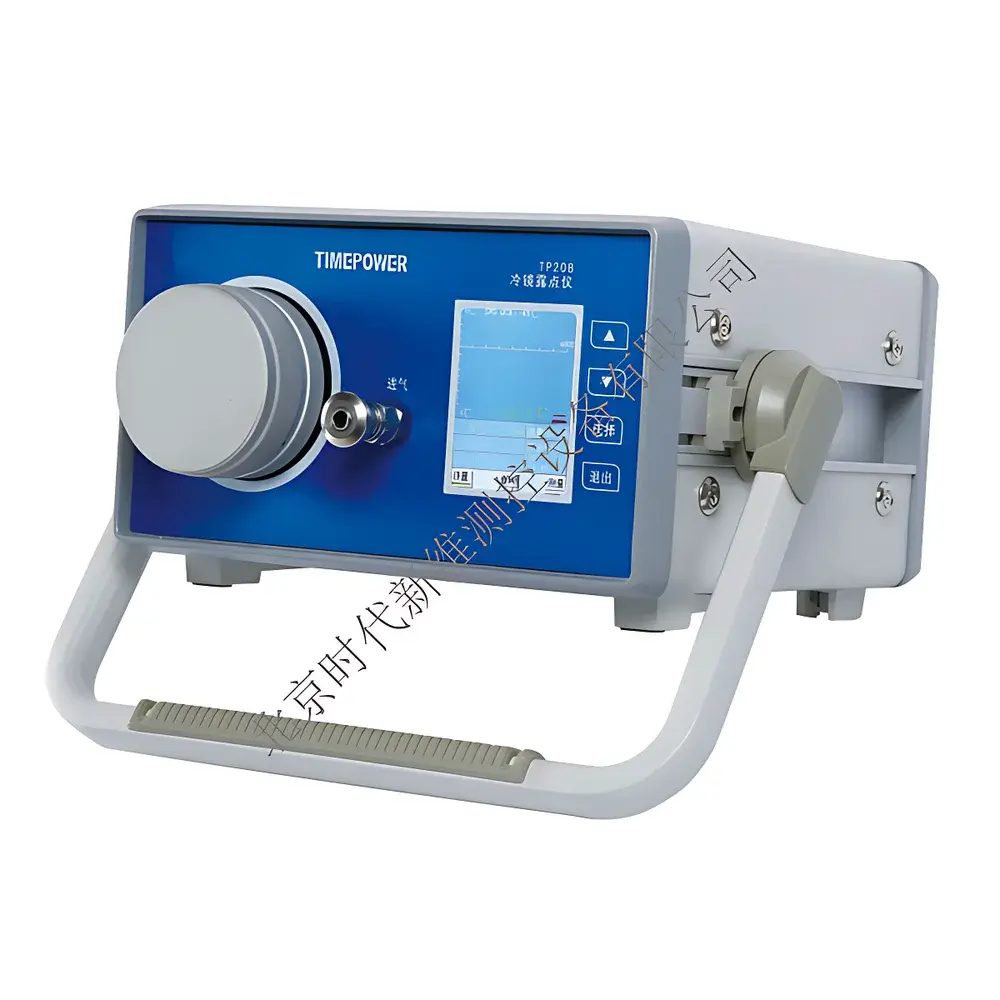
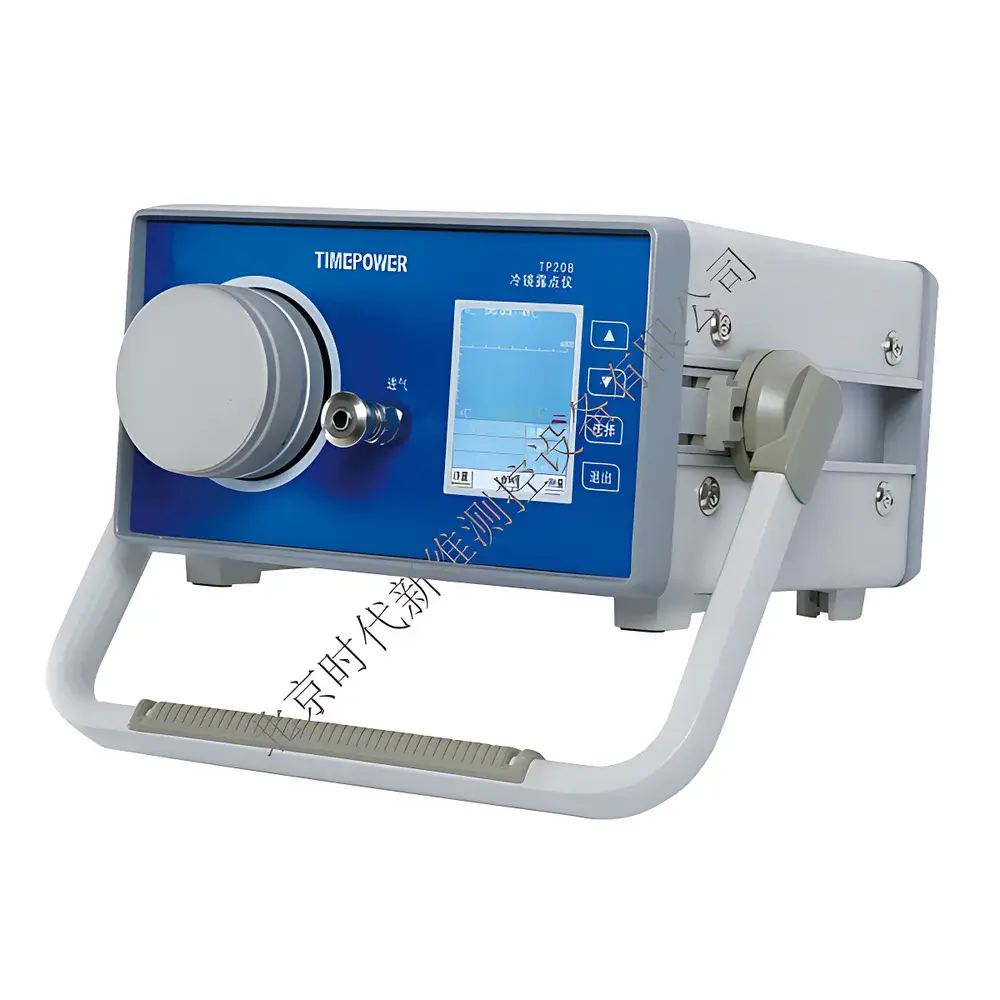
TimePower TP208 Chilled-Mirror Hygrometer
| Brand | TimePower |
|---|---|
| Origin | Beijing, China |
| Manufacturer Type | OEM Manufacturer |
| Origin Category | Domestic (China) |
| Model | TP208 |
| Pricing | Upon Request |
| Measurement Principle | Chilled-Mirror Dew Point Detection |
| Accuracy | ±0.2 °C |
| Resolution | 0.01 °C |
| Repeatability | ±0.1 °C |
| Cooling Capability | Down to −60 °C (dependent on ambient conditions) |
| Cooling Method | Four-Stage Peltier |
| Temperature Range | −70 °C to 0 °C (at 20 °C ambient) |
| Equilibration Time | 3–5 minutes |
| Gas Flow Rate | 15–60 L/h |
| Operating Pressure Range | 10 mbar–10 bar (1 kPa–1 MPa) |
| Display | Color LCD with real-time dew point, ppmᵥ (µL/L), equilibrium curve, and flow monitoring |
| Control Logic | Digital Fuzzy Control |
| Diagnostic Functions | Flow validation, optical energy monitoring, equilibrium status alert, fault self-diagnosis |
| Construction | Corrosion-resistant gas path |
| Power Supply | 220 VAC ±10%, 50 Hz |
| Power Consumption | 70 W |
| Operating Environment | −20 °C to +50 °C, ≤90% RH (non-condensing) |
| Dimensions | 250 × 150 × 250 mm |
| Weight | ~5 kg |
Overview
The TimePower TP208 Chilled-Mirror Hygrometer is a precision dew point analyzer engineered for trace moisture measurement in industrial process gases—including SF6, nitrogen, compressed air, and other non-corrosive or mildly corrosive gas streams. It operates on the fundamental physical principle of chilled-mirror condensation: a polished, temperature-controlled mirror surface is cooled until dew (or frost) forms under controlled gas flow; the corresponding mirror temperature at thermodynamic equilibrium is recorded as the true dew point temperature. This first-principles method delivers primary-standard-level accuracy without calibration drift, making it suitable for applications demanding metrological traceability and long-term stability—particularly where regulatory compliance (e.g., IEC 60480, ASTM D2029, ISO 8573-3) or quality assurance protocols (e.g., GLP, ISO/IEC 17025) are enforced.
Key Features
- Four-stage Peltier cooling architecture enables stable mirror temperatures down to −60 °C (ambient-dependent), supporting low-dew-point measurements critical for high-purity SF6 in GIS equipment and dry-air systems.
- Digital fuzzy logic control minimizes thermal overshoot and shortens equilibration time to 3–5 minutes—significantly faster than conventional single-stage chilled-mirror instruments—while maintaining ±0.1 °C repeatability.
- High-resolution optical detection system with auto-compensated light intensity monitoring ensures reliable condensate detection even under variable gas transmission or particulate loading.
- Corrosion-resistant wetted path (including stainless steel and fluoropolymer components) permits safe operation with halogenated gases, CO2, and other moderately aggressive media—eliminating the need for external scrubbers or conditioning modules.
- Integrated color LCD interface displays real-time dew point (°C), volumetric moisture concentration (µL/L), dynamic equilibrium curve, mass flow rate (L/h), and diagnostic status flags—enabling immediate operational assessment without external software.
- Self-diagnostic firmware continuously validates flow integrity, optical signal strength, mirror cleanliness, and thermal equilibrium convergence—alerting users to out-of-spec conditions such as insufficient flow (<15 L/h), excessive pressure drop, or inadequate optical reflectance.
Sample Compatibility & Compliance
The TP208 is validated for use with SF6, N2, synthetic air, argon, helium, and CO2 across a pressure range of 1 kPa to 1 MPa (10 mbar–10 bar). Its corrosion-resistant flow path meets material compatibility requirements per ASTM F1190 for elastomer-free gas handling. The instrument supports traceable calibration against NIST-traceable chilled-mirror reference standards and complies with data integrity expectations outlined in FDA 21 CFR Part 11 when paired with optional audit-trail-enabled PC software (sold separately). It satisfies the measurement uncertainty requirements of IEC 62271-1 for SF6 humidity verification in high-voltage switchgear commissioning and maintenance procedures.
Software & Data Management
While standalone operation requires no PC connection, the TP208 supports RS-232 and USB virtual COM port interfaces for integration into laboratory information management systems (LIMS) or SCADA environments. Optional TimePower DataLink software provides time-stamped data logging, trend visualization, report generation (PDF/CSV), and configurable alarm thresholds. All stored measurements include metadata: date/time stamp, operator ID (user-defined), gas type, pressure, flow rate, and diagnostic flags—supporting full audit readiness per ISO/IEC 17025 clause 7.7 and GLP principles. Firmware updates are delivered via signed binary packages to ensure cryptographic integrity.
Applications
- Condition monitoring of SF6 insulation gas in circuit breakers, GIS, and GIL systems per IEC 60480 and CIGRE TB 597.
- Moisture verification during nitrogen purging of transformers and reactors prior to energization.
- Compressed air quality certification per ISO 8573-3 Class 0–4 for pharmaceutical, electronics, and food packaging lines.
- Calibration transfer standard for aluminum oxide and tunable diode laser hygrometers in metrology labs.
- Research-grade humidity profiling in gas chromatography carrier gas lines and vacuum chamber purge validation.
FAQ
What is the lowest measurable dew point under typical lab conditions (23 °C, 50% RH)?
At 23 °C ambient, the TP208 achieves a lower limit of −60 °C dew point with full accuracy and resolution.
Can the instrument measure continuously, or is it batch-mode only?
It supports both continuous real-time monitoring (with configurable update intervals) and discrete sample analysis modes.
Is third-party calibration certification available?
Yes—TimePower offers ISO/IEC 17025-accredited calibration services with NIST-traceable dew point references and full uncertainty budgets.
Does the TP208 meet explosion-proof requirements for field use in hazardous areas?
The base unit is rated for general-purpose indoor use (IP20); intrinsic safety variants (e.g., ATEX II 2G Ex ib IIB T4) are available upon request with modified housing and barrier integration.
How often does the mirror require cleaning or maintenance?
Under clean-gas conditions, mirror cleaning is recommended every 6–12 months; the integrated optical health monitor alerts users when reflectance falls below operational threshold.





