
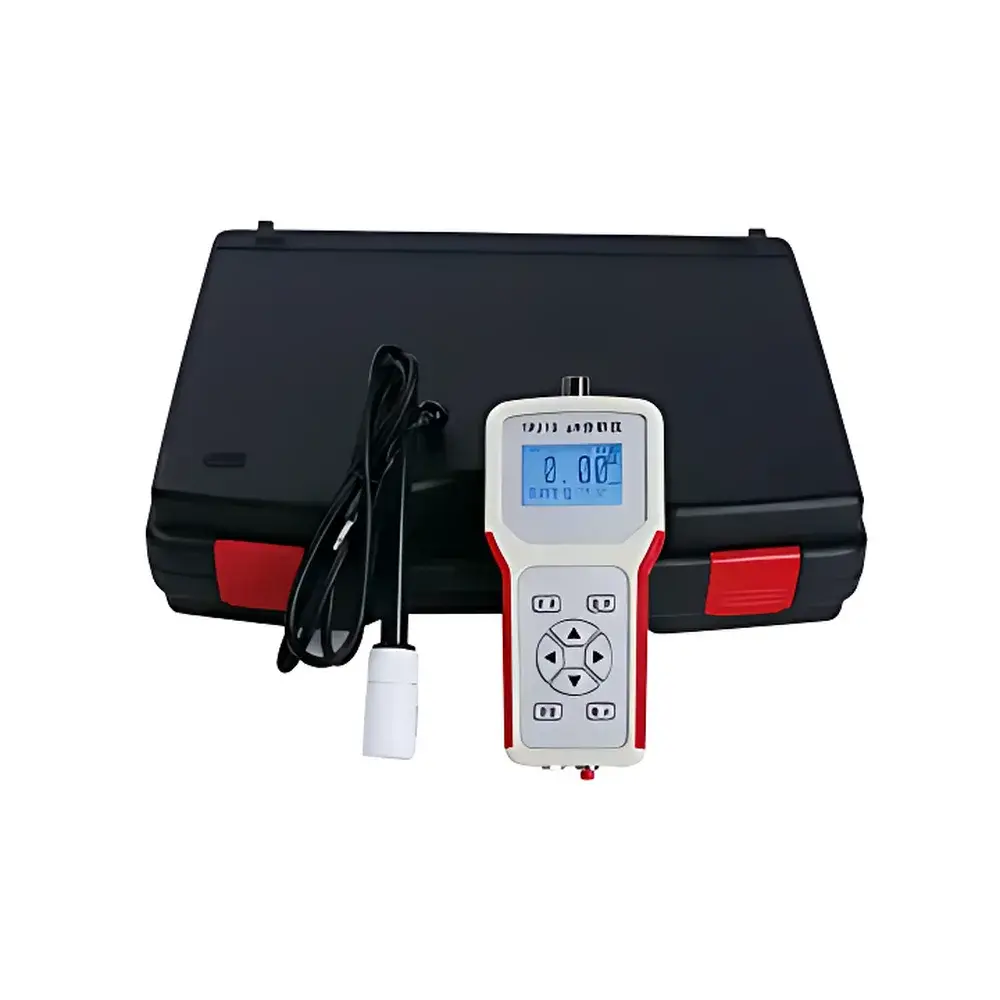
Timepower TP210 Precision Portable pH Meter
| Brand | Timepower |
|---|---|
| Origin | Beijing, China |
| Manufacturer Type | Manufacturer |
| Product Category | Domestic |
| Model | TP210 |
| Instrument Type | Portable |
| Parameter Type | Single-parameter (pH) |
| Measurement Accuracy | ±0.02 pH |
| Measurement Range | 0.00–14.00 pH |
| Resolution | 0.01 pH |
| Calibration Standard | NIST-traceable buffer solutions |
| Temperature Compensation Range | 0–60 °C (Pt1000 sensor) |
| Input Impedance | ≥1 × 10¹² Ω |
| Repeatability | ≤1% |
| Stability | ±1% F.S./4 h |
| Response Time (T90) | <1 min at 25 °C |
| Operating Temperature | 5–45 °C |
| Sample Temperature Range | 5–60 °C |
| Relative Humidity | ≤90% RH (non-condensing) |
| Storage/Transport Temperature | −25–55 °C (electrode must be stored >0 °C) |
| Power Supply | AC 85–265 V, 45–65 Hz |
| Power Consumption | ≤0.5 W |
| Dimensions | 80 × 30 × 175 mm |
| Weight | 0.26 kg |
| Display | 128 × 64 dot-matrix LCD with Chinese interface |
| Data Storage | Cyclic memory with auto-overflow management and >1-year power-loss retention |
| Battery Life | Up to 8 hours continuous operation after full charge |
Overview
The Timepower TP210 Precision Portable pH Meter is an electrochemical instrument engineered for high-accuracy field and laboratory pH measurement using the potentiometric principle. It operates by measuring the electromotive force (EMF) generated across a galvanic cell composed of a pH-sensitive glass electrode (indicator), a stable reference electrode, and the sample solution. This EMF correlates directly with hydrogen ion activity in accordance with the Nernst equation. Designed for rugged portability without compromising metrological integrity, the TP210 delivers traceable, repeatable results under variable environmental conditions—making it suitable for on-site monitoring in water treatment plants, power generation facilities, pharmaceutical cleanrooms, food processing lines, agricultural irrigation systems, and environmental field surveys.
Key Features
- Triple-junction combination pH electrode with integrated temperature sensor (Pt1000) for automatic temperature compensation (ATC) across 0–60 °C
- 24-bit analog-to-digital conversion circuitry ensures high signal fidelity and minimizes quantization error
- Microcontroller-based architecture optimized for low power consumption (≤0.5 W) and extended battery runtime (up to 8 hours)
- High-input-impedance amplifier (≥1 × 10¹² Ω) prevents loading effects during measurement of low-conductivity samples such as ultrapure water
- Robust mechanical design: compact form factor (80 × 30 × 175 mm), lightweight construction (0.26 kg), and sealed housing rated for operation at ≤90% RH (non-condensing)
- Real-time stability detection with auto-reading hold function; T90 response time <1 minute at 25 °C
- Onboard cyclic data storage with non-volatile memory retaining >1 year of logged values after power loss
- Intuitive Chinese-language menu interface with 128 × 64 pixel LCD display for rapid parameter navigation and result verification
Sample Compatibility & Compliance
The TP210 supports routine pH analysis across diverse aqueous matrices—including wastewater effluents, boiler feedwater, reverse osmosis permeate, fermentation broths, nutrient solutions, and ambient surface waters. Its triple-composite electrode configuration reduces liquid junction potential drift and enhances reliability in low-ionic-strength or contaminated samples. Calibration follows standardized protocols using NIST-traceable pH buffer solutions (e.g., pH 4.01, 7.00, and 10.01 at 25 °C), ensuring alignment with ISO 3696 (Grade 3 water), ASTM D1293 (Standard Test Method for pH of Water), and USP guidelines. While not certified for GMP or FDA 21 CFR Part 11 compliance out-of-the-box, its audit-ready data logging structure—including timestamped readings and calibration event records—supports GLP-aligned documentation workflows when integrated into validated laboratory information management systems (LIMS).
Software & Data Management
Data output is accessible via onboard display only; the TP210 does not feature USB, Bluetooth, or RS-232 connectivity. All measurements are stored internally in chronological order with automatic overwrite logic upon memory saturation. Each record includes pH value, temperature reading, date/time stamp, and calibration status flag. The device implements hardware-level memory protection to preserve integrity during unexpected power interruption. For regulatory environments requiring electronic record retention, users may manually transcribe entries into compliant spreadsheets or LIMS platforms. Future firmware updates (if released by Timepower) may expand export functionality—consult official product bulletins for revision history and compatibility notes.
Applications
- Real-time pH monitoring in municipal and industrial wastewater treatment processes (e.g., neutralization tanks, activated sludge basins)
- Quality control of purified water systems in pharmaceutical manufacturing (PW, WFI pre-checks)
- In-process verification of rinse water pH in semiconductor wafer cleaning lines
- Field assessment of soil leachate and groundwater acidity in environmental impact studies
- Batch verification of nutrient solution pH in hydroponic agriculture and bioreactor inoculation media
- Routine calibration validation of fixed-installation online pH analyzers in power plant condensate systems
FAQ
What calibration standards are required for accurate operation?
NIST-traceable pH buffer solutions—specifically certified at 25 °C (e.g., pH 4.01, 7.00, and 10.01)—must be used for two- or three-point calibration. Buffers should be free of visible contamination and replaced after opening per manufacturer shelf-life guidance.
Can the TP210 measure pH in non-aqueous or high-viscosity samples?
No. The instrument is validated exclusively for aqueous solutions with conductivity ≥50 µS/cm. Measurements in organic solvents, oils, or viscous suspensions will yield unreliable results due to junction potential instability and slow electrode response.
How often should the pH electrode be cleaned and stored?
Rinse thoroughly with deionized water after each use. Store immersed in 3 M KCl storage solution—not dry or in distilled water—to maintain hydration of the glass membrane and reference junction.
Is temperature compensation mandatory during measurement?
Yes. The built-in Pt1000 sensor enables automatic compensation; disabling ATC introduces systematic error exceeding ±0.1 pH per 10 °C deviation from calibration temperature.
Does the TP210 support electrode diagnostics or slope verification?
No. Slope calculation and asymmetry potential checks require manual computation using calibration mV outputs—a capability reserved for benchtop meters with diagnostic menus.




