
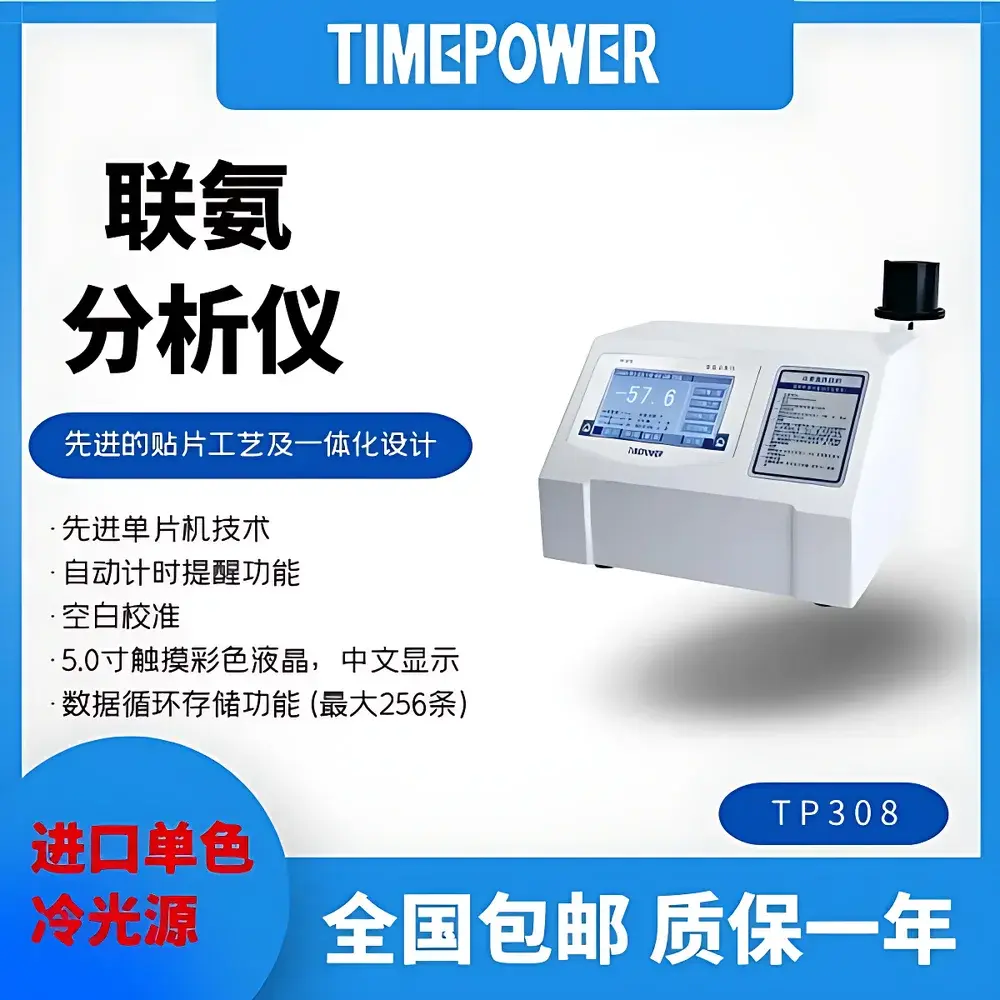
TimePower TP308 Hydrazine Analyzer for Laboratory and Online Water Quality Monitoring
| Brand | TimePower |
|---|---|
| Origin | Beijing, China |
| Manufacturer Type | Direct Manufacturer |
| Product Category | Domestic |
| Model | TP308 |
| Instrument Type | Online/Portable Hybrid Analyzer |
| Measurement Principle | Colorimetric Analysis via p-Dimethylaminobenzaldehyde (p-DMAB) Reaction |
| Display | 5.0-inch TFT Touchscreen with Chinese UI |
| Optical Source | Imported Monochromatic Cold Light LED |
| Microcontroller | Advanced Low-Power Single-Chip Architecture |
| Calibration | Automatic Zero Calibration (Blank Compensation) |
| Data Storage | Cyclic Memory for ≤256 Records |
| Compliance | Designed for ASTM D1385-18 (Standard Test Method for Hydrazine in Water), ISO 7888:2019 (Water Quality – Determination of Hydrazine), and Power Plant Chemistry Guidelines per EPRI TR-102491 |
Overview
The TimePower TP308 Hydrazine Analyzer is a dedicated laboratory-grade and semi-online water quality analyzer engineered for precise quantification of hydrazine (N₂H₄) in ultrapure and process water streams. It operates on the internationally recognized colorimetric principle using p-dimethylaminobenzaldehyde (p-DMAB) reagent, which reacts selectively with hydrazine under acidic conditions to form a stable yellow azine derivative measurable at 455 nm. This method ensures high specificity in complex matrices—critical for monitoring feedwater, condensate, boiler water, and steam-cycle chemistry in thermal power plants, nuclear facilities, and high-purity industrial processes such as semiconductor wafer cleaning, pharmaceutical water-for-injection (WFI) systems, and synthetic fiber manufacturing. Unlike electrochemical or amperometric sensors subject to interferences from dissolved oxygen, copper ions, or volatile amines, the TP308’s optical detection architecture delivers robust baseline stability and long-term reproducibility without electrode fouling or frequent recalibration.
Key Features
- 5.0-inch capacitive touchscreen interface with intuitive Chinese-language navigation—designed for routine operation by plant chemists and QC technicians without specialized software training.
- Integrated optical path with imported monochromatic cold-light LED source: eliminates thermal drift, ensures spectral consistency, and extends operational lifetime beyond 50,000 hours.
- Embedded microcontroller platform based on industrial-grade ARM Cortex-M4 architecture—optimized for low-power continuous monitoring and deterministic real-time response.
- Automatic zero-point calibration function that executes blank compensation prior to each measurement cycle, correcting for photometric drift, cuvette imperfections, and reagent background absorbance.
- Cyclic data logging supporting up to 256 timestamped entries (date, time, concentration, operator ID if enabled); overflow management auto-deletes oldest records to maintain integrity without manual intervention.
- Modular fluidic design compatible with standard 10-mm rectangular quartz or optical-grade polymer cuvettes; optional flow-through cell kit available for unattended online integration.
Sample Compatibility & Compliance
The TP308 accepts liquid samples within pH 2.5–4.5 range, free of suspended solids (>5 µm) and turbidity <1 NTU. It is validated for use with deionized water, condensate polishers effluent, and once-through boiler feedwater containing ≤10 µg/L dissolved iron and ≤5 µg/L copper. Method performance meets ASTM D1385-18 requirements for precision (RSD ≤3.2% at 10 µg/L) and detection limit (LOD = 0.5 µg/L, S/N = 3). The analyzer’s firmware architecture supports audit-trail-enabled operation per GLP and 21 CFR Part 11 Annex 11 guidelines when paired with external LIMS via RS-232/485 serial output. All wetted materials comply with USP Class VI biocompatibility standards and ASME BPE surface finish specifications (Ra ≤0.4 µm).
Software & Data Management
The onboard firmware provides non-volatile storage of calibration curves, user-defined method parameters (reaction time, incubation temperature, wavelength offset), and system diagnostics logs. Data export is supported via USB flash drive in CSV format—compatible with Microsoft Excel, LabArchives, and Empower CDS. Optional PC-based configuration utility (Windows 10/11, .NET Framework 4.8+) enables remote firmware updates, report generation (PDF/Excel), and multi-instrument fleet synchronization. No cloud dependency or subscription licensing is required; all functionality remains fully operational offline.
Applications
- Real-time hydrazine residual monitoring in fossil and nuclear power plant secondary coolant loops to verify oxygen scavenging efficacy and prevent corrosion under deposits (CUD).
- Pharmaceutical clean-in-place (CIP) validation where hydrazine is used as a reducing agent in stainless-steel passivation protocols.
- Quality control of ultrapure water (UPW) in 300mm semiconductor fabs—ensuring compliance with SEMI F63-0218 specifications for trace nitrogenous contaminants.
- Environmental compliance testing of wastewater effluents from hydrazine-based catalyst regeneration units in petrochemical refineries.
- Educational laboratories conducting kinetics studies of hydrazine decomposition or redox titration methodology validation.
FAQ
What is the recommended sample preparation procedure for high-turbidity condensate?
Pre-filtration through a 0.45-µm hydrophilic PVDF membrane syringe filter is mandatory to avoid light scattering artifacts and cuvette coating.
Can the TP308 be integrated into a DCS or SCADA system?
Yes—via optional 4–20 mA analog output (HART-compatible) or Modbus RTU over RS-485, enabling direct integration with Emerson DeltaV, Siemens Desigo, or Honeywell Experion PKS.
Is reagent consumption tracked automatically?
No—the TP308 does not include reagent level sensing; users must manually log reagent lot numbers and expiration dates per ISO/IEC 17025 documentation requirements.
Does the instrument support multi-point calibration?
Yes—up to five concentration points can be stored and applied using NIST-traceable hydrazine standards (e.g., AccuStandard HYD-1000-100).
What maintenance intervals are specified for optical components?
LED intensity and detector gain are verified during annual calibration; no user-serviceable optics—only qualified field service engineers may replace the light source assembly.
Related Products







