
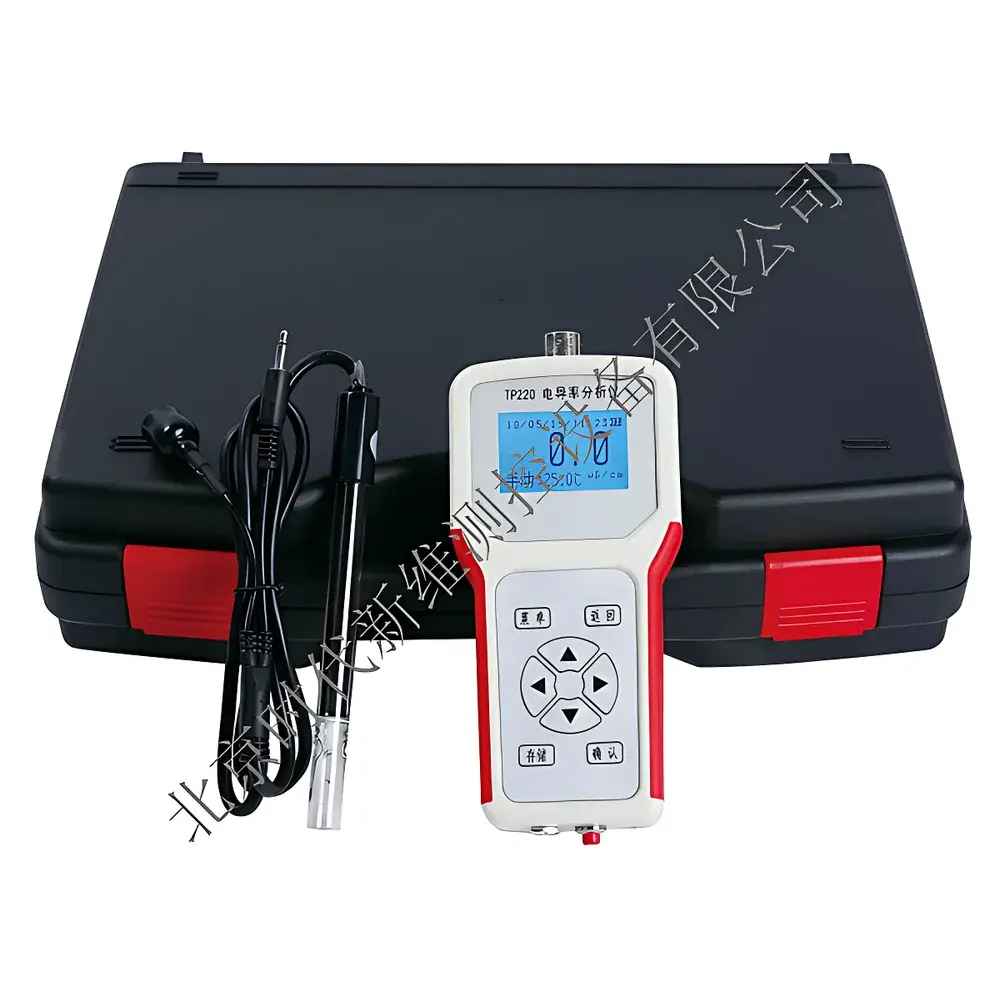
Timepower TP220 Portable Conductivity Analyzer
| Brand | Timepower |
|---|---|
| Origin | Beijing, China |
| Manufacturer Type | Manufacturer |
| Origin Category | Domestic (China) |
| Model | TP220 |
| Pricing | Upon Request |
Overview
The Timepower TP220 Portable Conductivity Analyzer is a precision-engineered, field-deployable instrument designed for reliable in-situ and grab-sample measurement of electrical conductivity (EC) in aqueous solutions. It operates on the fundamental principle of conductometric analysis: two parallel or cylindrical electrodes—characterized by a fixed cell constant (K = 0.01, 0.1, 1.0, or 10.0 cm⁻¹)—are immersed in the sample; a low-frequency sinusoidal voltage (1–3 kHz) is applied to minimize polarization and electrolytic decomposition, and the resulting current is measured to calculate solution conductivity via Ohm’s law and geometric correction. The instrument complies with GB/T 6908–2008, the Chinese national standard for conductivity determination in boiler feedwater and cooling water, and supports traceable measurements aligned with international metrological practices for industrial water quality monitoring.
Key Features
- High-integration design using advanced surface-mount technology (SMT) for mechanical robustness and long-term stability in demanding field environments.
- Embedded single-chip microcontroller architecture delivering high computational accuracy and ultra-low power consumption—optimized for extended battery operation.
- Auto-ranging capability across four selectable cell constants, enabling seamless adaptation to diverse sample matrices—from ultrapure water (30,000 µS/cm).
- 24-bit analog-to-digital conversion ensures high-resolution signal acquisition, minimizing quantization error and supporting reproducible measurements within ±2.5% full-scale accuracy.
- Backlit 128×64 dot-matrix LCD with intuitive Chinese-language menu navigation—designed for rapid setup, real-time parameter review, and operation under variable ambient lighting conditions.
- Simultaneous on-screen display of conductivity value, temperature-compensated reading, measurement timestamp, and system status indicators—enhancing data contextualization during field surveys.
- Rechargeable battery provides up to 8 hours of continuous operation; non-volatile memory retains stored data for over 10 years without power.
- Compact form factor (80 × 30 × 175 mm) and lightweight construction (0.26 kg) facilitate handheld use, integration into mobile labs, or mounting in confined sampling locations.
Sample Compatibility & Compliance
The TP220 is validated for use with aqueous samples across a broad thermal and compositional spectrum: sample temperature range 5–60 °C, ambient operating temperature 5–45 °C, and relative humidity ≤90% RH (non-condensing). Its Pt1000 temperature sensor enables automatic temperature compensation (0–60 °C), critical for accurate EC reporting per ISO 7888 and ASTM D1125. While not certified to IEC 61000-6-2/4 or ATEX, its design meets general-purpose industrial safety requirements for non-hazardous area deployment. For regulatory workflows, raw data storage includes timestamps and electrode identification—supporting basic GLP documentation needs. When used with appropriate K=0.01 or K=0.1 electrodes and sealed measurement cells, it satisfies method-specific requirements for ultrapure water validation in pharmaceutical water systems (e.g., USP Stage 1 screening).
Software & Data Management
The TP220 operates as a standalone analyzer with no external software dependency. All measurement data—including conductivity, temperature, date/time stamp, and selected cell constant—are stored in circular buffer memory. Users may scroll through historical records directly on-device; overflow entries are automatically overwritten. Data retention is maintained via EEPROM, ensuring integrity during power loss. Although the instrument lacks USB/Bluetooth connectivity or PC synchronization, its internal logging structure allows manual transcription into LIMS or Excel-based QA/QC spreadsheets. For audit readiness, users are advised to maintain logbooks correlating instrument ID, electrode calibration dates (per ISO/IEC 17025 clause 6.4.10), and field sampling metadata.
Applications
- Power generation: Routine monitoring of condensate, boiler feedwater, and cooling tower cycles per GB/T 6908 and DL/T 912.
- Environmental fieldwork: Rapid assessment of surface water, groundwater, and wastewater effluent conductivity as a surrogate for total dissolved solids (TDS) and salinity.
- Chemical & fertilizer manufacturing: Process control of rinse waters, reaction media, and product stream purity verification.
- Pharmaceutical and biotechnology: Verification of purified water (PW) and water-for-injection (WFI) conductivity prior to distribution loop sampling—aligned with EU GMP Annex 1 and WHO TRS 970.
- Municipal water treatment: Field validation of desalination output, chlorination efficacy, and distribution system integrity.
- Food & beverage production: Monitoring of cleaning-in-place (CIP) rinse endpoints and ingredient solution consistency.
FAQ
Which electrode constant should I select for ultrapure water applications?
For samples below 3 µS/cm—especially those below 1 µS/cm—use a K=0.01 cm⁻¹ or K=0.1 cm⁻¹ electrode with a sealed, air-tight measurement cell to prevent CO₂ absorption and surface contamination.
Does the TP220 support linear or non-linear temperature compensation?
It applies linear temperature compensation based on the NaCl reference curve (25 °C reference), consistent with GB/T 6908 and widely adopted industrial practice.
Can the device be calibrated with NIST-traceable standards?
Yes—calibration is performed using certified KCl standard solutions (e.g., 1413 µS/cm at 25 °C); users must verify traceability documentation from their standard supplier per ISO/IEC 17025.
Is the instrument suitable for continuous online monitoring?
No—the TP220 is a portable, batch-measurement instrument. For permanent installation, consider Timepower’s industrial online conductivity transmitters (e.g., TP300 series) with 4–20 mA output and IP65-rated housings.
What maintenance is required for long-term reliability?
Rinse electrodes with deionized water after each use; store K=0.01 and K=0.1 electrodes in moistened storage solution; inspect O-rings and cable integrity quarterly; recalibrate before critical measurements or after electrode replacement.




